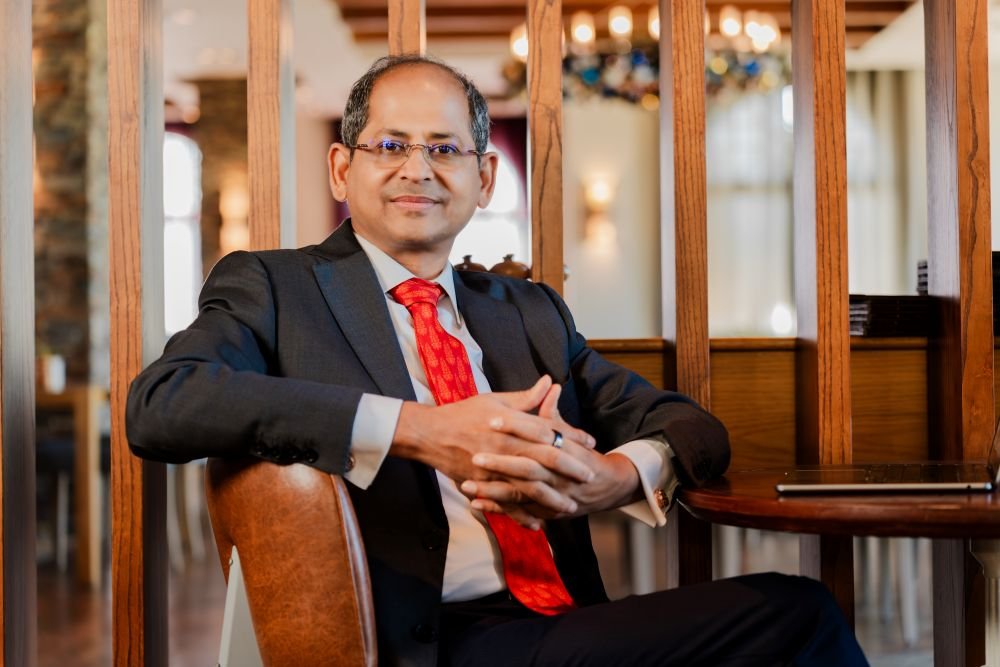
- Mr. Ramki Jayaraman brings over 25 years of strategy consulting experience to the UAE.
- Synarchy Consulting works across governments, enterprises, and family businesses regionally.
- He believes resilient economies are built on strong institutions, not just fast growth.
- In uncertain times, Mr. Jayaraman says restraint is not caution, it is a strategic choice.
There’s a version of leadership that looks impressive from the outside: fast decisions, bold moves, relentless growth at any cost. And then there’s the kind that actually holds up when the world gets complicated. Mr. Ramki Jayaraman, Managing Partner of Synarchy Consulting, has spent over 25 years working with governments, enterprises, and family businesses across the Middle East and Africa on strategy, digital transformation, and institutional capability building, and if his approach to the current regional climate is anything to go by, he is firmly in the second camp. Quiet discipline, he says, is what separates resilient organisations from fragile ones. And right now, he’s walking that talk.
Synarchy Consulting sits at an interesting crossroads. As one of the few niche consulting firms with a strong public sector portfolio in the UAE, Synarchy has built relationships with entities ranging from federal government bodies to leading Emirati family businesses, giving Mr. Jayaraman a genuinely cross-regional perspective on how ecosystems shift during periods of pressure. When the current uncertainty began to build, his immediate response wasn’t to pivot loudly or announce a new strategy. It was quieter than that, and more considered. “In moments of uncertainty, reassurance matters more than statements,” he says. His team activated business continuity protocols quickly, reached out to clients through direct one-to-one conversations rather than formal announcements, and adapted project timelines with flexibility rather than rigidity. People first. Clarity second. Everything else after.
(Synarchy Consulting)
What’s striking about Mr. Jayaraman’s leadership philosophy is its honest resistance to the pressure that most founders quietly feel but rarely name. The instinct to scale, to take on more clients, to chase every opportunity the UAE ecosystem throws at you, is real and constant. He felt it too. But the hardest decision of this period wasn’t dramatic. It was the choice to say no. Synarchy deliberately declined projects that didn’t align with its long-term direction, recalibrated parts of its 2026 roadmap, and chose purposeful growth over opportunistic expansion. “Restraint is often misunderstood as caution,” he reflects. “In reality, it is a strategic choice.” For a firm built on the principle that resilient economies are built on strong institutions, practising that belief internally wasn’t optional. It was the whole point.
His message to the business owners who are quietly struggling but not saying so publicly is both practical and deeply human. Return to fundamentals. Protect liquidity. Stay close to your customers. Be transparent with your teams. And remember that businesses are built over decades, not quarters. Mr. Jayaraman has consistently argued that periods of uncertainty often accelerate the adoption of smarter operating models, pushing organisations to rethink risk, diversify revenue, and build the kind of governance structures that create genuine long-term stability. That’s not a consultant’s talking point. For Synarchy, it’s the entire business model.
What moved Mr. Jayaraman most during this period wasn’t a policy or a press release. It was the small, human gestures. Clients and partners across the UAE, and even from markets Synarchy operates in across Africa, reached out simply to check in. No project timelines. No deliverables. Just people asking if the team was okay. “Business relationships ultimately rest on trust, not transactions,” he says simply. In a city that moves as fast as Dubai, that reminder lands with weight.
Looking ahead, Mr. Jayaraman is genuinely optimistic, and specific about why. He sees strong momentum building in digital infrastructure, advanced industries, sustainability, and knowledge-driven services. He believes AI will move from experimentation to meaningful adoption across the region faster than most expect. And he’s encouraged by a new generation of UAE business leaders who combine global exposure with deep local understanding. But above everything else, what he keeps coming back to is something less tangible and more enduring. “The UAE retains something intangible but powerful,” he says. “Optimism.” In a moment when that quality feels genuinely rare, it’s worth noting that the people building this city’s future still have it in full supply!