
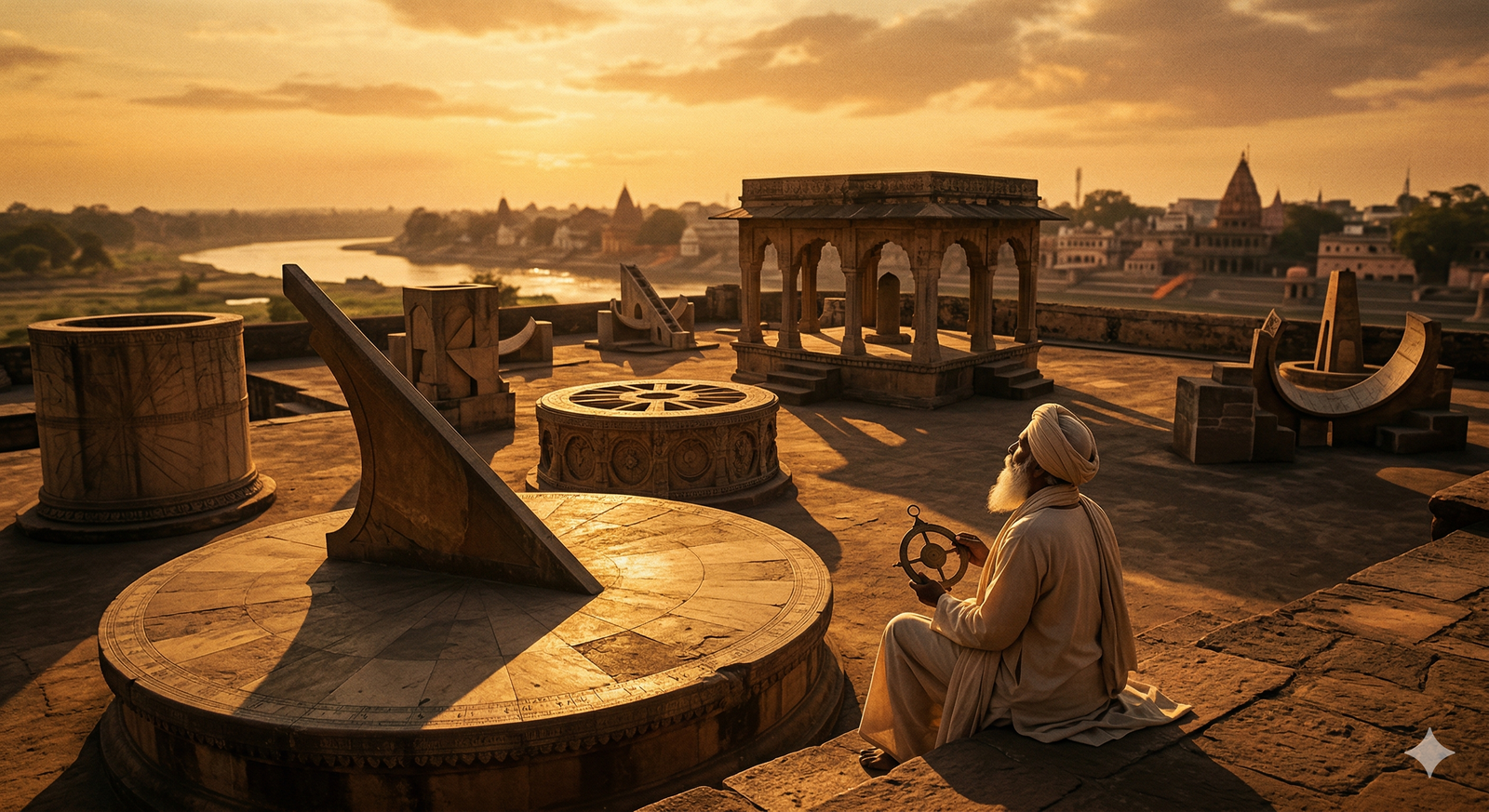
- India’s Brahmagupta was the first person in history to define zero as a number.
- Without zero there would be no computers, no smartphones, and no modern science.
- He wrote his world-changing ideas in a book composed entirely in Sanskrit verse.
- Zero traveled from India to Arabia to Europe, reshaping every civilization it touched.
Every time you check your phone, withdraw money from an ATM, or watch a film stream on a screen in your living room, you are using something that was born in a small city in Rajasthan, India, over fourteen hundred years ago. Not a device. Not a material. A number. Specifically, the number that represents nothing at all. The earliest known use of zero in its modern mathematical sense is attributed to Brahmagupta in the 7th century AD, the first person in human history to treat zero not as an empty space or a placeholder but as a number in its own right, with rules, properties, and the power to transform every calculation it touched. Without him, the world as we know it quite literally could not have been built.
Brahmagupta was born in 598 CE in Bhillamala, in what is now the Bhinmal district of Rajasthan, during the reign of the Chavda dynasty. He was primarily an astronomer, studying the movements of celestial bodies with a precision that would not be matched in the Western world for centuries. But it was his mathematics that changed everything. In his seminal text, the Brahmasphutasiddhanta, written in 628 CE when he was just 30 years old, Brahmagupta defined zero as the result of subtracting a number from itself and provided the first formal rules for arithmetic operations involving zero. Adding zero to any number leaves it unchanged. Subtracting zero from any number leaves it unchanged. Multiplying any number by zero produces zero.
These are rules every schoolchild learns today without ever knowing they were first written down by a mathematician in ancient India, in a book composed entirely in metered Sanskrit verse. He is also considered the father of algebra, geometry, and trigonometry, was the first to formulate the solving of quadratic equations, described gravity as a universal force over a millennium before Newton, and headed the most famous astronomical observatory in the world at the time in Ujjain. The sheer breadth of what one mind produced in a single lifetime is almost impossible to absorb.
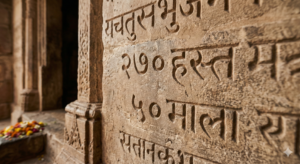
The philosophical and cultural factors in ancient India played a significant role in this development. The concept of shunya, or void in Sanskrit, permeated Indian philosophy and contemplations about the universe, facilitating the conceptual leap necessary to see zero not just as an absence but as a finite quantity, a concept that would have been considered a dangerous idea in other civilizations of the time. Ancient Greece, for all its mathematical brilliance, never arrived at zero because their philosophy had no framework for nothingness. When Brahmagupta attempted to divide zero by zero he came to the result of zero, a conclusion most modern mathematicians would call undefined, but the rest of his grasp on the number zero is exactly how we conceptualize it today. He called zero “shunya,” the Sanskrit word for emptiness, and inscribed its use on the walls of the Chaturbhuj Temple in Gwalior, where the carved numerals 270 and 50 can still be seen today, making it the second oldest recorded use of zero in physical form anywhere in the world.
Zero spread from India through Persian mathematician Al-Khwarizmi, who introduced Hindu-Arabic numerals to the Islamic world, and in the 13th century Italian mathematician Fibonacci introduced zero to Europe in his book Liber Abaci, written in 1202. Europe had resisted zero for centuries, dismissing it as meaningless and even, in some quarters, satanic. The idea that nothing could be something offended deeply held philosophical and religious sensibilities across the Western world. India had no such resistance. Its culture of meditation, philosophical inquiry, and comfort with the concept of void gave its mathematicians the freedom to see what no one else could. From India, the concept of zero spread to the Islamic world during the 8th and 9th centuries, where scholars translated Indian mathematical texts into Arabic, incorporating zero into their studies and passing it westward into the civilization that would eventually build the modern world on top of it.
The binary code that powers every computer and smartphone on earth is built on a foundation of ones and zeros. The calculus that describes the laws of physics depends on zero as a central concept. Every coordinate system, every graph, every equation of any sophistication rests on the existence of this one number. And it all began with a man born in Rajasthan in 598 CE, who looked at nothing and saw everything!