Long before anyone called it globalisation, India’s spices were already connecting continents, reshaping empires, and rewriting maps.
- India accounts for more than 40% of the global spice trade to this day
- The search for Indian spices triggered the Age of Exploration and reshaped world history
- Arab traders controlled the spice routes for centuries, passing through what is now the UAE
- Spices like turmeric, pepper and cardamom were used as currency, medicine and sacred offerings
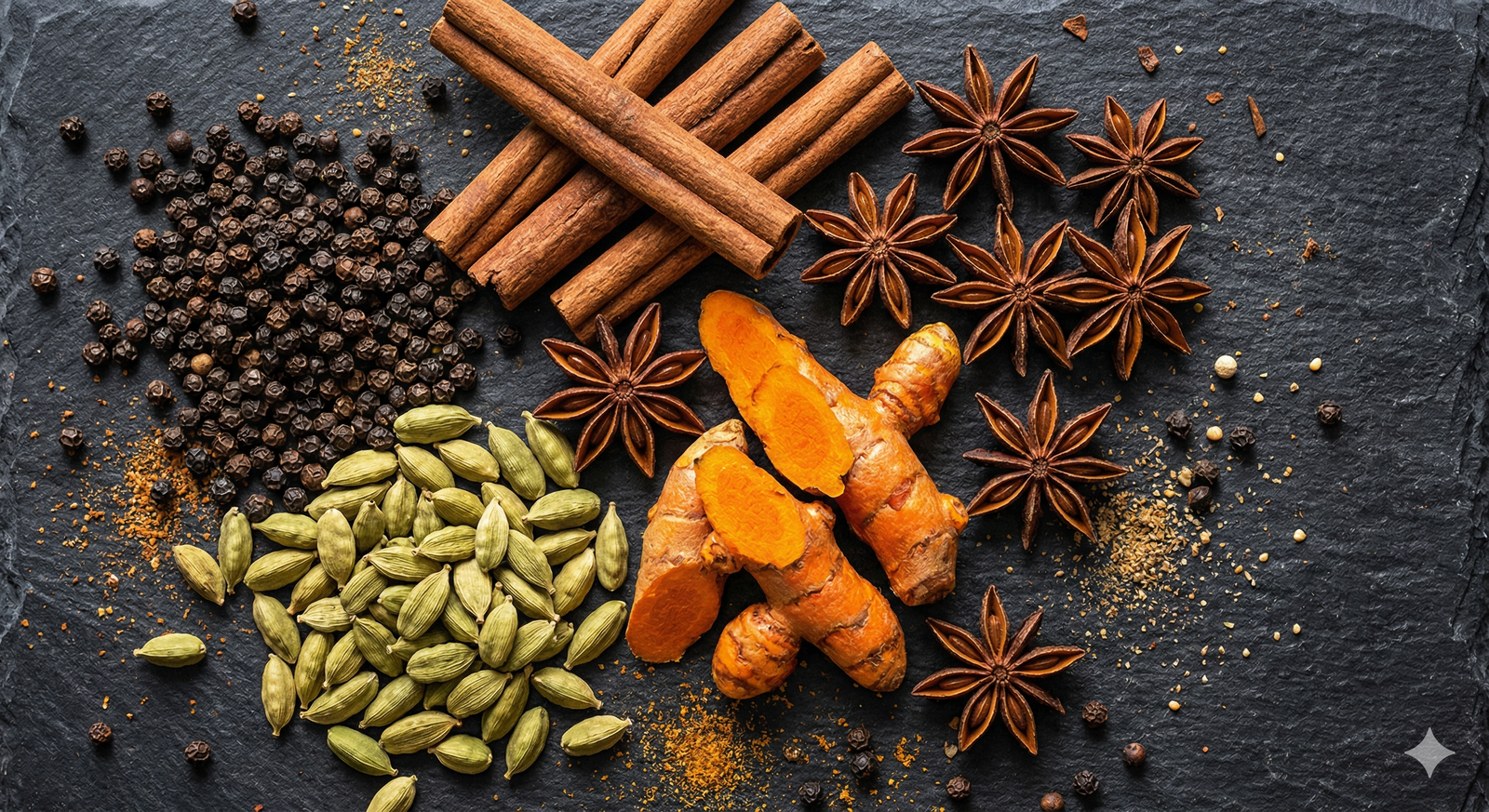
There is a moment in every history textbook where Christopher Columbus sails west looking for a route to India. Most of us were taught that he was looking for gold. He was not, at least not primarily. He was looking for spices. Black pepper. Cinnamon. Cardamom. Cloves. The same things sitting in your kitchen right now, unremarkably small jars next to the salt, were once so valuable that empires were built to find them, wars were fought to control them, and the entire map of the modern world was redrawn in their pursuit.
That is the story of Indian spices. And it is one of the most astonishing stories in human history.
India is known as the Land of Spices and is home to more than half of the 109 spices recognised by the International Organisation for Standardisation, a diversity that is a testament to the subcontinent’s unique geography, climate and botanical heritage. This was not an accident of nature that went unnoticed. Spices such as black pepper, cinnamon, cardamom and turmeric were highly valued for their medicinal properties and were traded goods as far back as ancient civilisations, with their allure so strong it led to the establishment of trade routes that eventually drove global exploration.

Cinnamon and cassia found their way to the Middle East at least 4,000 years ago, carried by merchants who understood something the rest of the world was still figuring out: that the small, fragrant products of India’s soil were worth more by weight than almost anything else on earth. Every year India produces more than two million tonnes of spices and remains one of the world’s top exporters, accounting for more than 40% of global spice trade. The numbers today are remarkable. The history behind them is even more so.
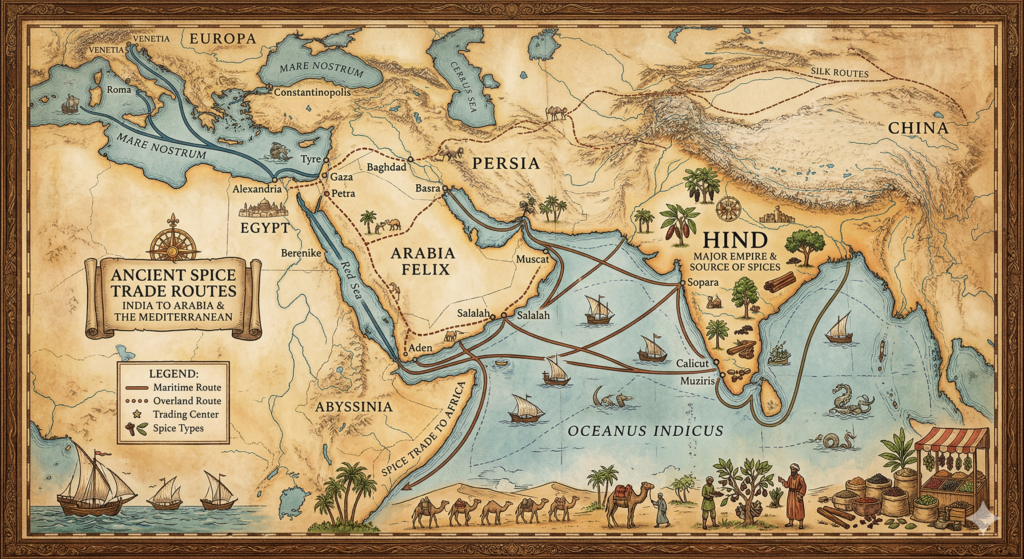
For those of us living in the UAE, this history is not distant or abstract. It ran directly through this region. Indian merchants, skilled navigators and seafarers were instrumental in facilitating the movement of spices across the Indian Ocean, through the Red Sea, and ultimately to the Mediterranean, where Greek and Roman markets were hungry for them. The Arabian Peninsula was not merely a waypoint. It was the engine room of the entire operation.
Arab traders artfully withheld the true sources of the spices they sold. To protect their market and discourage competitors, they spread fantastic tales: that cassia grew in shallow lakes guarded by winged animals, and that cinnamon grew in deep glens infested with poisonous snakes. These stories sound absurd now. At the time they were extraordinarily effective. For centuries the Arabian monopoly on the spice trade held firm, generating wealth that built cities, funded armies and positioned this part of the world as the commercial centre of the ancient globe. The scent of Indian pepper and cardamom was, in a very real sense, what made this region powerful.
The moment that changed everything came in 1498, when the Portuguese explorer Vasco da Gama landed in Calicut on India’s Malabar Coast, having found a sea route around the Cape of Good Hope. The Arabian monopoly shattered. Da Gama’s discovery of an alternate route to India marked the beginning of the short-lived Portuguese dominion on the spice trade, and by 1511 the Portuguese were in control of the spice trade of the Malabar Coast. The Dutch followed, then the British, whose East India Company arrived in 1600 specifically to trade in spices and never quite left. The colonial history of the entire Indian subcontinent traces a direct line back to the global appetite for what grew in India’s soil.
It is a particular kind of historical irony that the search for Indian spices is what connected the world, opened sea routes, founded trading empires, and set in motion the chain of events that shaped modernity as we know it. All of it, ultimately, because someone in Rome wanted their food to taste better.
Spices in India were never only about flavour. Many spices possess anti-inflammatory, antioxidant and immune-boosting properties, making them a significant ingredient in traditional medicine systems like Ayurveda. Turmeric was used in rituals and offered to deities. Cardamom was currency. Black pepper was payment for taxes, tribute and ransom. The spice cabinet of an ancient Indian household was simultaneously a pharmacy, a treasury and a sacred space.
That layered significance has not entirely disappeared. When an Indian grandmother measures out her masala by instinct rather than measurement, she is working from a tradition that is older than most of the world’s surviving empires. When turmeric turns up in a Dubai wellness cafe as the hero ingredient of a golden latte, it is completing a journey that began on the Malabar Coast thousands of years ago, passed through Arabian hands, and eventually reached every corner of the known world.
The spices were always the story. We are still, in many ways, living inside it!