In two corners of India, entire communities have lived for generations on water, not beside it. Their stories are as fragile and extraordinary as the islands they call home.
- Loktak Lake in Manipur is India’s only floating national park in the entire world
- Phumdis are naturally formed floating islands made of vegetation, soil and organic matter
- Over 100,000 people depend on Loktak Lake for their food, income and daily survival
- Dal Lake’s houseboat culture dates back centuries and is unlike anywhere else on earth
Floating villages in India exist in a category of human ingenuity so specific and so extraordinary that most people who live within the same country have never seen them, let alone the rest of the world. In Manipur’s northeast corner and in the mountain-ringed valley of Kashmir, two entirely different communities have built entire ways of life on water, not on land beside water, but on it, above it, moving with it, farming on it, sleeping on it and sustaining generations of culture on surfaces that shift with every season. The rest of India largely gets on with things. These communities get on with water.
Loktak Lake is the largest freshwater lake in South Asia, covering an area of 250 square kilometres which may increase up to 500 square kilometres during the monsoon season. Located in Moirang, Manipur, the name loosely translates to “the end of the stream” in Meitei. What makes the lake so extraordinary is the floating biomass called Phumdi, formed from a heterogenous mass of vegetation, soil and organic matter in various stages of decomposition, with low gravitational pull and high buoyancy that causes them to float up to the surface of the water.
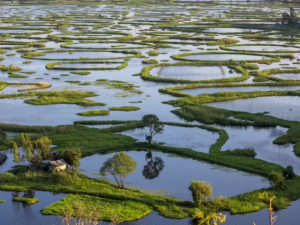
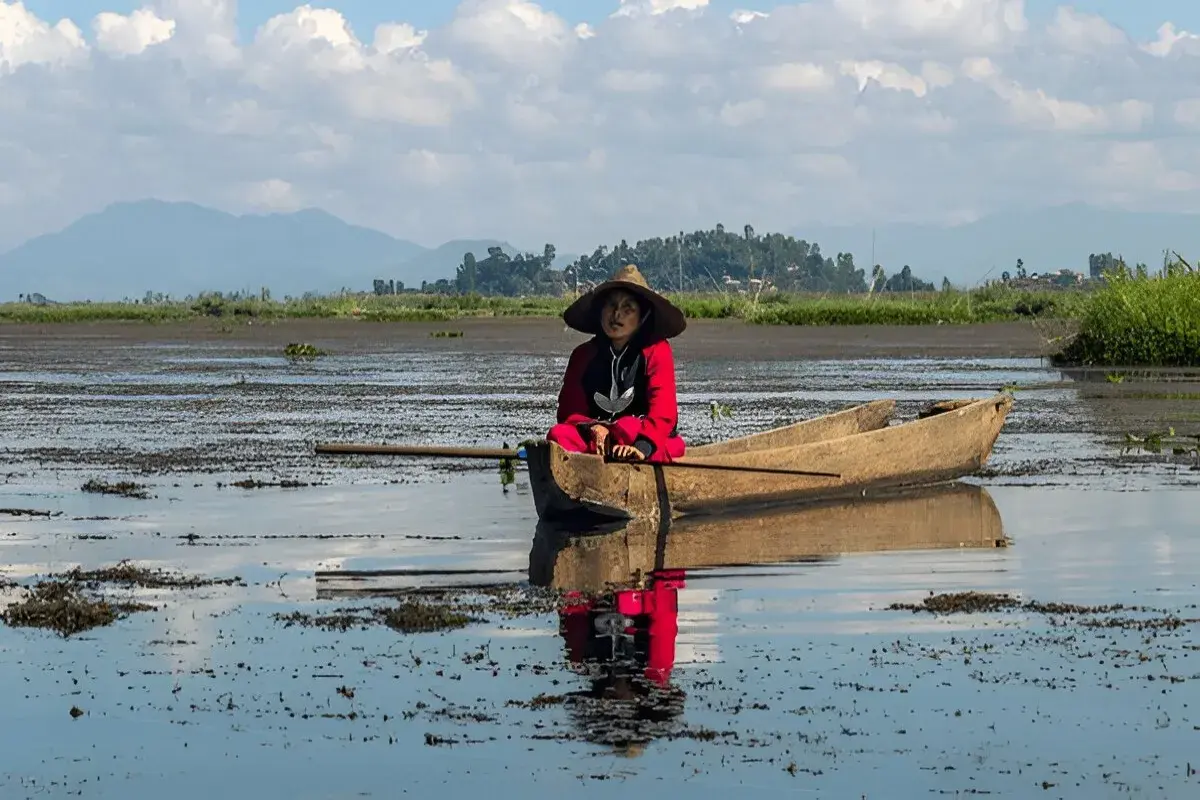
These are not static islands. They are living, breathing, seasonally shifting landmasses that rise in the monsoon and sink during the dry season to absorb nutrients from the lake floor before floating back up again. Fishermen build huts, locally known as Phumsang, on these islands and use wooden boats as transport across the lake. The huts are built on bamboo bases to keep them well above water and they have roofs of plastic or wood. Apart from fishing, the other source of livelihood for the locals is the cultivation of vegetables including cabbage, cauliflower, potato, brinjal, ladyfinger and bamboo shoots from the lake.
About 100,000 inhabitants live in villages in and around the lake and depend on it for their livelihoods. The lake is the lifeline not only of these inhabitants but of a large portion of Manipur, providing hydro-power, irrigation and drinking water. For the Meitei community who have lived on and around Loktak for generations, the lake carries spiritual weight that goes far beyond economics. It is not simply where they live. It is who they are.
The ecological marvel goes further still. On the southeastern periphery of Loktak Lake floats the Keibul Lamjao National Park, the only floating national park in the world and the last natural habitat of the magnificent brow-antlered Sangai deer, the state animal of Manipur. A national park that moves with the water. Animals that live on islands that breathe with the seasons. It is the kind of thing that sounds impossible until you look at the photographs, and then sounds completely right.
In recent years, Loktak has been promoted as a major tourist destination, with boating, eco-homestays and the annual Sangai Festival attracting visitors from across India. But tourism is a double-edged sword. While it brings visibility and income, it has also displaced some of the very communities that kept Loktak alive for generations. Fishermen’s huts have been labelled illegal, even as new floating resorts rise for tourists. The danger is not unfamiliar in heritage contexts: in the effort to make a place accessible and attractive, the original soul of it gets quietly pushed aside.
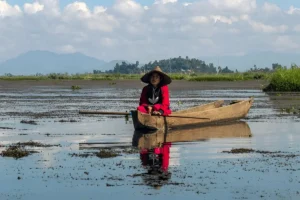
In Kashmir, the floating community story takes a different shape. Dal Lake, ringed by the Zabarwan mountains and spread across the valley of Srinagar, has been home to houseboat communities for centuries. The houseboats of Dal Lake were originally built by the British during the colonial period, when they were prohibited from owning land in Kashmir and chose instead to build elaborate floating homes on the water. What began as a workaround became a tradition, and the tradition became one of the most distinctive cultural landscapes in all of India.
The shikara boats that glide across Dal Lake at dawn, loaded with fresh flowers, vegetables and saffron for the floating markets, are one of the most recognisable images in Indian travel. But behind the images is a community of boat-builders, market gardeners and fishermen who have maintained an entire economy on water for generations, navigating the lake the way others navigate streets, with routes and rhythms and a knowledge of the water that takes a lifetime to accumulate.
Both lakes, one in the far northeast and one in the far north, tell the same essential story. That humans are extraordinarily creative in how they make a home of difficult places. That water is not an obstacle to settlement but an invitation to a different kind of living. And that the communities who accepted that invitation centuries ago deserve considerably more attention than they typically receive!