
Before Rani Lakshmibai, there were women who defeated Portuguese fleets, outwitted Mughal armies and built the first known suicide squads in history. You just were not told about them.
- Abbakka Chowta repelled Portuguese invasions of coastal Karnataka for over four decades
- Rani Durgavati rode an elephant into battle and chose death over surrender to the Mughals
- Rani Velu Nachiyar was the first Indian queen to fight and defeat the British East India Company
- All three ruled centuries before Rani Lakshmibai and are barely known outside their regions
The warrior queens India remembers most loudly is Rani Lakshmibai of Jhansi, the 1857 uprising, the horse, the sword, the British accounts that could not help admiring what they were fighting. She deserves every word written about her. But the story of Indian women who led armies, commanded navies, negotiated with empires and chose death over submission does not begin or end with Lakshmibai. It goes back centuries earlier, into coastal Karnataka, into the forests of Gondwana, into the riverbanks of Tamil Nadu, where women whose names most people cannot pronounce were doing things that most men of their era would not have attempted. Their stories were not lost by accident. They were simply never told loudly enough to travel.
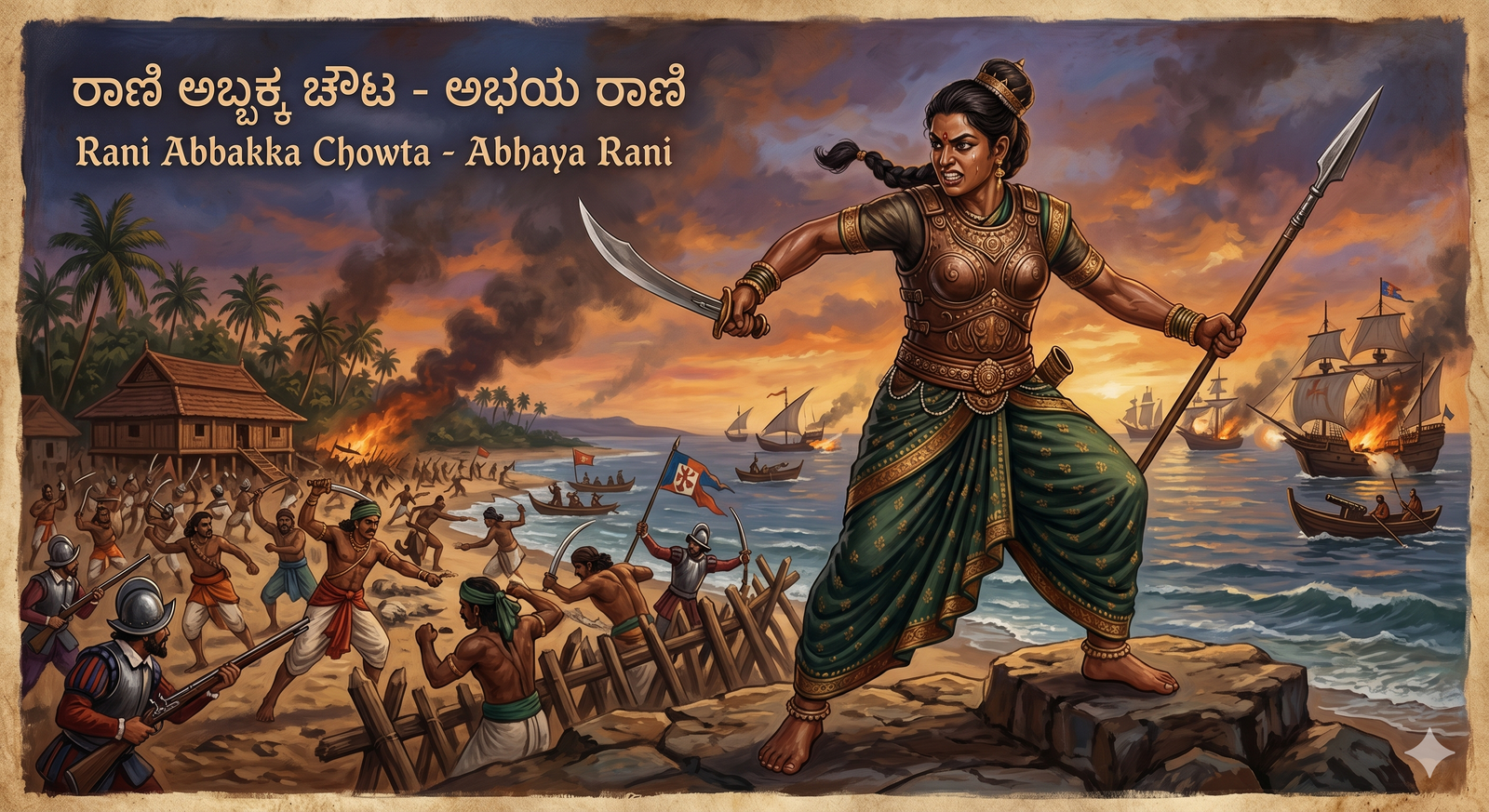
Rani Abbakka Chowta was the first Tuluva Queen of Ullal who fought the Portuguese in the latter half of the 16th century. She belonged to the Chowta dynasty, an indigenous Tuluva dynasty who ruled over parts of coastal Karnataka. The Portuguese made several attempts to capture Ullal as it was strategically placed but Abbakka repulsed each of their attacks for over four decades. For her bravery she came to be known as Abhaya Rani, the fearless queen, and is sometimes regarded as the first woman freedom fighter of India.
The Portuguese, at the height of their Indian Ocean empire, were not a force that small coastal kingdoms typically survived intact. Abbakka not only survived them but defeated them comprehensively, twice, in 1555 and 1568. She was a Jain queen who maintained a capable and cosmopolitan army with Hindus, Muslims and warriors from various castes. She refused to pay the tributes the Portuguese demanded. This led to a series of battles in which she consistently outmanoeuvred a naval power that had subdued most of the coastline around her. She was eventually betrayed by her estranged husband, who sided with the Portuguese, and died in captivity, still fighting. Karnataka remembers her. The rest of India largely does not.
Rani Durgavati was born in 1524 into the Chandela dynasty and became the queen of Gondwana after her husband’s death. She is renowned for her valiant resistance against the Mughal invasion led by Emperor Akbar’s general Asaf Khan. Despite being outnumbered, Durgavati led her troops with exceptional bravery.
She rode an elephant into the thick of war. Even when wounded by arrows, she kept fighting. Realising defeat was certain, she chose death over capture and stabbed herself with her dagger. To this day, people in Madhya Pradesh honour her courage. But outside the region, her story remains mostly forgotten.
The Mughals were, at the time of their invasion of Gondwana, the most militarily dominant force on the subcontinent. Durgavati had governed her kingdom for fifteen years after her husband’s death, managing both administration and defence with a competence that made Asaf Khan’s eventual victory hard-won rather than swift. She was fifty-one years old when she died in battle. She had known the invasion was coming and had time to flee. She chose not to.
Rani Velu Nachiyar, ruling in the 18th century, is hailed as the first queen to challenge the British East India Company. After the death of her husband and the usurpation of her kingdom, Rani Velu Nachiyar waged a guerrilla war against the British. Her daring tactics and strategic brilliance made her a formidable opponent.
What most accounts omit is the specific method she used to destroy the British ammunition depot at Thanjavur. Nachiyar’s commander Kuyili, who led an all-women military unit, covered herself in ghee, set herself alight and walked into the depot. The resulting explosion destroyed the ammunition supply and turned the battle. Rani Velu Nachiyar resisted British colonialism through strategic alliances and guerrilla warfare, forming one of the earliest recorded examples of an organised resistance specifically targeting British military infrastructure in India. She won her kingdom back. She ruled for another decade after the British were expelled. She died not in battle but in her bed, her kingdom intact around her.
Her name in Tamil is Veeramangai. It means brave woman. It barely appears in standard history curricula anywhere outside Tamil Nadu.
All three of these queens governed during periods of sustained external threat. All three led armies personally rather than delegating military command. All three operated without the institutional support that male rulers of the same era would have received from neighbouring kingdoms and from historical memory. Often overlooked in historical records, their actions challenged social norms and contributed to India’s diverse heritage, exercising significant control over governance, diplomacy and military affairs while their stories were systematically marginalised in the version of history that came to dominate after colonial consolidation.
The version of Indian history that travels is not always the most complete version. Rani Lakshmibai was brave and real and deserves every statue. So do the women who came before her by three hundred years, whose names are carved into regional memory and almost nowhere else.
India’s warrior queens did not wait to be included in the story. They wrote it themselves. It is simply a matter of reading the parts that were left out!