Centuries before cranes existed, Indian artisans carved entire cathedrals out of solid mountain rock. What they left behind has never been surpassed.
- The Ajanta Caves contain 30 Buddhist monuments carved between 200 BCE and 480 CE
- Ellora’s Kailasa Temple was carved from a single rock and required 200,000 tonnes removed
- Elephanta Caves on Mumbai’s harbour island hold a 7-metre Shiva sculpture of pure genius
- Three faiths, Buddhism, Hinduism and Jainism, coexist across Ellora’s 34 cave temples
Cave temples in India were not built. They were removed. Every pillar, every shrine, every corridor and every soaring ceiling was achieved not by assembling stone but by taking it away, by hand, with simple chisels and hammers, from the inside of a living mountain. The people who created Ajanta, Ellora, Elephanta and Badami were not builders in any conventional sense. They were sculptors working at a scale that has never been replicated anywhere on earth. What they left behind are not ruins. They are complete worlds, carved in darkness, still standing exactly as their makers intended, waiting for anyone willing to walk inside a mountain and look up.
The Ajanta Caves are 30 rock-cut Buddhist cave monuments dating from the second century BCE to about 480 CE in Aurangabad district of Maharashtra. Universally regarded as masterpieces of Buddhist religious art, the caves include paintings and rock-cut sculptures described as among the finest surviving examples of ancient Indian art, particularly expressive paintings that present emotions through gesture, pose and form.
The paintings are what make Ajanta genuinely astonishing. Most ancient art that survives does so in fragments, faded almost beyond recognition. Ajanta’s murals, depicting scenes from the life of the Buddha, Jataka tales and the full sweep of ancient Indian court life, retain colour and detail that feels impossible given their age. The preparation method, a careful layering of plaster and organic binders, was so sophisticated that it has outlasted almost every other surface painting tradition from the ancient world. After centuries in obscurity, Ajanta was rediscovered in 1819 by British officer John Smith while hunting in the hills. Subsequent documentation, conservation and scholarship restored its place as a crown jewel of ancient Indian painting and rock-cut architecture.
It sat hidden in a horseshoe-shaped gorge for over a thousand years. The jungle simply grew around it. When it was found again, the paintings were still wet with colour.
Ellora stands out as a monumental ensemble where Hindu, Buddhist, and Jain cave temples coexist, containing over 100 caves with 34 open to visitors, built primarily between the 6th and 13th centuries CE under the patronage of the Rashtrakuta, Kalachuri, Chalukya and Yadava dynasties. The sheer ambition of this is worth pausing on. Three entirely distinct religious traditions, working across seven centuries, each carving their own sacred spaces into the same cliff face, producing a site that functions simultaneously as a Buddhist monastery, a Hindu temple complex and a Jain sacred precinct. The coexistence was not incidental. It was the point.
The Kailasa Temple at Ellora is a massive monolithic structure carved from a single rock, commissioned by Rashtrakuta king Krishna I in the 8th century CE. It required excavation more than 100 feet deep into basalt rock. The numbers attached to the Kailasa Temple are so extreme they require repetition. To create it, workers removed an estimated 200,000 tonnes of rock from a single hill, working from the top down, which means every decision made at the beginning could never be corrected. There was no assembly. No scaffolding from the ground up. No room for error. The entire temple, its courtyards, its sculptures, its elephant processions carved along the base walls, emerged from subtraction alone. It remains the largest monolithic rock excavation in human history and was completed in roughly 18 years. Engineers studying it today still cannot fully explain how the planning worked without computational tools.
The Elephanta Caves are located on Elephanta Island in Mumbai Harbour, 10 kilometres east of Mumbai. The rock-cut cave temples were constructed about the mid-5th to 6th centuries AD and contain rock-cut stone sculptures, mostly in high relief, that show a syncretism of Hindu and Buddhist ideas and iconography. The caves are hewn from solid basalt rock.
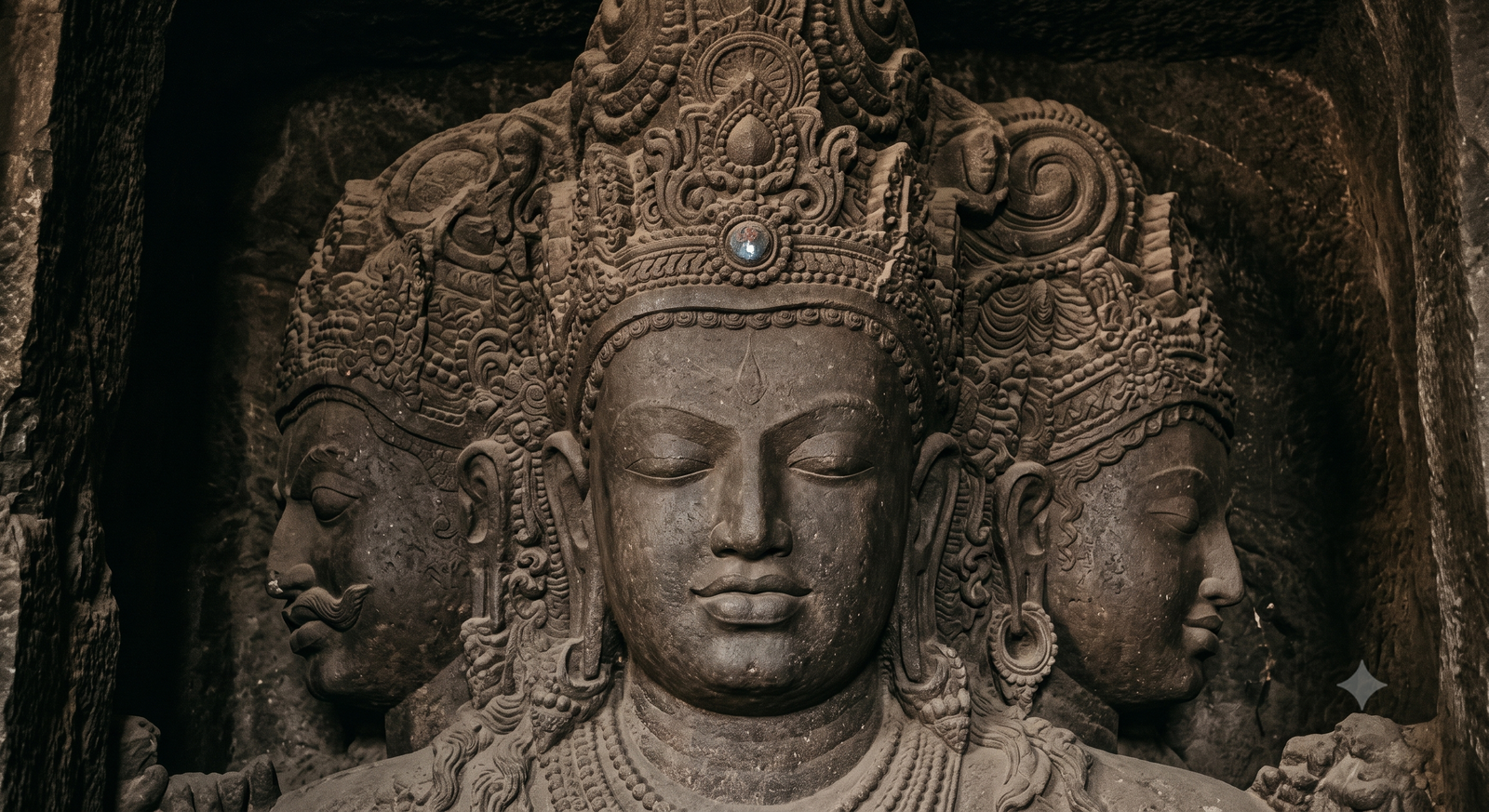
The ferry from the Gateway of India to Elephanta Island takes about an hour. You arrive at a jetty, climb a stepped path through trees, and then enter a carved hall that is 27 metres square, supported by rows of stone columns that have stood for fifteen centuries. At the far end, dominating everything, is the Trimurti Sadashiva. The 7-metre-high masterpiece Sadashiva dominates the entrance to Cave 1, representing Shiva in his three aspects: creator, preserver and destroyer. It is one of the greatest sculptures ever made by human hands and it has been sitting in a cave on a small island in Mumbai Harbour for 1,500 years while the city grew up across the water.
The Portuguese established a base on the island and the main cave was a Hindu place of worship until they arrived, whereupon the island ceased to be an active place of worship. The earliest attempts to prevent further damage to the caves were started by British India officials in 1909. Much of the sculpture was damaged during the Portuguese period. What survived, including the Trimurti, survived through extraordinary luck and the sheer depth of the carving, which made it difficult to destroy completely.
Rock-cut architecture in India developed across nearly two thousand years, from the earliest Buddhist cave retreats of the 3rd century BCE through the Hindu and Jain monuments of the medieval period. Rock cut architecture is the practice of excavating and sculpting structures from a single solid rock mass, where instead of constructing buildings with bricks or stones, artisans removed unwanted rock portions to create interior spaces, pillars, halls and sculptures. The discipline it required was absolute. A mistake in a free-standing building can be corrected. A mistake inside a mountain simply becomes part of the mountain.
The people who built these places had no margin for error and left behind work of such precision and beauty that it has outlasted most of what the world built above ground during the same period. The Colosseum in Rome, built around the same era as some of Ajanta’s caves, required constant repair and partial rebuilding over the centuries. Ajanta’s paintings are still on their walls.
India did not just build temples. It built them inside mountains. And then it left them there for the world to find!