
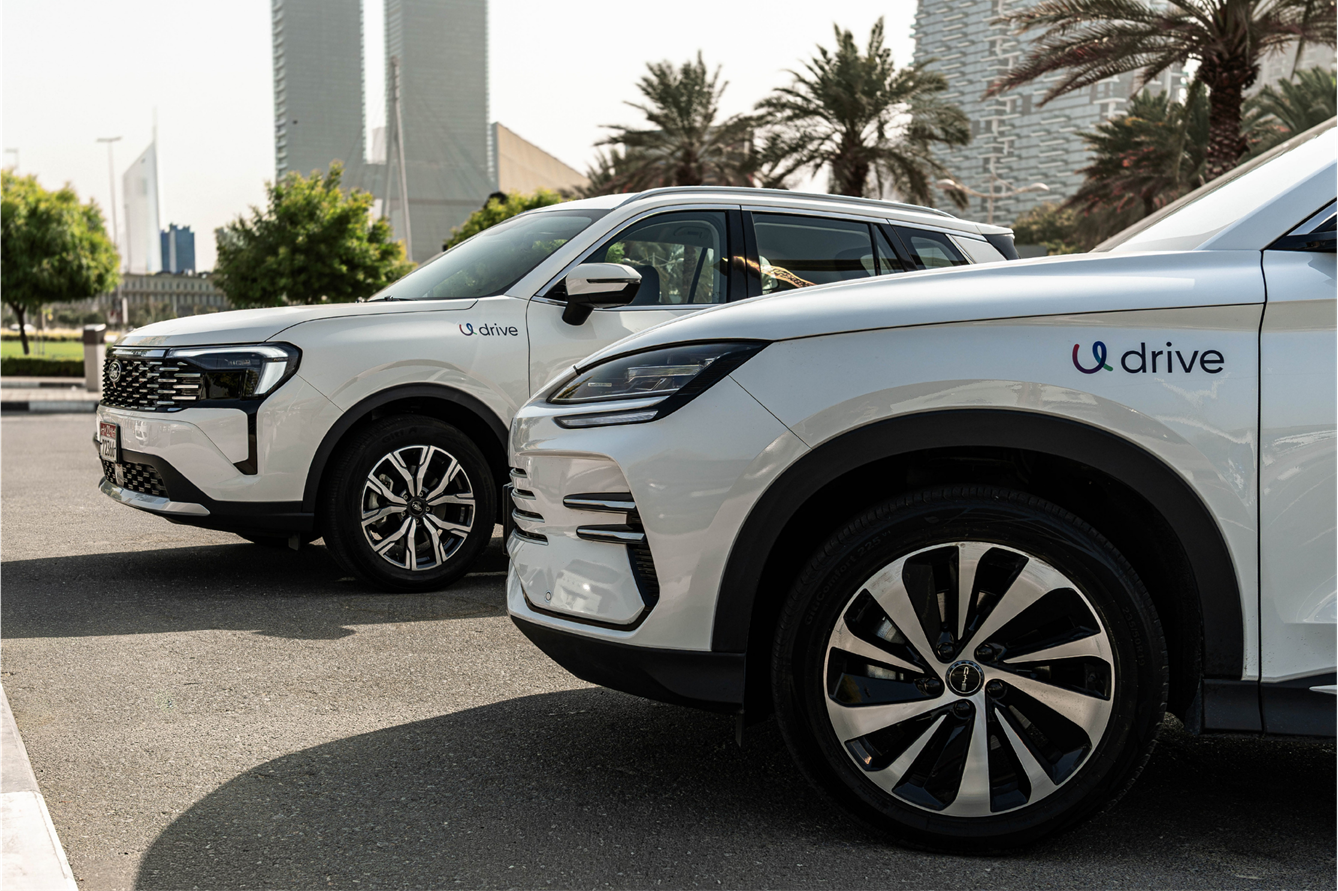
Udrive Founder and CEO Hasib Khan on the numbers behind Dubai’s car sharing boom, and why owning a car might be the more expensive habit.
- Udrive users clocked over 45 million kilometres in 2025, with residents making up 90% of its customer base.
- Long-term customer retention jumped from 21% to 32%, a signal that shared mobility is becoming routine rather than occasional.
- The fleet has crossed 2,000 vehicles and three million completed rentals across Dubai, Abu Dhabi, Sharjah and Ajman.
- New hybrid additions like the BYD Song and BYD QIN, alongside MINI Convertibles, point to a fleet strategy balancing sustainability with variety.
- Hasib Khan weighs in on when car ownership actually stops making financial sense.
Dubai has never been short on ways to get around, but the way residents are choosing to move through the city is quietly shifting. Car sharing platform Udrive has just released data that backs this up, and the numbers tell a story about a city rethinking what it means to “have a car.”
Udrive users logged more than 45 million kilometres in 2025 alone. Residents, not tourists or short-term visitors, make up 90% of the customer base. That is not a small detail. It suggests something has changed in how long-term UAE residents think about ownership versus access.
We sat down with Hasib Khan, Founder and CEO of Udrive, to unpack what is behind the growth, and where it is headed next.

Access is becoming the new ownership
For Mr. Khan, the 45 million kilometre figure reflects a shift away from car sharing as an occasional convenience. “Customers are booking vehicles for the full range of daily life,” he says, pointing to commutes, errands, school runs, family visits and weekend travel as now-common use cases. People still want the flexibility and control that comes with driving, he explains, just without the cost and responsibility of ownership. Dubai’s broader mobility trends back this up too, with shared mobility ridership growing 30% in 2025.
The resident-heavy customer base is arguably the more surprising number, given how tourist-facing Dubai’s economy can seem from the outside. Mr. Khan puts it down to residents understanding the real cost of car ownership better than anyone. Between insurance, registration, maintenance, depreciation and parking, owning a car adds up fast. Car sharing removes that monthly weight while still giving people a vehicle whenever they actually need one. Research he references shows 21% of UAE residents aged 18 to 50 now prefer renting over buying, with younger residents leading that shift.
Why people are sticking around longer
One of the more telling numbers in Udrive’s report is retention. Customers staying for 12 months or more jumped from 21% to 32%, a meaningful jump for a subscription-style service. Mr. Khan credits this to a broader, more reliable fleet, better availability in high-demand areas, and a smoother booking experience overall.
But there is also a behavioural shift happening alongside the product improvements. “Customers stay when a service becomes dependable enough for everyday planning,” Mr. Khan says, listing reliable cars, area coverage, clear pricing and responsive support as the real drivers of loyalty. Once locating, unlocking and paying for a car becomes second nature through the app, he adds, the service simply folds into someone’s routine.
Fleet strategy built around timing, not just size
With over 2,000 vehicles and three million completed rentals across four emirates, Udrive’s fleet planning has had to get more precise. Mr. Khan says the focus now is on matching vehicle type, location and availability to actual demand patterns throughout the day, using booking times, trip duration, utilisation and customer search data to figure out where each car will serve the most people.
The expansion into new Business Zones across Dubai, Sharjah and Ajman follows a similar logic. Mr. Khan says the company looks for areas with strong demand, growing residential or business activity, and a genuine gap in flexible transport options, particularly places where public transport is still catching up or families need an extra car occasionally.
New residents and existing owners, both driving growth
Registrations grew 14% year on year, and Mr. Khan says that growth is coming from two different directions at once. New-to-the-UAE residents need immediate transport before they settle into longer-term plans, while existing car owners are increasingly using Udrive for flexibility, whether as a second vehicle or for specific trips. Some, he notes, are also realising their own car sits idle more often than not, especially as remote and hybrid work cut down on daily commuting.
When does owning a car stop making sense?
This is the question most residents actually want answered, and Mr. Khan does not dodge it. It depends on frequency of use, he says. Daily drivers covering long distances may still be better off owning. But for occasional or irregular driving, pay-per-use tends to win out financially.
His bigger point is about how people calculate the comparison in the first place. “The biggest mistake people make is comparing only the cost of fuel or a monthly car payment,” Mr. Khan says, arguing that a fair comparison has to include depreciation, insurance, maintenance and parking too. With Udrive, fuel, basic insurance and public parking come built into the cost already.
A fleet shifting toward hybrid, without losing variety
Udrive’s fleet now includes hybrid options like the BYD Song and BYD QIN, alongside additions like MINI Convertibles. Mr. Khan says sustainability is playing a bigger role in fleet decisions, but variety still matters just as much, since customer needs range from efficient daily commuting cars to SUVs, premium vehicles and the occasional convertible for a special occasion. With the UAE targeting electric vehicles to make up 50% of cars on the road by 2050, Mr. Khan says Udrive is building toward that shift while still covering the full spread of what customers actually want to drive.
Where car sharing fits into Dubai 2040
Dubai’s 2040 Urban Master Plan places heavy emphasis on flexible, connected transport, including a goal of getting residents to most daily needs within 20 minutes and placing 55% of residents within 800 metres of mass transit. Mr. Khan sees Udrive playing a connective role in that system, with trains and buses handling large-scale movement while shared cars fill in the shorter connections, errands and trips between areas without direct transit links. Over the next five years, he expects car sharing to become more tightly woven into public transport, residential communities and business hubs.
Is this a bridge, or the long-term model?
Asked whether car sharing is simply a stepping stone to something bigger like autonomous fleets, Mr. Khan is clear that he sees it as the long-term model, just one that will keep evolving technologically. He points to Dubai’s Autonomous Transportation Strategy targeting 25% of trips to be autonomous by 2030, with shared fleets likely to adopt the technology early.
The underlying behaviour, though, is what he expects to stay constant. “People will want access to a vehicle when they need it,” Mr. Khan says, “without necessarily owning it.”
That shift, from asking what car someone drives to asking how they get around, is really what Udrive’s numbers are pointing to. As Dubai’s population grows and its transport network gets more connected, the city’s residents are not just adapting to shared mobility, they are actively shaping what it looks like next. For Mr. Khan and Udrive, the road ahead is less about convincing people to give up ownership, and more about making sure access is always there when they need it!
Instagram: @udrivecarsharing