Four thousand years ago, traders linked Gujarat’s coast with what is now the Emirates.
- Sumerian texts call the UAE region Magan, a land of mines
- Indus-style seals and pottery patterns have been found at Hili
- Lothal in Gujarat is seen as the Indus Valley’s main port
- Carnelian beads and ivory likely from India travelled across the Gulf
Hold a carnelian bead up to the light and you are holding a receipt. Four thousand years ago, somebody in the Indus Valley drilled it, somebody carried it across the Arabian Sea and somebody in what is now the UAE treasured it. Indus Valley trade with the Gulf is one of the oldest business relationships on earth, and the Emirates were part of it.
Indus Valley Trade Begins With Three Lands in Clay
Sumerian tablets from Mesopotamia keep mentioning three distant lands: Dilmun, Magan and Meluhha. Dilmun is generally identified with Bahrain. Magan is now accepted as the area covering the UAE and Oman, and one of its key sites, Umm an-Nar, sits near Abu Dhabi. Meluhha, most scholars agree, was the Indus Valley. In the 24th century BCE, Sargon of Akkad boasted that ships from all three were docked at his capital. Ships crossed the Gulf.
Magan was known as the land of mines. Texts list copper, stone vases, timber, gold dust and carnelian beads among its goods. Some of those items, including carnelian beads and ivory, likely originated in India, with Magan acting as a transhipment point. Scholars add one caution: the surviving archaeological record of the Indus and Mesopotamian trade is thinner than the texts suggest, and Meluhha’s exact location is still debated. But the pattern keeps repeating.
The Lothal Dockyard: The Port That Looked Out to Sea
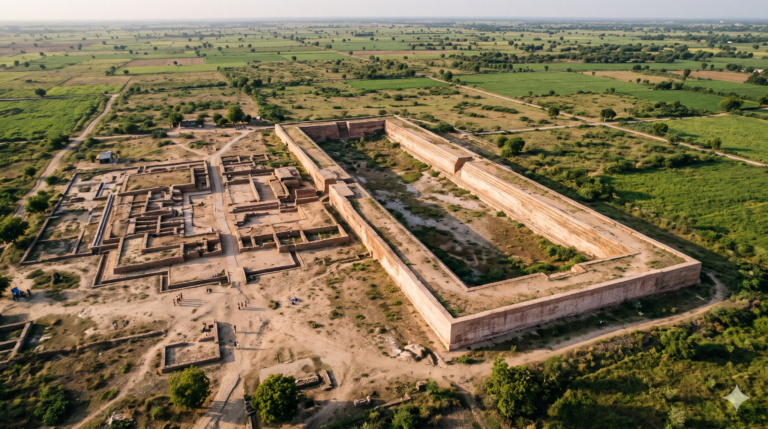
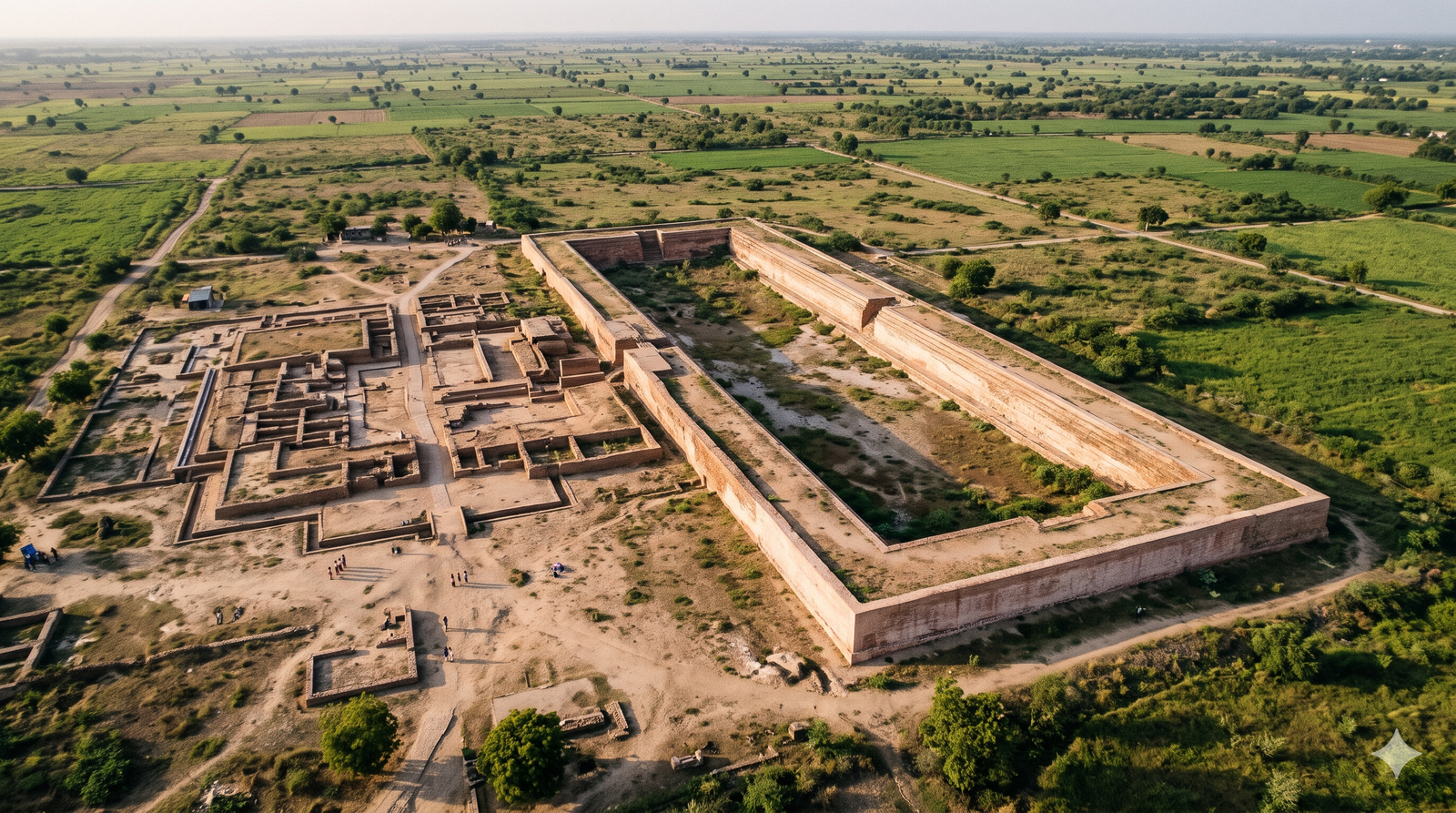
On the Gulf of Khambhat in Gujarat sits Lothal, a Harappan town with a large brick basin long interpreted as the world’s oldest known dockyard. Some archaeologists have argued it was a water tank instead. Scholars still argue. A recent study by researchers at IIT Gandhinagar strengthens the dockyard case. Using satellite and ground data, it traced ancient channels linking Lothal to the Sabarmati river and the sea, suggesting the basin was built for boats, not irrigation.
Other clues point the same way. Seals found at Lothal include circular stamped seals in the Persian Gulf style, also known from Bahrain and Failaka Island in Kuwait. Harappan settlements line the coast from the Makran to Lothal like stepping stones.
Umm an-Nar Culture: What Turned Up in the UAE
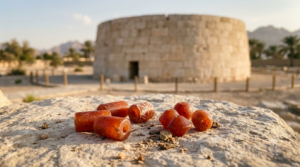
Cross the Arabian Sea and the evidence reappears. The Umm an-Nar culture, which flourished in the UAE and Oman between about 2700 and 2000 BCE, takes its name from that island near Abu Dhabi and is known for its round stone tombs. Excavations at sites including Hili in Al Ain, now a UNESCO World Heritage Site, have turned up Indus-type seals and pottery patterns. Carnelian beads from Indus workshops show up too. Archaeologists can often spot them by their drill holes, which are exceptionally well centred, while beads made elsewhere tend to be irregular.
Trade ran both ways. Magan had its own copper, and its communities shaped the exchange rather than simply serving it. Think of a bead maker in Gujarat, a copper smelter near Al Ain and a scribe in Ur, all linked by one sailing season.
Direct trade with Meluhha seems to have faded around 2000 BCE, as the Indus cities declined, with Dilmun taking over as the middleman. The sea routes did not close, though. The same monsoon winds that later carried Arab dhows to the Malabar Coast and merchants from India to the Gulf kept ships moving between these shores. Today India is one of the UAE’s largest trading partners, and Indians form the largest community in the country. The cargo has changed. The sea has not.