
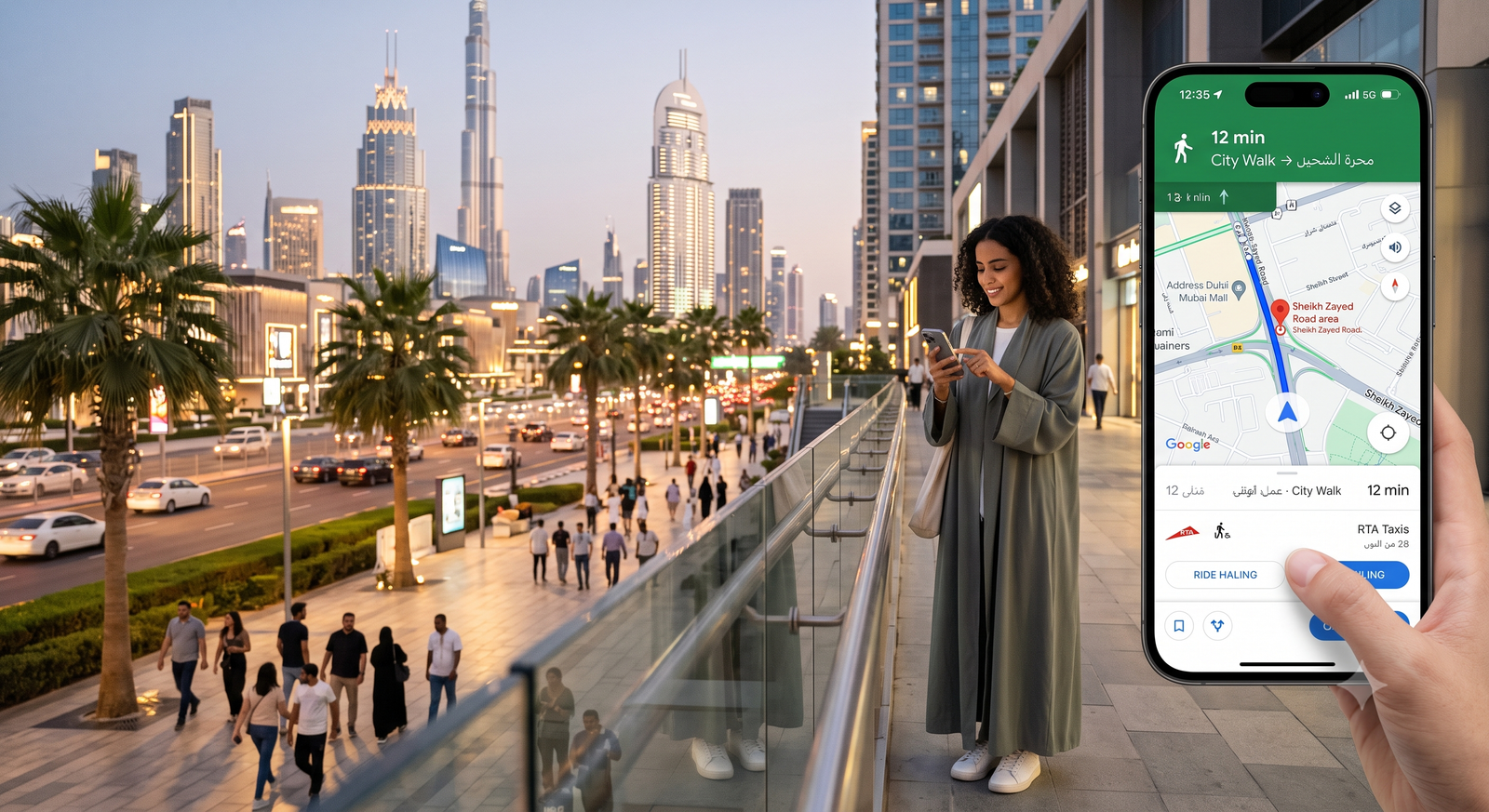
From the ride that arrives before you finish booking it to a government licence renewed without a single human in the loop, AI is already here.
- The UAE is the first country in the world to cross 70 percent AI adoption among working-age population.
- AI could contribute up to 96 billion dollars to the UAE economy by the year 2030.
- Ajman became the first UAE entity to renew a trade licence entirely through agentic AI this month.
- Abu Dhabi is working toward becoming the world’s first fully AI-native government by 2027.
Most UAE residents used artificial intelligence at least once today without knowing it. The route that rerouted itself before the traffic built up on Sheikh Zayed Road. The banking app that flagged an unusual transaction before it was noticed. The government platform that completed a request in minutes rather than days. The delivery window that narrowed itself based on nothing you did. The UAE is now the first country in the world to cross the 70 percent threshold in AI adoption among the working-age population, recording a usage rate of 70.1 percent in the first quarter of 2026 according to the Microsoft AI Economy Institute, significantly exceeding the global average of 17.8 percent and placing the UAE more than four times above the worldwide benchmark. This is not a country experimenting with artificial intelligence. This is a country running on it. We spoke to three industry experts across financial services, mobility technology, and AI development to understand what this moment actually means for ordinary UAE residents and where it is heading next.
Sonal Chiber, Senior Financial Services Consultant, Coalition Greenwich, S&P Global

Sonal Chiber has spent over 24 years at the intersection of strategic communications, financial services, and digital transformation, and her perspective on AI adoption in the UAE comes from a position of observing how institutions and individuals alike are navigating a shift that is moving faster than most frameworks can keep up with.
Her starting point is a deliberate reframe of how most people still think about artificial intelligence. “AI is no longer a future concept,” she says. “It is becoming an everyday enabler across the UAE, transforming how people work, access services, manage finances, receive healthcare, and interact with businesses.” The gap between AI as something discussed at conferences and AI as something woven invisibly into the fabric of daily life has closed, and the UAE’s strong institutional focus on digital transformation has accelerated that shift from experimentation to real-world application faster than almost anywhere else on earth.
Her perspective from the financial services sector is particularly instructive for UAE residents who may not connect their banking experience to AI at all. The personalised product recommendation that appeared before you thought to look for it. The fraud alert that arrived before you checked your statement. The risk assessment that shaped your loan offer without a human reviewer touching your file. “Across sectors such as finance, AI is enabling smarter decision making through data-driven insights, enhancing customer personalisation, improving operational efficiency, and strengthening risk management,” she explains. But she is careful to balance the opportunity with an equally important caution. “Responsible adoption will be critical. The future of AI should focus on creating a meaningful partnership between technology and people, balancing innovation with human judgement, transparency, data privacy, and digital literacy.” The technology is running ahead of public understanding in the UAE as it is everywhere else, and Chiber’s argument is that the residents who will benefit most are those who engage with it deliberately rather than passively. “AI should not be viewed simply as a replacement for human capabilities, but as a tool to enhance creativity, productivity, and informed decision making.”
Islam Abdul Karim, Regional Head, Yango Group Middle East

Islam Abdul Karim leads Yango Group’s operations across the Middle East, giving him a ground-level perspective on how AI shows up in one of the most data-rich and operationally complex sectors in urban Dubai life: mobility. His answer to the question of how AI is present in everyday UAE life is immediate and specific, and it begins with a principle that defines the best AI implementations everywhere. “AI often becomes most noticeable only when something goes wrong or takes longer than expected,” he says.
The ride-hailing example he offers is more technically layered than most passengers ever realise. When a UAE resident orders a ride, AI is simultaneously analysing vehicle locations, traffic conditions, weather patterns, likely demand clusters, driver availability, route efficiency, and service category matching, compressing a decision that would take a human dispatcher several minutes into a fraction of a second. Yango Group’s AI-powered routing technology saved users more than five million hours across over 20 cities in 2025, including 34,000 hours in Dubai and Abu Dhabi collectively, a figure that represents something more human than a statistic: 34,000 hours of people’s lives returned to them because an algorithm optimised a route they never had to think about. “The most effective AI is often the one that does not show up at all,” Abdul Karim observes. It is a definition that captures something important about where the most meaningful AI applications actually live, not in the dramatic demonstrations but in the invisible smoothness of things working better than they used to.
Looking ahead, he identifies a shift from AI as a series of separate service interactions to something more integrated and proactive. Yango Ride’s integration with ChatGPT is an early signal of this direction: a user plans a journey through natural conversation, receives a fare estimate, compares travel times, and identifies a pickup point without navigating a single menu. “Instead of starting with a particular app or navigating several menus, the interaction begins with a simple dialogue,” he explains. The voice-first dimension is equally significant. A resident can already ask Yasmina, Yango’s Arabic-speaking AI assistant, to play a favourite playlist rather than opening an app and searching manually. The shift from typed commands to spoken requests to anticipated needs is the arc Abdul Karim sees completing itself over the next two years, making technology feel “like a continuous and largely invisible form of assistance throughout the day.”
Bindesh Vijayan, Co-Founder and CTO, Myndlab
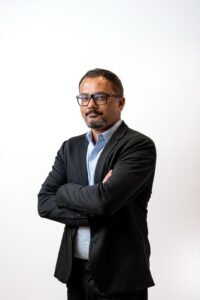
Bindesh Vijayan builds AI systems, which gives him both the technical depth to understand what is actually happening inside these products and the entrepreneurial perspective to see where the real opportunities and real risks sit. His response to the question of what most people misunderstand about AI cuts in two directions simultaneously, and both are worth sitting with carefully.
The first misunderstanding he identifies is the assumption that AI’s primary purpose is replacing people. “In practice its most valuable role is to absorb repetitive work, surface patterns and support better-informed decisions,” he says. A doctor, a banker, a teacher, or a business owner is not valuable because they can process information quickly. Their value comes from judgement, experience, and understanding people, qualities that AI strengthens rather than replaces when deployed with intention. The second misunderstanding is more surprising and considerably more optimistic than the public conversation about AI typically allows. The emergence of what has been called vibe coding, where plain-language descriptions can be turned into working applications, has collapsed the distance between having an idea and having a product in ways that are already changing who gets to participate in the digital economy. “A person with a strong idea can increasingly turn it into a working product without first becoming a software engineer or assembling a team,” Vijayan explains. “What would have taken a funded team and six months two years ago can now be built by one person in a weekend.”
His most striking data point comes from his direct professional context. The UAE Cabinet approved a framework in April 2026 to shift half of all federal government sectors, services, and operations to agentic AI within two years, with a training programme covering 80,000 employees from ministers to new joiners. The distinction between conventional AI and agentic AI is one Vijayan is careful to explain clearly. “A chatbot answers you. An agentic system carries out a multi-step task: it identifies what you need, gathers approvals, coordinates across departments and completes the work.” He offers a local example that makes this concrete: Ajman became the first government entity in the UAE to renew a trade licence entirely through agentic AI this month, completing the entire service journey without a human in the loop. “It was not a demonstration,” he notes pointedly. “It was a licence, renewed.” Looking ahead, Vijayan’s excitement is reserved for what he sees as the most significant shift of all: not the UAE’s extraordinary record as an AI adopter, but its emerging potential as the place where the next generation of AI products is actually built. “The UAE has already proven it can be the world’s most enthusiastic adopter of AI. The next step is becoming a place where the next generation of AI products and companies are actually built, and I think the conditions for that are now genuinely in place.”
Three experts, three sectors, and one consistent picture: AI in the UAE is not arriving. It is already here, running quietly in the background of services that residents use every day without attributing them to artificial intelligence at all. The route that rerouted itself. The fraud that was caught before you saw it. The licence renewed without a queue. The ride that arrived before you finished deciding where to go. PwC Middle East estimates that artificial intelligence could contribute up to 96 billion dollars to the UAE economy by 2030, accounting for nearly 14 percent of national GDP, one of the highest projected impacts globally. But the more immediate story, the one that Chiber, Abdul Karim, and Vijayan are each telling from their own angle, is simpler and more human than any economic projection. AI is making daily life in the UAE measurably smoother, faster, and more responsive than it was two years ago, often in ways that are only noticed when they are absent. The next two years will make that presence deeper, more personalised, and considerably more conversational. Whether residents engage with that shift deliberately or simply experience it passively is, according to all three experts, the choice that will matter most!