
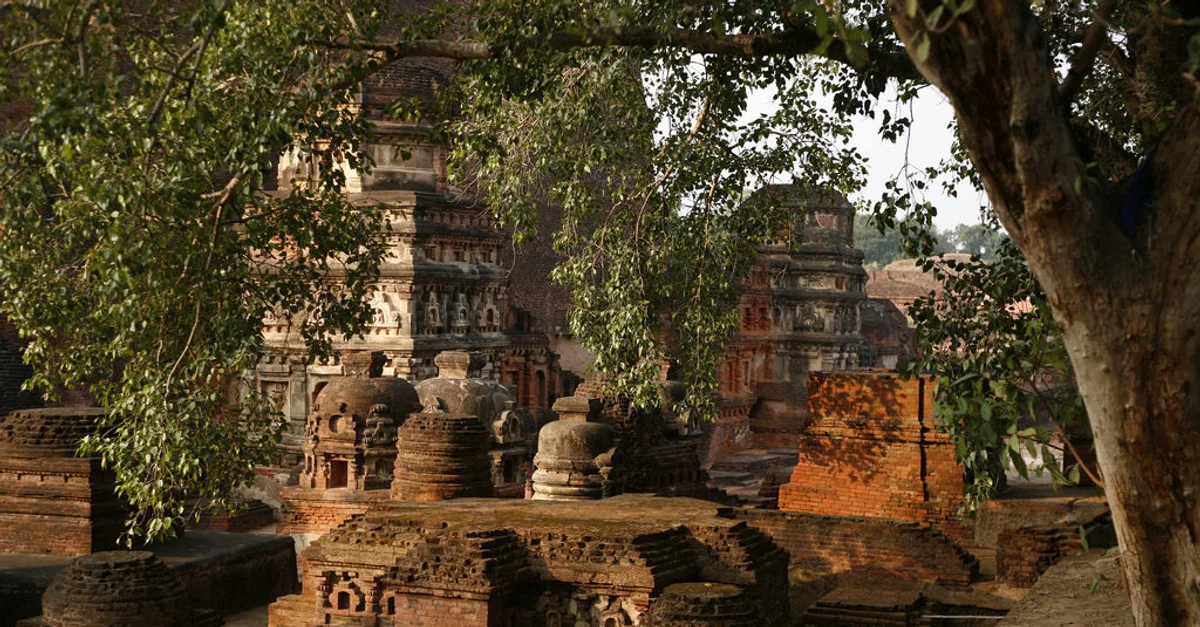
Centuries before Harvard or Oxford existed, India was running the world’s most international, most rigorous and most extraordinary centres of learning.
- Takshashila was established around 700 BCE, making it the world’s first university
- Nalanda housed over 10,000 students and 2,000 teachers at the height of its power
- Scholars travelled from China, Greece, Arabia and Persia to study at these institutions
- Nalanda’s legendary library reportedly burned for three months after it was destroyed
Ancient universities in India predate Oxford by more than a thousand years. That is not a boast. It is simply a fact that most history curricula have not found the time to mention. While Europe was still centuries away from its first university, the Indian subcontinent was already running fully residential, internationally attended, rigorously examined centres of higher learning that attracted students from China, Korea, Tibet, Persia, Greece, Arabia and Babylonia. They had libraries. They had dormitories. They had entrance examinations that rejected seven out of ten applicants. They had alumni who went on to shape the political, medical and philosophical thought of the ancient world. And then, across a series of invasions and a slow withdrawal of patronage, they were gone. The story of how they rose and how they fell is one of the most remarkable in human history.
The world’s first university was established in Takshashila in 700 BCE, located about 50 kilometres west of Rawalpindi, in what is now Pakistan. It was an important Vedic, Hindu and Buddhist centre of learning that accommodated students from as far as Babylonia, Greece, Arabia and China and offered over sixty different courses in fields including science, mathematics, medicine, politics, warfare, astrology, astronomy, music, religion and philosophy.
The scale of this is worth pausing on. In 700 BCE, when most of the ancient world was organising knowledge through oral tradition or royal courts, Takshashila had a functioning admissions system. Entrance to Takshashila was very difficult, with only three out of every ten students passing the admission test. Students generally entered at the age of sixteen and attached themselves to individual master teachers. The model was closer to the classical Gurukul system than a modern campus, with learning happening through close mentorship rather than lecture halls, but the ambition was unmistakably institutional.
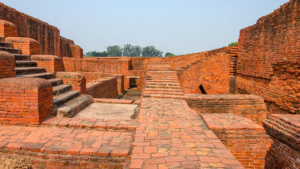
Takshashila’s position at the junction of three major trade routes, from eastern India, western Asia and Kashmir, made it not just an academic centre but a genuine crossroads of civilisations. Through its connections with the Silk Road, Takshashila helped transmit Indian medicine, mathematics and Buddhist philosophy to regions as far as China, Tibet and Southeast Asia. Some of its most famous students included Chanakya, who wrote the Arthashastra, one of the oldest treatises on statecraft and economic policy ever composed, and Charaka, the ancient physician whose work on medicine remained a reference point for centuries.
Nalanda, located in present-day Bihar, is widely regarded as the most celebrated university of the ancient world. Founded in the 5th century CE during the reign of Kumaragupta I of the Gupta dynasty, it flourished for nearly 700 years, rising to particular prominence under Emperor Harshavardhana. Where Takshashila was decentralised and mentor-led, Nalanda was something entirely new: a fully organised residential campus with dormitories, lecture halls, temples and a library of such legendary scale that it was known as the Dharmaganja, which translates as Mountain of Knowledge.
At its height, Nalanda had more than 10,000 students and 2,000 teachers. It taught theology, philosophy, logic, grammar, medicine and mathematics, and was deeply international. Students and scholars came from as far as China, Korea, Japan, Tibet, Mongolia, Turkey, Sri Lanka and Southeast Asia. The Chinese pilgrim Xuanzang, who spent years studying at Nalanda in the 7th century, left detailed accounts of its organisation and intellectual life that remain primary historical sources to this day. He described a campus where debate and rigorous examination were fundamental to the culture, where scholars were tested publicly and where the standard of learning was consistently demanding.
The Dharmaganja library was housed in three buildings. Even by the standards of the medieval world, the collection it contained was extraordinary. It would not survive.
Both Nalanda and Vikramashila were destroyed by the forces of the Turkic general Muhammad bin Bakhtiyar Khilji around 1193 CE. The burning of Nalanda’s library, a collection so vast that according to historical accounts it reportedly smouldered for months, represented an irreversible loss for global knowledge. The monks who survived scattered. The manuscripts that remained were carried to Tibet, Nepal and other parts of Asia, where fragments of the tradition survived in translation.
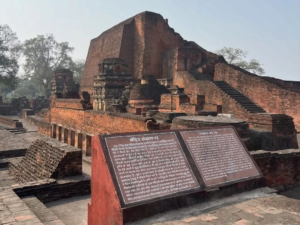
But invasions alone do not fully explain the collapse. What made these institutions fatally vulnerable was their dependence on a narrow base of support. When royal patronage evaporated, there were no alternative institutional structures, no broadly distributed community of supporters and no independent economic model to keep them alive. The knowledge was real. The infrastructure was extraordinary. The fragility was built into the foundation.
The tradition did not entirely disappear. Manuscripts carried out of Nalanda by fleeing scholars kept Buddhist philosophical texts alive in Tibet and China. Ayurvedic medical knowledge transmitted through Takshashila’s students survived in practice across South Asia. Chanakya’s Arthashastra, composed at Takshashila, was rediscovered in 1905 and recognised immediately as one of the most sophisticated political texts of the ancient world.
In 2014, the Nalanda University project was launched as an international academic collaboration based in Rajgir, near the ancient site. Its aim is to recapture the spirit of global scholarship and multidisciplinary learning that defined the original. The ambition is right. Whether it can honour the extraordinary thing that existed there for seven centuries is a question worth watching.
The ruins of Nalanda in Bihar are a UNESCO World Heritage Site. The ruins of Takshashila in Pakistan’s Punjab are also UNESCO listed. Both are worth visiting not as museum pieces but as reminders that the story of human knowledge does not begin with European institutions, and never did!