On July 29, hundreds of millions of people across India and the diaspora will bow to the people who took them out of the dark. Here is what Guru Purnima really means and where it began.
- Guru Purnima 2026 falls on Wednesday July 29 on the full moon of the Ashadha month
- The word Guru comes from Sanskrit: Gu meaning darkness and Ru meaning the remover
- The festival is observed across Hindu, Buddhist and Jain traditions simultaneously
- Lord Shiva gave his first teaching on this day making him the original Guru of all
Guru Purnima 2026 falls on July 29 and the word at the centre of it deserves to be unpacked properly before anything else. Guru. Everyone uses it. Very few people know exactly what it means. It comes from two Sanskrit roots: gu, meaning darkness or ignorance, and ru, meaning the remover. A Guru is the one who clears away the darkness of ignorance and gives light to your life. Not a teacher in the administrative sense, not someone who marks your papers or updates your grades. Someone who changes the quality of your seeing. Someone who makes the world more legible than it was before you found them. On the full moon of Ashadha every year, India stops and collectively thanks the people who did that for them. This year it happens on July 29. The gratitude is the same it has been for thousands of years.
What makes Guru Purnima genuinely extraordinary is that it belongs to no single tradition. It is observed simultaneously and with equal sincerity by Hindus, Buddhists and Jains, each marking a different foundational moment in their own history that happened to fall on the same lunar day. That is not a coincidence that the calendar manufactured. It is a convergence that the traditions themselves have chosen to honour together across centuries.
For Hindus, Guru Purnima is celebrated on the full moon of Ashadha month and commemorates the birth of Sage Ved Vyasa, who compiled the Vedas and authored the Mahabharata, making him one of the greatest gurus in Hindu tradition. Vyasa is not simply a historical figure. He is the man who gathered the scattered oral wisdom of ancient India, organised it into texts that could be transmitted across generations, and in doing so, ensured that the knowledge survived. Without Vyasa there would be no Mahabharata. Without the Mahabharata there would be no Bhagavad Gita. The thread goes very deep very quickly. Guru Purnima, often referred to as Vyasa Purnima, commemorates his birth, and Hindus pray to the deity Shiva on this day.
For Buddhists, the day carries a different but equally fundamental significance. Regarding Gautam Buddha, it is believed that he attained enlightenment and delivered his first sermon at Sarnath on the full moon day. That first sermon, delivered to five disciples in a deer park, was the moment the wheel of dharma began turning. Everything that followed in two and a half thousand years of Buddhist thought, art, architecture and practice traces back to that afternoon in Sarnath on a July full moon.
For Jains, on this day in the Ashadha month, Indrabhuti Gautam became the first disciple of the 24th Tirthankar of the Jain religion, Lord Mahavira. The formal beginning of the guru-shishya tradition in Jainism. The same day, three different moments, three traditions that have run in parallel across the Indian subcontinent for millennia, all finding their founding act of transmission on the same full moon.
According to one belief, Lord Shiva shared his wisdom with people on this day, making him the first teacher. The story connected to this is the Adiyogi, the original yogi, who is said to have transmitted the science of yoga to the seven sages, the Saptarishis, on the banks of the Kantisarovar lake in the Himalayas after they spent 84 years in preparation. The disciples became known as Saptrishis after 84 years of sadhana, on the day of the full moon when Shiva took over as their teacher and became their guru. The Saptrishis then rose to fame and learned things that they later shared with the rest of the world.
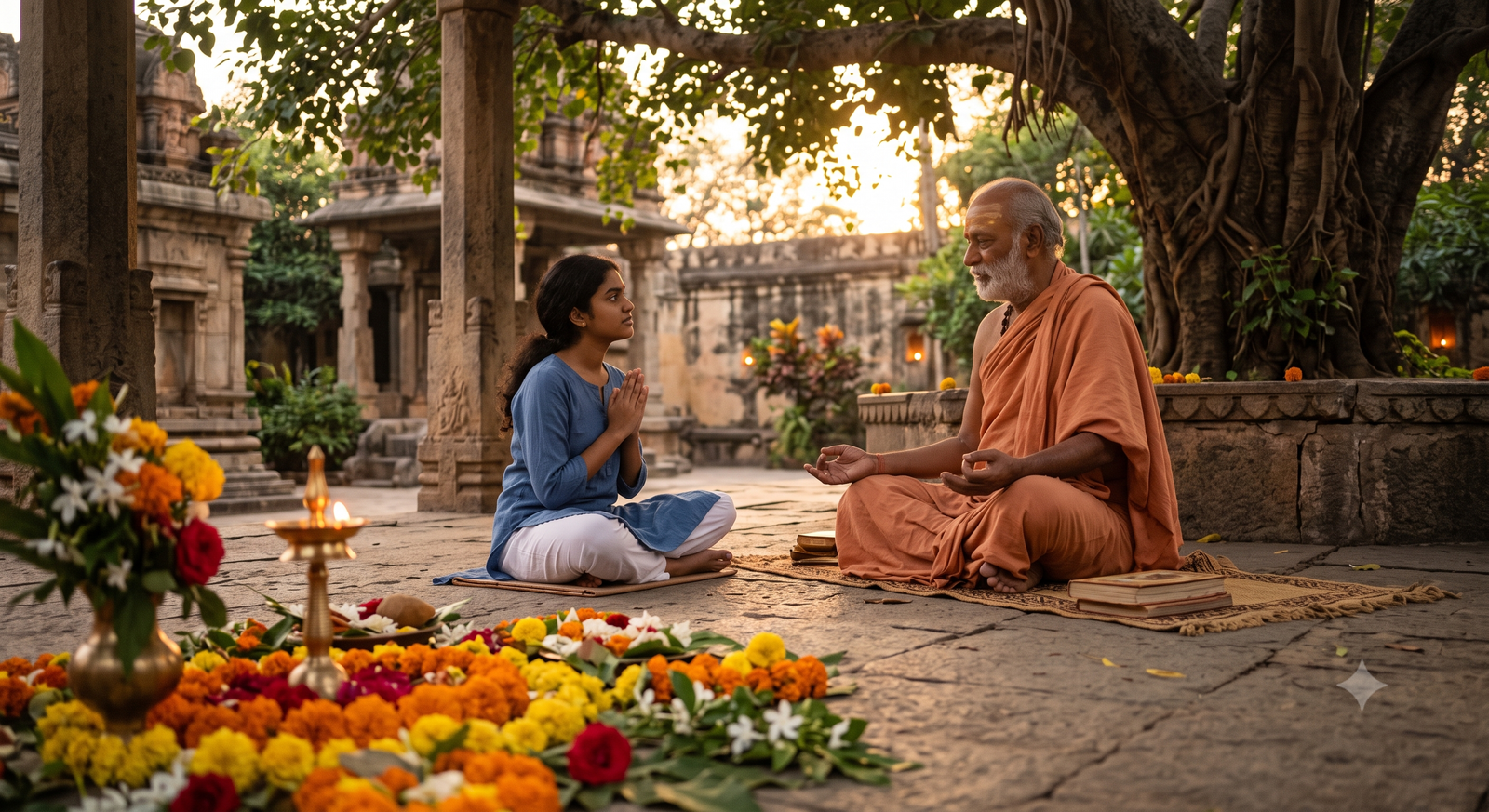
This is where the festival’s deepest root sits. Not in any single human teacher, however brilliant, but in the idea that knowledge itself is something that passes between people and that the act of transmission is sacred. The guru does not simply give you information. The guru changes how you receive reality. That is why the bond between guru and shishya, teacher and disciple, is treated in Indian tradition as one of the most important relationships a person can have. More important, in many traditions, than family.
In Indian classical music and arts, Guru Purnima holds immense significance. Students across the country honor their music or dance gurus through performances and heartfelt tributes. In ashrams and spiritual centres across India, disciples gather around their teachers for darshan, which is the auspicious sight of someone spiritually elevated, offering flowers, performing puja and receiving blessings. In universities and schools, teachers are honoured by students with gifts and gratitude. In homes, elderly members of the family are acknowledged as the living gurus of the household.
Historically, Guru Purnima held great agrarian significance in ancient India. As this festival falls during the monsoon season, farmers worship deities and seek their blessings for good rainfall and prosperous harvests, making Guru Purnima a day of gratitude and divine grace. The monsoon is not incidental to all of this. The rains arrive, the earth turns green, and it is the right moment to bow your head to whatever force, human or divine, has brought light into your particular darkness.
For the Indian diaspora across Dubai and the UAE, Guru Purnima is observed in temples and community centres, often quietly, often privately, often as a moment to call a teacher from decades ago and say thank you. The festival does not require a particular ritual. It requires a particular feeling: genuine, specific gratitude for whoever taught you to see more clearly than you could before.
Guru Purnima 2026 falls on July 29. There is someone who removed some darkness for you. You know who they are. This is the day to tell them!