
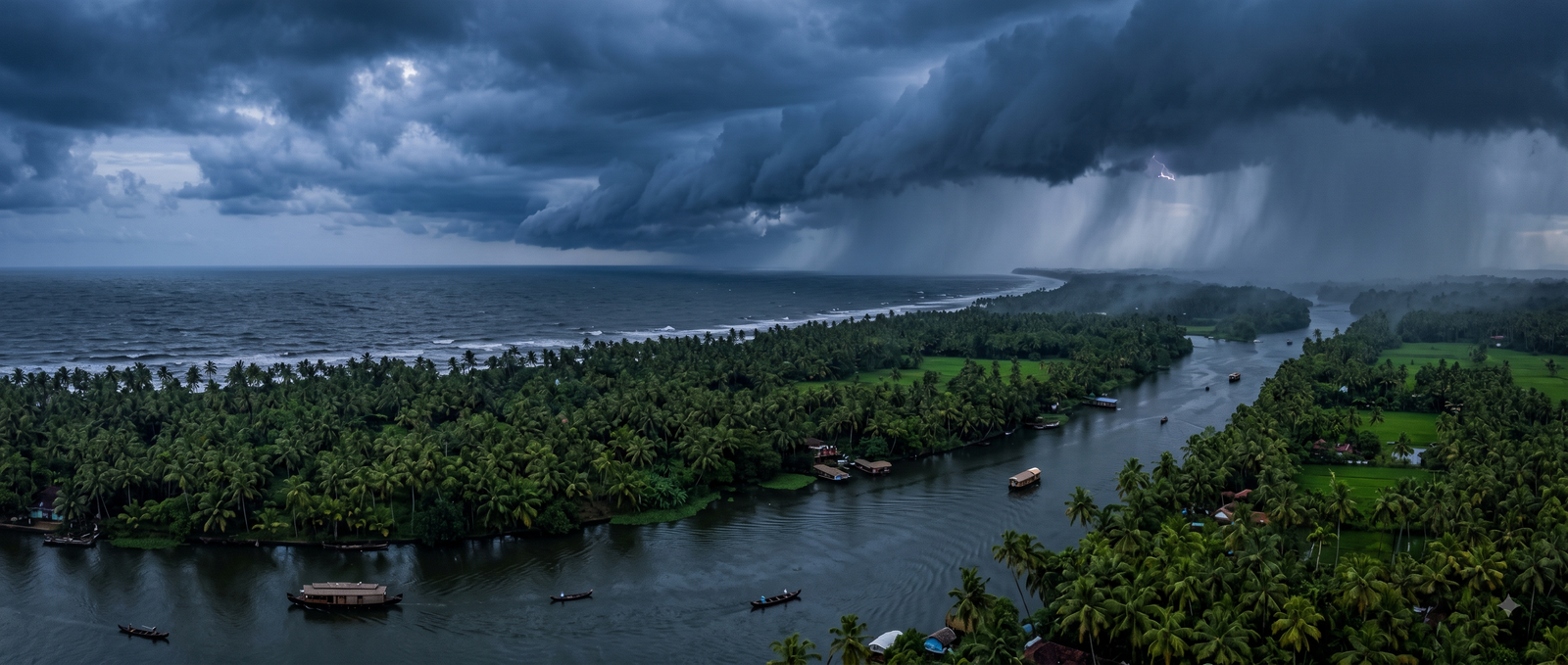
It built the Harappan civilisation, inspired a musical raga that could summon rain and wrote itself into every mythology India has ever produced. The monsoon is not weather. It is who India is.
- The word monsoon comes from the Arabic mausim meaning seasonal winds proving its ancient trade connections
- The collapse of the Harappan civilisation 4,000 years ago is linked to a failure of the monsoon
- Raga Megh Malhar was composed specifically to invoke rain and is still sung at monsoon onset
- Nearly half of India’s population depends on monsoon rains for agricultural survival today
India monsoon history begins with a word that most people do not know comes from Arabic. Monsoon derives from the Arabic mausim, meaning seasonal winds, which arrived in European languages through Portuguese sailors who learned it from Arab traders navigating the Indian Ocean. Those Arab traders were using the monsoon winds to reach India and back for centuries before European ships arrived. The monsoon was not just weather to them. It was a highway. The same seasonal wind that drenches Kerala in June and floods Rajasthan by July was also the engine of one of the most active trading systems the ancient world ever produced. The Indian Ocean trade routes ran on monsoon time. India’s entire relationship with the Arabian Peninsula, including the fragrance trade we covered last week, the spice routes, the textile exchanges, all of it moved with the monsoon.
For anyone sitting in Dubai right now in the middle of August, reading about the monsoon from inside an air-conditioned room while India turns green with rain, the distance feels very specific. The UAE is in its driest, hottest month. India is in its wettest. The contrast is so total that it almost feels like different planets. But for the millions of Indians across the Gulf who grew up watching the sky for the first dark cloud of June, who remember the smell of petrichor on dry earth before the rain reached them, who have a specific emotional relationship with the sound of rain on a tin roof, the monsoon is not weather. It is memory. It is home.
The lifestyle, agriculture and economy of ancient India were profoundly shaped by the dominant monsoon cycle, a seasonal reversing wind system that brought heavy rainfall during the summer months. This annual rainfall not only rendered the lands fertile for agriculture but also replenished water bodies, maintaining the region’s biodiversity. The monsoons were so ingrained in their way of life that the ancient Indians developed a sophisticated understanding of the cycle, as evidenced in their ancient texts where they recorded the onset and retreat of the monsoons.
The Harappan or Indus Valley Civilisation, the most advanced urban culture of the ancient world, built everything on the monsoon. Their agriculture, their water management systems, their city planning and their extraordinary network of trade all ran on the reliable arrival of rain. The various historical, archaeological and geological records show an abrupt drying trend at 4,000 years ago which coincides with the end of the Harappan Civilisation in the Indus Valley. The rain that built them also, when it stopped coming reliably, undid them. The monsoon was not just a resource. It was the condition of possibility for everything they had created. When it weakened, the civilisation followed.
The Vedic civilisation that followed shows the same deep dependency written directly into its sacred texts. Deities like Indra, associated with thunderstorms and rainfall, were revered for their roles in agriculture and fertility, embodying a deep understanding and respect for the natural world. Indra is the king of the gods in the Rig Veda and his primary power is rain. That is not a coincidence or a poetic choice. It is a direct reflection of what the people who composed the Rig Veda depended on most. The most powerful god in the earliest Hindu pantheon controls the monsoon because the monsoon controls everything.
In Hindu mythology, the monsoon months known as Chaturmas are believed to coincide with Lord Vishnu’s resting period. It is during this time that the earth receives essential rainfall, vital for agriculture and sustaining life. The idea that the preserver of the universe takes his rest precisely when the monsoon arrives is a beautiful encoding of ecological truth in mythological form. The world does not need Vishnu’s active intervention during the monsoon months. The rain takes care of everything.
The mythology around the monsoon is also, uniquely, joyful. Most weather mythology in most cultures deals with storms as punishment, floods as divine wrath, drought as divine anger. India’s monsoon mythology is celebratory. The rain is waited for. The rain is welcomed. The rain is danced in. Teej, the festival of women that falls in the monsoon, involves swings hung from trees, songs about reunion and the rain, and a celebration of the earth’s fertility that connects women to the season in a way that feels genuinely ancient. The peacock, India’s national bird, spreads its spectacular tail at the first monsoon rains. The entire natural world responds to the monsoon with a visible, audible relief that humans have been joining for thousands of years.
Indian classical music has an entire category of compositions dedicated to the monsoon. Raga Megh Malhar, one of the most celebrated of all classical ragas, is specifically associated with the monsoon season and is believed, in tradition, to have the power to invoke rain when performed with sufficient mastery and devotion. The great singer Tansen, court musician of Emperor Akbar, is said to have sung Raga Deepak with such perfection that it literally lit lamps, and then sung Megh Malhar with equal mastery to bring rain and extinguish them. Whether taken literally or as the highest possible compliment a musical tradition can pay to its own power, the story tells you something real: India built an entire musical system around the experience of the monsoon. The first cloud, the first drop, the smell of wet earth, the sound of rain on leaves, the relief of a sky that finally delivers what it has been promising for months, all of this is encoded in classical music, in painting, in poetry and in the daily calendar of an entire subcontinent.
Each year, the monsoon literally transforms life in India. In the wild, lush green landscapes cloak the environment. Rejuvenated lakes and streams lead to rapidly flowing rivers and heavy waterfalls. The transformation is so total and so rapid that it feels less like weather and more like a different country arriving every June. Kerala receives the monsoon first, usually in the first week of June, and the Kerala monsoon arrival is announced by meteorologists, watched on news channels, celebrated in photographs and treated as a genuine national event.
Agriculturally, the monsoon is the lifeblood of India. With nearly half of the country’s population dependent on farming, timely and adequate monsoon rains are essential for crop cultivation, particularly for staples like rice, wheat and pulses. This is not a historical dependence that modernity has dissolved. It is a present, active relationship that shapes the Indian economy every single year. A good monsoon year and a bad monsoon year produce measurably different economic outcomes, which is why the weather forecast for June in Kerala is watched by financial analysts, agricultural planners, water resource managers and farmers across the entire subcontinent simultaneously.
For the Indian diaspora in the Gulf, the monsoon arrives as news, as photographs from home, as a specific kind of longing for the smell of rain that the UAE’s climate simply does not offer. The word for it in the Urdu tradition is barish. The feeling it produces has no single word in any language. It is the emotional equivalent of a country exhaling after holding its breath for eight months.
India without the monsoon is not India. The rain is not what falls on the country. The rain is what the country is built from!