The last Asiatic lions on earth live in one forest in Gujarat. The one-horned rhino came back from 200 individuals to thousands. India’s wildlife stories are as extraordinary as its wildlife.
- India hosts the world’s largest population of Bengal tigers, now over 3,682 animals
- The Asiatic lion exists in the wild only in Gujarat’s Gir Forest, nowhere else on earth
- Kaziranga National Park holds 70 percent of the world’s one-horned rhinoceros population
- Project Tiger launched in 1973 when tigers had fallen to just 1,827 individuals across India
India wildlife heritage begins with a number that stops you cold. In 1973, when the Indian government launched Project Tiger, there were 1,827 tigers left in the entire country. A species that had roamed the subcontinent in its tens of thousands for millennia, that had defined the forest landscapes of Bengal and Rajasthan and the Sundarbans mangroves, that had entered the mythology and iconography and daily cultural language of India so completely that it was declared the national animal, had been reduced to fewer than two thousand individuals by a combination of habitat loss, poaching and the casual elimination of what colonial-era India had classified as vermin rather than heritage. The number was so low that extinction was not a distant possibility. It was a near-certainty being measured in decades.
India chose not to let it happen. And what followed is one of the most significant wildlife conservation stories the world has ever produced.
The Bengal Tiger: From the Edge Back
Project Tiger, launched by Prime Minister Indira Gandhi in 1973, established nine tiger reserves across India with a total area of 16,339 square kilometres. The programme combined rigorous anti-poaching enforcement with the relocation of villages from core tiger habitat, the restoration of prey populations and the strict monitoring of tiger numbers. Within a decade the population began to recover. By 2022 the national tiger census recorded 3,682 tigers across India, making India home to more than 70 percent of the world’s wild tiger population. From 1,827 to 3,682 in fifty years. No other large predator conservation programme anywhere in the world has achieved anything comparable at this scale.
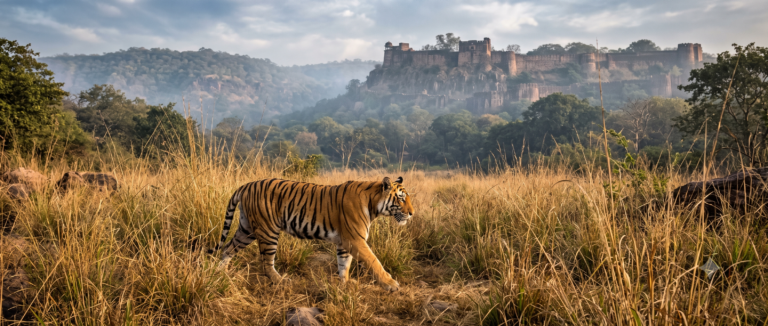
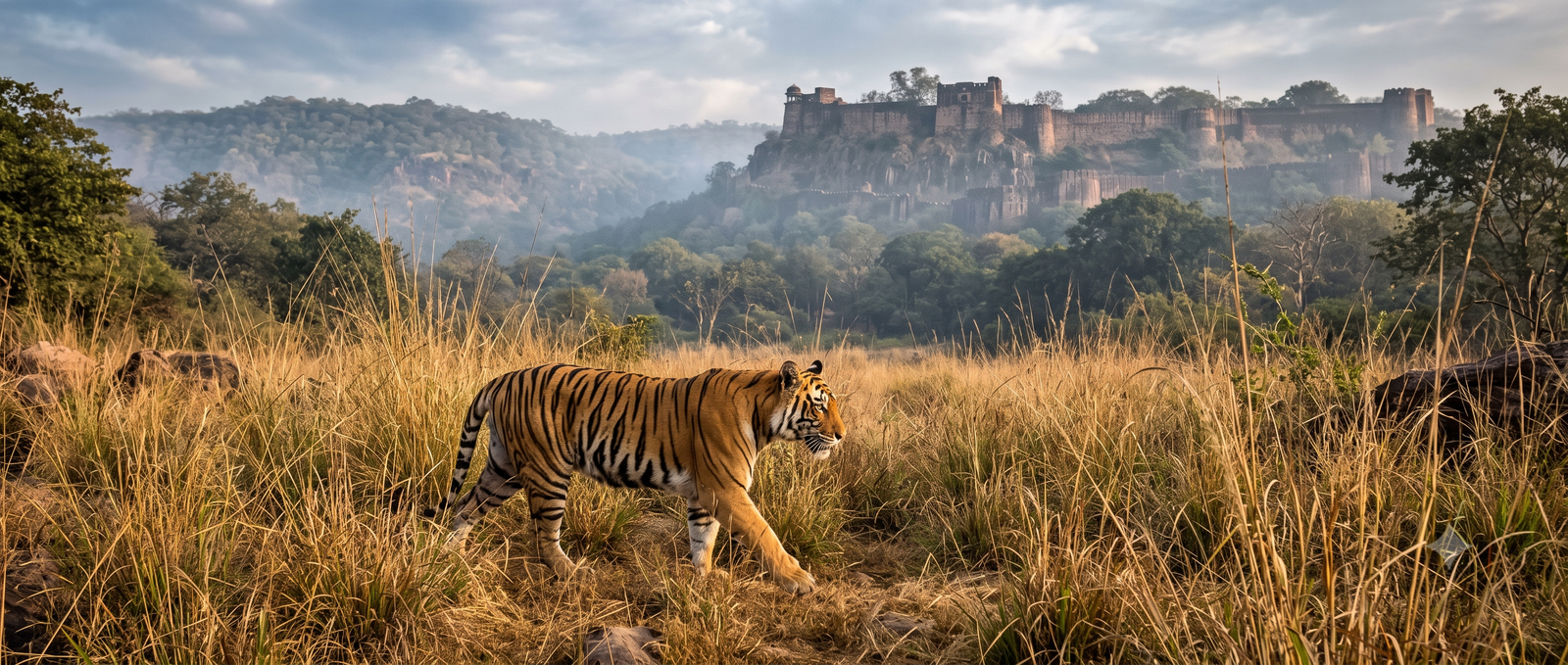
The Bengal tiger today roams reserves across a remarkable spread of habitats. Ranthambore National Park in Rajasthan, where tigers move against the dramatic backdrop of a medieval fort, offers some of the most iconic wildlife viewing in Asia. Bandhavgarh in Madhya Pradesh has the highest density of tigers of any reserve in India. And the Sundarbans, the largest mangrove forest in the world spanning the Bengal delta into Bangladesh, is home to tigers that swim between islands and have adapted to saltwater in a way no other tiger population on earth has managed. Each of these populations is genetically distinct, ecologically specific and irreplaceable.
The Last Asiatic Lions on Earth
While Africa has the lion that most of the world knows, Asia once had its own: the Asiatic lion, smaller than its African cousin, with a distinctive fold of skin along its belly and a mane that does not cover the ears as fully as African lions do. By the early 20th century, hunting had reduced the entire global population to fewer than 20 individuals in the Gir Forest of Gujarat. Twenty animals. The entire species balanced on a number so small that a single disease outbreak or a single bad monsoon season could have ended it entirely.
The recovery since then has been one of the most inspiring in wildlife conservation. According to the 16th Asiatic Lion Census, the population has increased by 70 percent over the last decade, reaching 891 lions across the Gir landscape. The African lion is extinct in 26 of 48 African countries. The Asiatic lion, which was far closer to extinction, now has a growing population. It exists in the wild exclusively in India, in one landscape in one state. The Gir Forest is not simply a wildlife reserve. It is the last address on earth for an entire species.
The One-Horned Rhino: A Northeast India Story
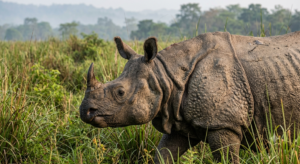
In the tall grasslands of Assam, where the Brahmaputra floods annually and the landscape shifts between terrestrial and aquatic with the seasons, lives the greater one-horned rhinoceros. At the start of the 20th century, poaching had reduced the global population to just 200 individuals. Today, thanks to strict conservation measures across Kaziranga National Park, Pobitora and Jaldapara, India is home to the largest population of this species in the world, approximately 3,260 individuals as of the most recent census, with 70 to 80 percent concentrated in Kaziranga.
Kaziranga is extraordinary in ways that go beyond the rhinos. A UNESCO World Heritage Site, it also holds one of the highest densities of tigers of any protected area in India, the largest population of wild water buffalo in the world and extraordinary bird populations that make it one of Asia’s most significant wetland habitats. The annual Brahmaputra floods, which most people would understand as a threat, are actually the ecological driver that keeps Kaziranga’s grasslands productive. The rhinos, tigers and elephants that live here have evolved to swim between islands of high ground when the waters rise. The flood is not a disaster. It is the habitat.
The Ghost of the Himalayas
High above the altitude where most things live, across the boulder-strewn slopes of Ladakh and Himachal Pradesh and Uttarakhand, the snow leopard exists at the edge of what the atmosphere allows. Called the Ghost of the Himalayas for the extreme difficulty of spotting it, the snow leopard is found across twelve countries in Central and South Asia, but India’s Himalayas, particularly the trans-Himalayan region of Ladakh, hold a significant portion of the global population. The snow leopard has the widest tail of any big cat, used for balance on rocky terrain and as a blanket against the cold. Its prey are blue sheep and ibex that live at altitudes of 3,000 to 5,500 metres. Everything about it is an adaptation to extremity.
The Hemis National Park in Ladakh, the largest national park in India by area, is one of the best places in the world to observe snow leopards, particularly in winter when prey animals descend from higher elevations. Even here, a sighting is never guaranteed. The ghost earns its name.
India is the only country in the world whose national river has its own national animal. The Gangetic river dolphin was declared the national aquatic animal of India in 2009, an acknowledgment of its ecological and cultural significance to the Ganga and Brahmaputra river systems it inhabits. Largely blind, navigating entirely by echolocation in the muddy waters of India’s great rivers, the Gangetic dolphin is one of the oldest dolphin species on earth and a direct indicator of river health. Where the dolphin thrives, the river is functioning. Where it disappears, something has gone wrong.
India’s wildlife conservation record is not without its complications, its contradictions and its ongoing battles between human and non-human claims on the same land. The human-wildlife conflict around tiger reserves and elephant corridors is real, complex and unresolved. But the recovery of the Bengal tiger from 1,827 to 3,682. The Asiatic lion from 20 to 891. The one-horned rhino from 200 to 3,260. These numbers represent something extraordinary: a country that chose, repeatedly and at significant cost, to share its land with the animals that had always lived there.
The forests are still standing. The animals are still there. That did not happen by accident!