
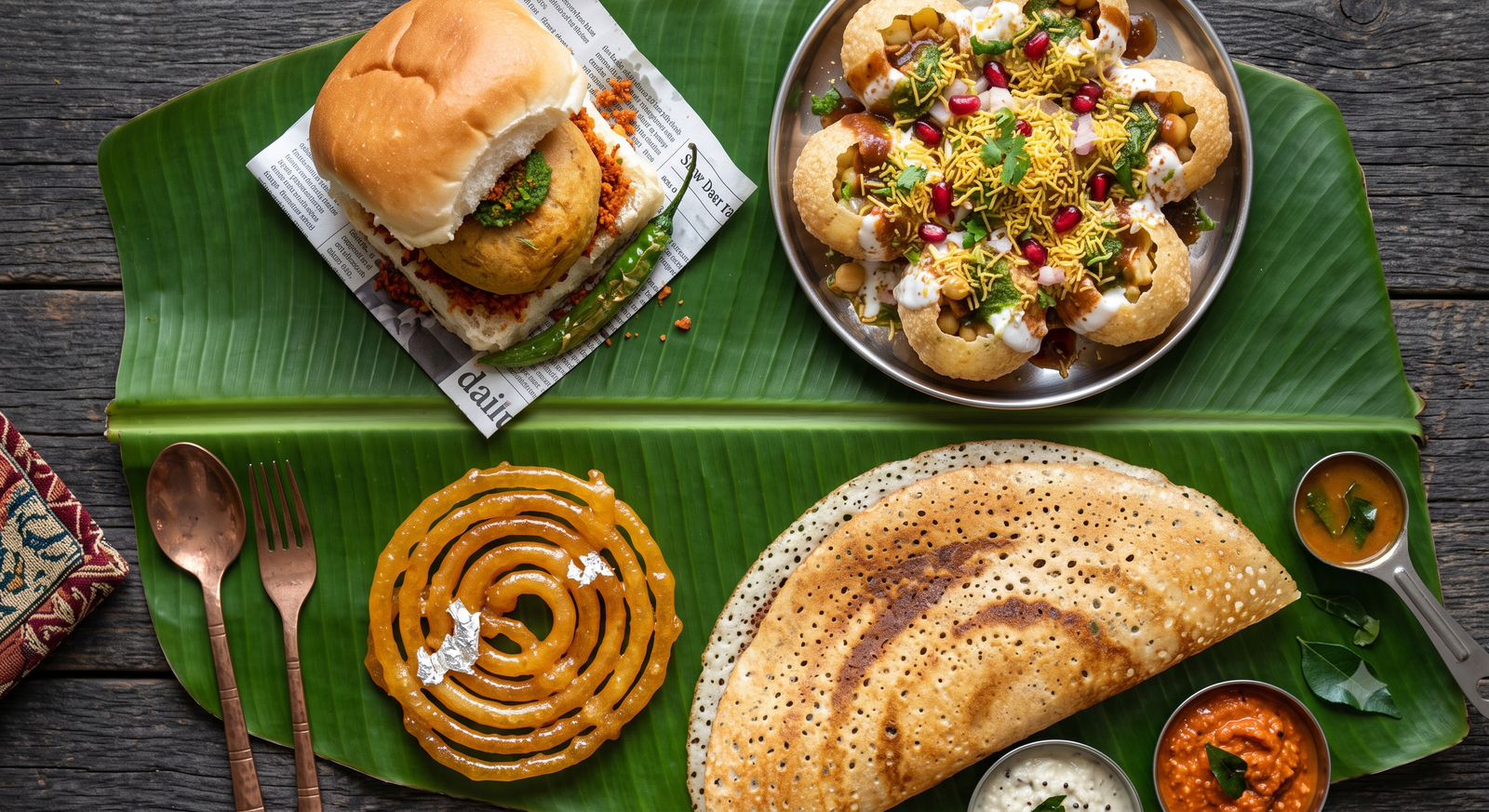
Before it was street food, it was royal medicine, a Mahabharata challenge and a mill worker’s lunch. The origin stories behind India’s most beloved snacks are genuinely extraordinary.
- Archaeological evidence places Indian street food culture as far back as 2000 BCE
- Chaat was reportedly invented by Emperor Shah Jahan’s physicians as a digestive remedy
- Pani puri folklore traces its origin to Draupadi’s kitchen challenge in the Mahabharata
- Vada pav was born outside Dadar station in the 1960s and became Mumbai’s identity
Indian street food history does not begin at a roadside stall. It begins in the Indus Valley Civilisation, where archaeological evidence from sites like Harappa and Mohenjo-daro suggests that food vendors were already selling quick, affordable meals to people going about their daily lives over four thousand years ago. The instinct to eat well, quickly, cheaply and communally is apparently ancient. India simply perfected it earlier than everyone else and never stopped. What is sold today from a cart in Chandni Chowk or outside a Mumbai railway station carries the genetic memory of a culinary tradition that has been running without interruption since the Bronze Age.
The story of Indian street food is also the story of India itself: its empires and trade routes, its migrations and fusions, its extraordinary capacity for taking ingredients from one corner of the world and making something entirely its own from them. Every puri, every jalebi, every perfectly balanced plate of chaat is carrying a history that most people eating it have never been told.
Chaat: Royal Medicine That Escaped the Palace
Chaat is believed to have been born in the kitchens of the Mughal Empire, specifically during the reign of Emperor Shah Jahan. The story goes that when Shah Jahan fell ill, his royal physicians prescribed light, spicy and tangy foods to aid his digestion. The combination of flavours they developed, sour, sweet, salty and spicy in deliberate balance, was so effective and so delicious that it did what all great food eventually does. It left the palace and went to the streets. Within a generation, what had been a medical prescription for an emperor was being sold from carts across Delhi to anyone who wanted it.
North Indian street food culture flourished around the bustling markets of Delhi and Punjab, where the region’s wheat-growing agriculture influenced the prevalence of bread-based snacks. Chaat adapted to every region it entered: aloo tikki in Delhi, dahi puri in Maharashtra, raj kachori in Rajasthan. Each version absorbed local ingredients and local sensibility while keeping the essential architecture of the original. A dish invented for a sick Mughal emperor is now eaten by hundreds of millions of people every day. That is a remarkable trajectory for something that started as medicine.
Pani Puri: Older Than Most Civilisations
The origin of pani puri reaches further back than the Mughals, into mythology itself. According to folklore, pani puri was invented by Draupadi, the wife of the Pandavas in the Mahabharata. When she was challenged to make a meal out of leftover food, she created the first pani puri, a dish that continues to thrive today. Whether taken literally or as the kind of cultural shorthand that attaches great things to great names, the story tells you something important: pani puri feels ancient because, in spirit at least, it is.
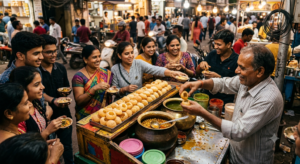
What makes pani puri so enduring is not its complexity. A hollow, crisp shell filled with spiced potato, chickpeas and tamarind water, eaten in a single bite, is about as simple as food gets. What makes it extraordinary is the balance. The crunch against the give of the filling. The heat against the tang of the water. The fact that eating six of them in a row at a street stall, with the vendor’s hand moving at a speed that defies comprehension, is one of the most communally joyful experiences Indian food offers. In Maharashtra it is pani puri. In Delhi it is golgappa. In Bengal it is phuchka. The name changes. The joy does not.
Vada Pav: Born Outside a Railway Station
Not every great Indian street food has an ancient origin. Some arrived recently and became essential immediately. Vada pav originated in the bustling streets of Mumbai. It was first conceived in the 1960s by Ashok Vaidya, a street vendor outside Dadar railway station, as a cheap and quick snack for busy commuters.
Vada pav combines the Portuguese-influenced pav, meaning bread, with the traditional Maharashtrian vada, which is a fried potato dumpling. This fusion represents how Indian street food continuously evolves while maintaining its authentic soul. The Portuguese brought the bread. Maharashtra already had the spiced potato. A vendor outside a railway station put them together and created something that would eventually be called the Indian burger, consumed by millions of Mumbaikars every single day, costing next to nothing and tasting like the city itself.
The fact that one of India’s most iconic foods is sixty years old and was invented by a specific person we can actually name is a useful reminder that culinary tradition is not always ancient. Sometimes it is just a very good idea that arrived at exactly the right moment, in exactly the right place, and refused to leave.
Dosa: The 1st Century CE Has Entered the Chat
Dosa, a crispy savoury pancake made from a fermented batter of rice and urad dal, is a South Indian delicacy with a history dating back to the 1st century CE, as mentioned in ancient Tamil literature. The fermentation technique used to make dosa batter is one of the oldest food science processes in the world, a natural leavening that improves both flavour and nutrition, developed and refined by South Indian cooks centuries before modern nutritional science caught up with what they already knew. The fermentation techniques used in these foods not only enhanced flavors but also improved nutritional value, a testament to the scientific approach of ancient Indian cooks.
Masala dosa, the version most people outside South India have encountered, was first created in Udupi, Karnataka. It travelled north, south and eventually around the world because a fermented rice and lentil crepe served with coconut chutney and sambar is, as it turns out, one of the best breakfast foods the human race has produced.
The vendors who sell these foods are carrying more than a cart. They are carrying the accumulated culinary intelligence of a civilisation that has been feeding itself brilliantly for four thousand years. When you know the history behind a dish, every bite becomes more meaningful. A plate of biryani becomes a tale of empires and migration. A dosa becomes a celebration of culinary ingenuity.
For the Indian diaspora across Dubai and the UAE, these foods are also memory. The taste of a good pani puri at an Indian restaurant in Bur Dubai or a plate of chaat in Karama is not just lunch. It is a direct connection to a street corner somewhere in India, a specific vendor, a specific temperature, a specific combination of flavours that the brain stores in the same place it stores everything else that matters. Food is how cultures survive migration. India’s street food is how India travels with its people wherever they go!