- India has over 2,000 surviving stepwells, most hiding in plain historical sight
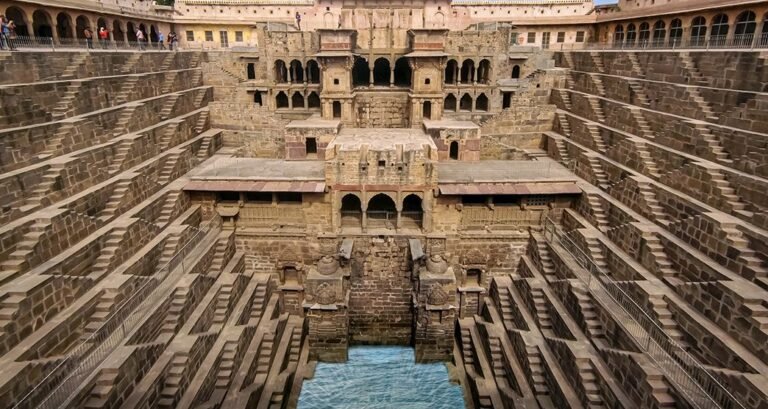
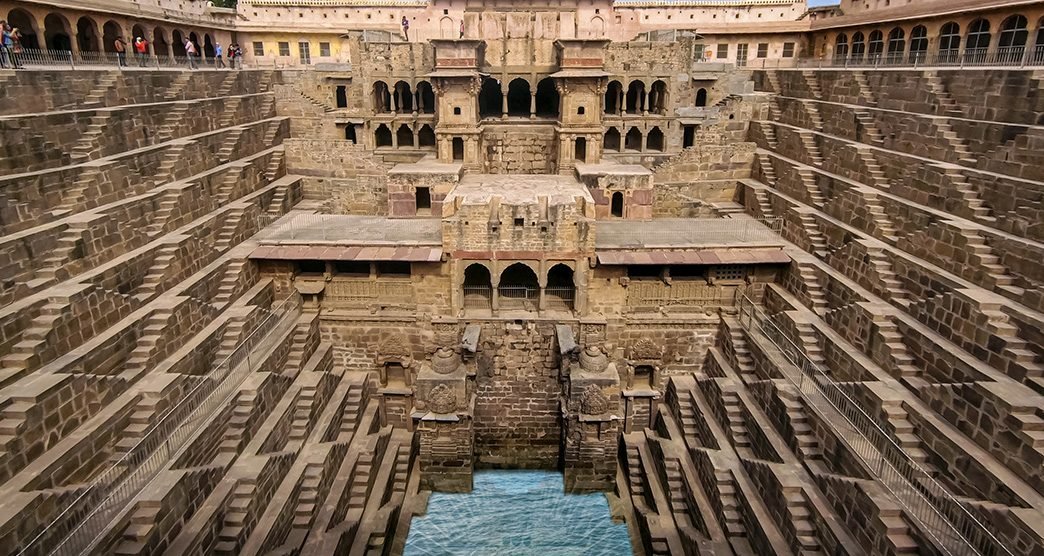
- Chand Baori in Rajasthan descends 30 metres across 13 floors and 3,500 steps
- Rani ki Vav is the only UNESCO World Heritage stepwell in India
- Adalaj’s tragic love story is as layered as its intricate stone carvings
Most people who have seen Chand Baori did not know what they were looking at the first time. You approach it through an unremarkable village entrance in Abhaneri, Rajasthan, past goats and dust and nothing particularly remarkable, and then suddenly the ground opens up. Thirteen floors. 3,500 steps. A geometric descent so precise and so symmetrical that it looks less like something built by human hands and more like something dreamed up by a mathematician who also happened to be a poet. It stops you cold. And then you find out it has been sitting there since the 9th century, and the disbelief doubles.
This is the thing about India’s stepwells. They are not obscure ruins tucked away in inaccessible places. They are hiding in villages, in the middle of cities, between a McDonald’s and a railway track in Ahmedabad. They are simply, bafflingly, not part of the conversation the way they should be.
Stepwells, known as vav or baori depending on the region, are wells or cisterns with a long corridor of steps descending to the water level. They played a defining role in subterranean architecture across western India from the 7th to the 19th century. They were built primarily as a response to climate: in the arid and semi-arid western regions of the country, including Gujarat, Rajasthan and parts of Maharashtra, precipitation is low, and stepwells served as crucial sources of water during summers and droughts. But calling them functional is like calling the Taj Mahal a tomb. Technically accurate, entirely insufficient.
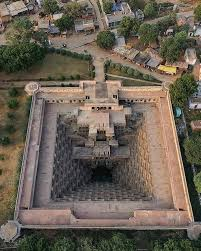
At their peak, stepwells were community infrastructure, social gathering spaces, pilgrimage rest stops, and architectural statements all at once. Rulers commissioned them the way they commissioned palaces. Craftsmen carved their walls with gods, dancers, mythological scenes and celestial figures. Ashokan inscriptions mention stepwells being built along major Indian roads every 20 miles or so for the convenience of travellers, suggesting a tradition that predates most of what we consider ancient history.
Built in the 9th century by King Chanda of the Nikumbha Dynasty, Chand Baori was constructed as a water source for the surrounding community and served as a social hub offering shelter from the desert heat. What resulted is one of the most visually astonishing structures on earth. Its 3,500 narrow steps are arranged in perfect symmetry, descending 20 metres to the bottom across 13 floors, making it India’s largest and deepest stepwell. The geometric precision is so exact that modern architects still study it with genuine bewilderment.
There is also the matter of the mythology. Locals insist Chand Baori was built in a single night by spirits. You can see why. No one looking at those cascading steps, that perfect diamond-pattern geometry, that play of light and shadow across the stone, can quite believe it was done by ordinary means. Film directors clearly agree: the scene in which Bruce Wayne escapes a subterranean prison in The Dark Knight Rises was shot here.
If Chand Baori is the one that makes your jaw drop, Rani ki Vav is the one that breaks your heart a little. Built in the 11th century by Queen Udayamati in memory of her husband King Bhima I of the Chaulukya dynasty, it is a masterpiece of proportion and devotion. The queen commissioned not just a well but a cathedral underground, measuring 65 metres long, 20 metres wide and 28 metres deep, adorned with over 500 principal sculptures and more than a thousand smaller ones.
Its seven levels are filled with detailed carvings of gods, goddesses, apsaras and scenes from Hindu mythology, showcasing engineering techniques so advanced that the structure ensured water availability even during drought conditions. Then, at some point, the Saraswati River flooded and buried it entirely. It sat underground, perfectly preserved, for centuries. The present incarnation of Rani ki Vav is the result of more than 50 years of excavations and restorations, and today it stands as the only UNESCO World Heritage stepwell in India. The sculptures emerged from the earth almost entirely intact. The flood that buried it was also, in a strange way, what saved it.

The Adalaj stepwell in Gujarat operates on an entirely different emotional frequency. Built by Queen Rudabai in memory of her husband, legend says she took her own life after its completion due to the political turmoil that surrounded it. The story goes that after her husband was killed in battle, the conquering king agreed to complete the stepwell on the condition that she marry him. She agreed, the well was finished, and she jumped into it.
Whether entirely true or shaped by centuries of retelling, the legend colours every visit to Adalaj. The stepwell bears five floors and a labyrinth of intricately carved rooms, passages and halls, blending Muslim and Hindu architectural traditions in a way that feels less like a compromise and more like a conversation. Its central octagonal space with balconies and staircases, intricate motifs of flowers, birds and fish, and the design that ensures sunlight reaches the lowest levels make it as functional as it is achingly beautiful.
According to estimates, there are about 2,000 stepwells surviving in India today, only a fraction of what once existed. Many are unmaintained. Many are unknown outside the villages they sit in. And yet they represent one of the most original and enduring contributions India made to the architecture of the ancient world. A solution to scarcity that became an art form. Infrastructure that became a monument. Utility that became devotion.
The stepwells were never trying to be famous. They were trying to sustain life. That they are also staggeringly, irreducibly beautiful is almost incidental. Almost!