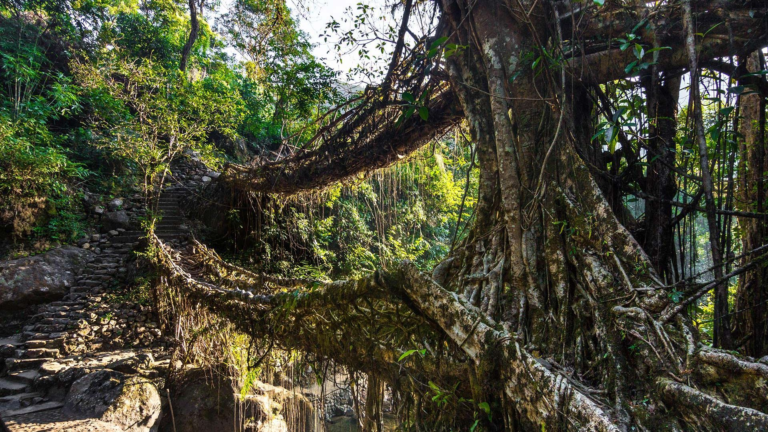
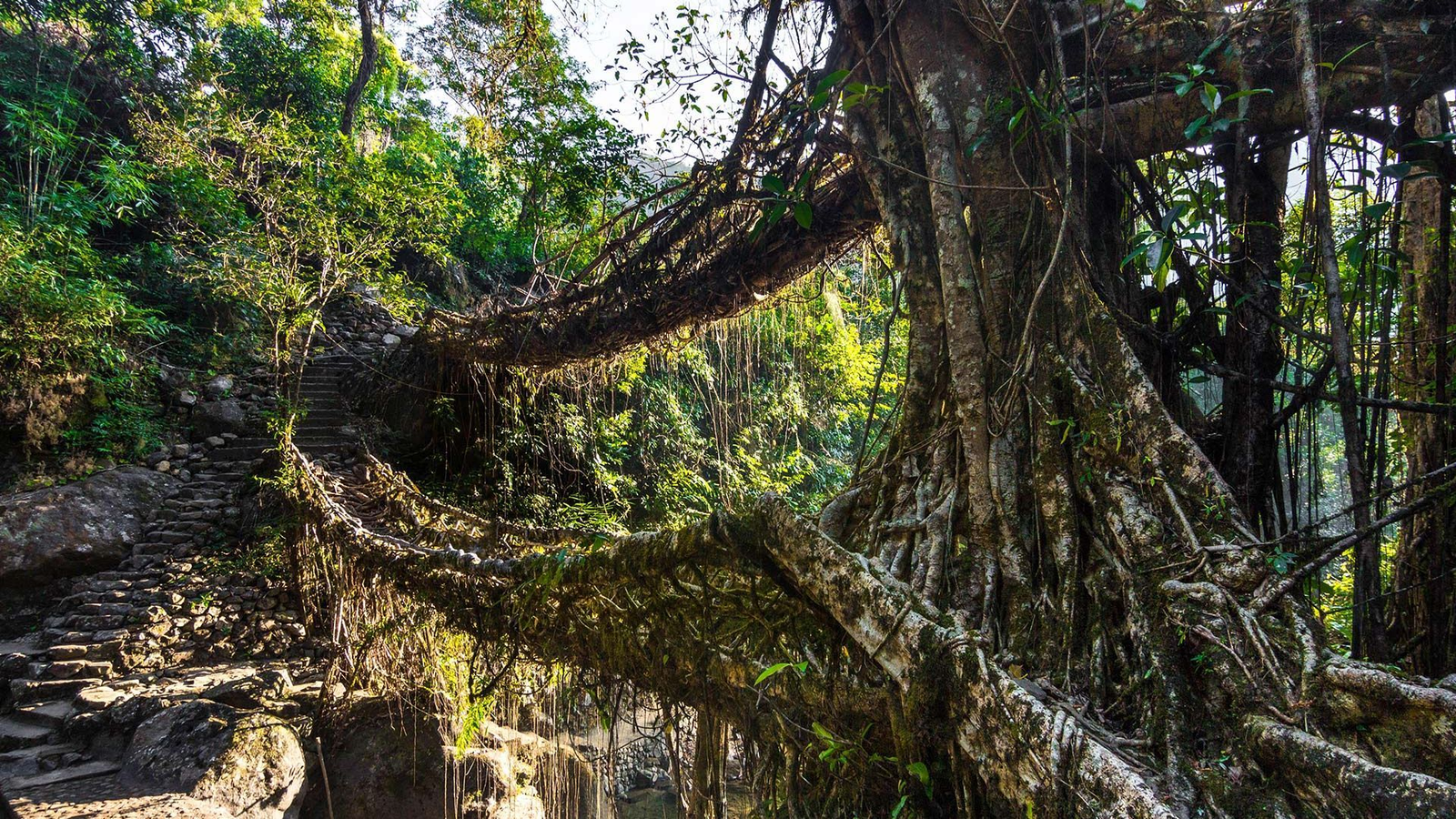
- The Khasi tribe of Meghalaya has been growing living bridges for over 200 years.
- Each bridge takes between 15 and 30 years to grow strong enough to cross safely.
- Some living root bridges are over 500 years old and still in active daily use.
- The Living Root Bridges are now on UNESCO’s tentative World Heritage Site list.
There is a place in northeastern India where bridges are not built. They are grown. In the southern Khasi hills of Meghalaya, a state that experiences the heaviest rainfall in the world for more than six months of the year, a conventional bamboo or wood bridge would be washed away almost as quickly as it was erected. So the Khasi people did something that no other civilization on earth has done in quite the same way. They looked at the rubber fig trees growing along their riverbanks, studied the behaviour of their long, pliable aerial roots, and decided to build their bridges from something that would not just survive the floods but grow stronger because of them. Long before the availability of modern construction materials, the Khasi devised an ingenious way to traverse the turbulent waterways and link isolated villages: living root bridges, locally known as jing kieng jri. Some of those bridges are still standing and still in daily use today, over five centuries later.
Grown by indigenous Khasi tribes over a time period of 15 to 30 years, these bridges range in span from 15 feet to 250 feet and last for several centuries. The process begins with planting Ficus elastica trees, the Indian rubber fig, on both banks of a river or stream. Young aerial roots are then threaded through hollow areca palm trunks that act as guidance channels, directing the roots slowly across the water toward the opposite bank. A temporary bamboo scaffold supports the structure during the early years. The indigenous builders harnessed the raw materials of their natural environment and started building structures across streams and inhospitable terrain, creating a living architecture found nowhere else on earth in terms of its application and philosophy. Over time, as more roots are woven in and the humidity, foot traffic, and weight of crossing villagers compact the soil and strengthen the structure, the bamboo scaffold becomes unnecessary and is removed entirely. What remains is a bridge that breathes, that grows, and that becomes more resilient with every passing year. Unlike modern building materials like concrete and steel, these structures typically become more resilient with age and can survive centuries, regularly withstanding flash flooding and storm surges that are common in the region.
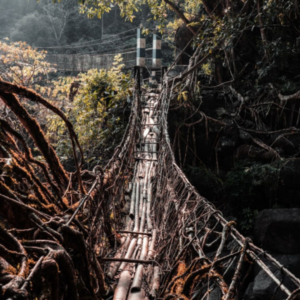
As per indigenous belief, only an elder who has no children can plant the Ficus sapling for a living root bridge, interpreted as a profound act of giving and merging with mother nature, known as meiramew in the Khasi language. This single detail captures everything that makes the living root bridge tradition so extraordinary. The person who plants the sapling will never cross the finished bridge. They plant it for their grandchildren, or their great-grandchildren, or for people they will never meet. It is an act of pure, intergenerational generosity, rooted literally and figuratively in the belief that what you build for the future matters more than what you enjoy in the present. Living root bridges epitomize the sustainable lifestyle and culture of the Khasis that acknowledges the interdependence and interconnectedness of all life, reflected in their reverence toward nature, from sacred groves where extraction of natural resources is prohibited to allow natural regeneration, to a deeply ingrained community ethic of collective responsibility.
In March 2022, the Living Root Bridge Cultural Landscapes of Meghalaya were included in the tentative list of UNESCO World Heritage Sites, a recognition that feels long overdue for structures that have been performing as critical infrastructure for centuries without a single nail, a single beam of steel, or a single drop of concrete. There are 72 bridges and other living root structures in the Indian state of Meghalaya, some of which date back 500 years, with the most famous being the double-decker bridge in Nongriat village, a two-storey living root bridge that draws visitors from every corner of the world and still manages to feel like a secret when you finally stand on it. The longest known example, near the town of Pynursla, stretches over 50 metres above the ground. It was planted by someone who knew they would never see it finished. Every year, thousands of people from all over the world come to witness this unique amalgamation of human ingenuity and nature, and through tourism, the tradition is slowly finding new reasons to survive in a world that increasingly reaches for the faster, easier answer.
In Meghalaya right now, somewhere in the East Khasi Hills, a young root is being threaded through a hollow palm trunk across a stream. It will take twenty years to reach the other side. The person doing the threading knows this and does it anyway. That patience, that generosity toward a future they won’t fully see, is perhaps the most important thing India’s living bridges have ever taught the world!