They carried salt across empires, embroidered entire histories into their clothing and followed the same mountain routes for a thousand years. India’s nomadic tribes are still moving.
- The Banjara tribe supplied salt and grain to Mughal armies and fed entire empires on the move
- Banjara embroidery uses mirrors, coins and shells to record genealogy and community history
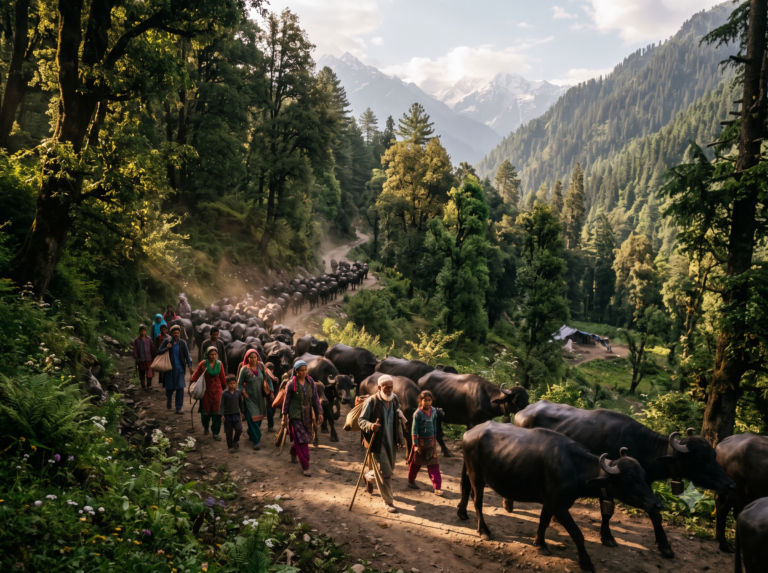
- Van Gujjars migrate vertically between the Himalayan foothills and high alpine meadows twice yearly
- Banjara migration routes extended from Rajasthan through the Middle East into Europe
Nomadic tribes in India do not travel without direction. They travel without stopping. The Banjara community, also known as Lambani or Gor, have been moving across the Indian subcontinent for centuries along routes so deeply established that they constitute their own invisible geography, a map written not in ink but in the memory of communities who have walked the same paths for a thousand years. They carried salt. They carried grain. They carried bamboo and firewood and every essential commodity that a pre-modern economy needed moved from one place to another before roads existed and after roads were built but before trucks arrived. An army without Banjaras was an army that could not eat. The Mughal Empire fed on Banjara logistics. So did the armies of the Maratha Confederacy, the Nizams and the British East India Company. They were the supply chain of the ancient world, and they built an entire culture around the act of keeping everything moving.
The Banjaras are believed to have originated from the Rajputana region of northwest India. Their history is steeped in nomadism and the life of traders and transporters, and this mobility has led to a cultural amalgamation evident in their customs, language and artistic expressions. Banjaras speak Gor Boli, also known as Lambadi, a mix of Rajasthani and Gujarati with influence from whatever local dialect surrounded them in a given season. It is a language shaped by movement, borrowing words from every community the Banjaras passed through across centuries of continuous travel.
The Embroidery That Carries the History
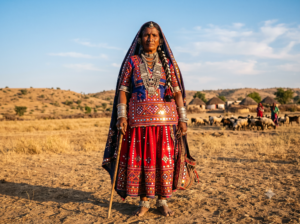
One of the most striking aspects of Banjara culture is what the women wear and what it records. Banjara embroidery includes vibrant thread work accented with mirrors, coins, shells and intricate beadwork, and it is not decorative in the sense of being arbitrary or aesthetic. Every element is coded. The mirrors ward off the evil eye. The coins record wealth and lineage. The specific patterns indicate which Tanda, the community group, a woman belongs to, and where her family has travelled. What appears to the outsider as extraordinarily beautiful textile work is, to the community that created it, a visual biography, a community archive worn on the body.
This style, known as Lambani craft, has gained recognition and appreciation on a global scale, with initiatives working to preserve and promote these craft traditions through skill development programs and market access. Fashion houses from Europe and Japan have drawn on Banjara embroidery for decades, often without attribution or compensation, a pattern familiar from the history of craft knowledge extracted from tribal communities globally. The recent recognition of Lambani craft by UNESCO and its inclusion in craft heritage programmes has begun to shift that dynamic, slowly, toward something more equitable.
The Rabari of Gujarat: Embroiderers and Herders
In Gujarat and Rajasthan, the Rabari community represents a different but equally vivid strand of India’s nomadic heritage. Traditionally cattle herders closely associated with Gujarati culture, the Rabari people have a unique and deeply rooted set of traditions they have maintained across centuries of pastoral movement. Rabari women are particularly celebrated for their white hand-embroidered blouses decorated with intricate geometric patterns, mirror work and silver jewellery so heavy it constitutes a visible record of the family’s accumulated wealth.
Rabari men traditionally managed the movement of livestock across vast distances, following seasonal routes that took them from the Rann of Kutch in winter to the hills of Rajasthan in summer. The knowledge required to manage these routes, to know which grazing grounds would be ready in which month, to navigate hundreds of kilometres across terrain with a herd of cattle, was passed from father to son across generations without ever being written down. It exists entirely as embodied knowledge, carried in the people who hold it and vulnerable to extinction if the tradition that transmits it ceases to function.
The Van Gujjars: Between the Plains and the Sky
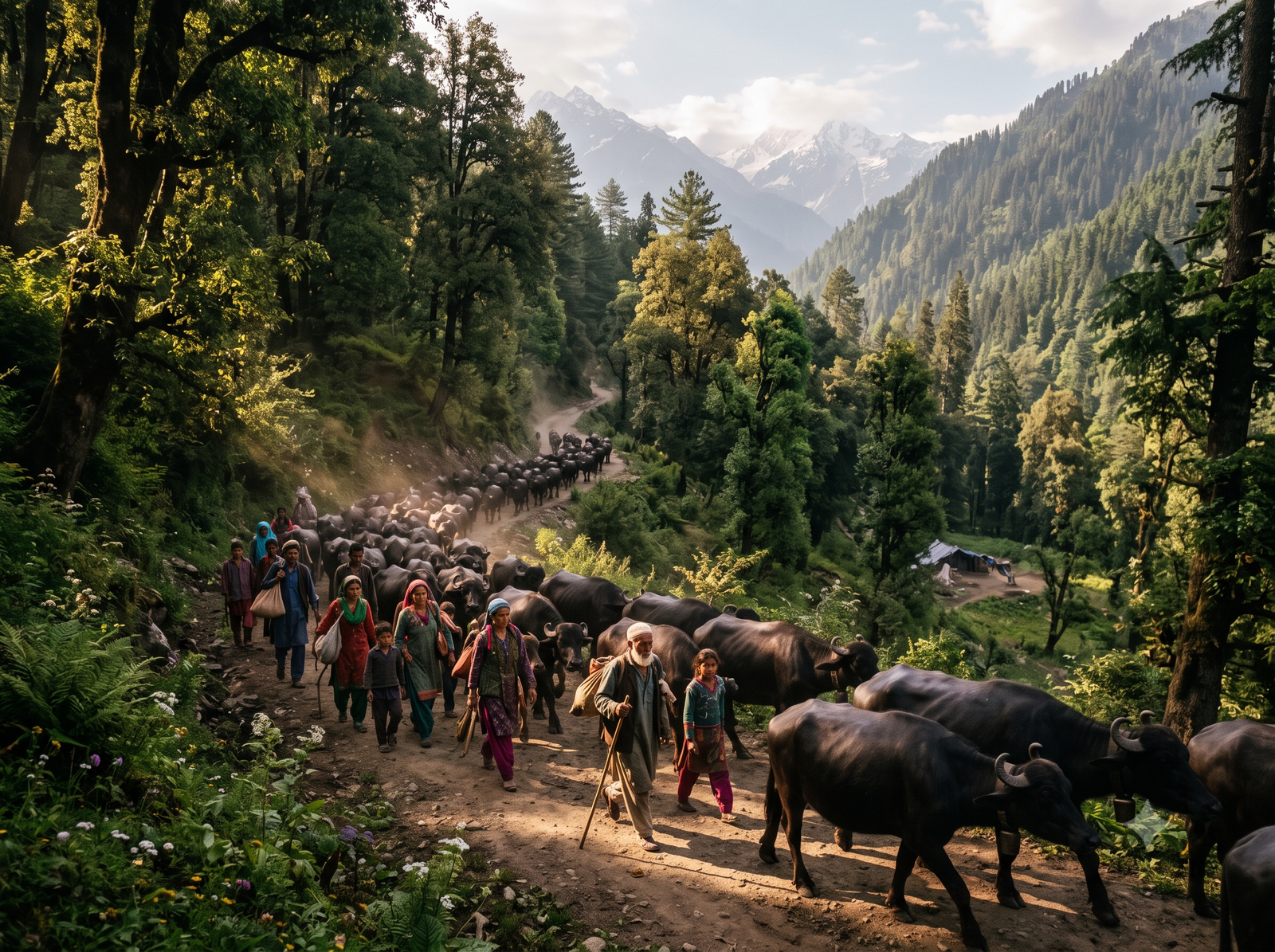
In the Himalayan foothills of Uttarakhand and Himachal Pradesh, the Van Gujjars practice a form of nomadism that operates on a vertical axis rather than a horizontal one. Twice a year, the entire community migrates: downward to the foothills as winter approaches and the high alpine meadows disappear under snow, and upward again as spring opens the mountain passes and the high grasslands bloom. This practice of seasonal vertical migration is known as transhumance and it is one of the oldest forms of land use in the world, a way of following the grass and the season without ever exhausting either.
The Van Gujjars live primarily in the forests, moving their buffalo herds between seasonal grazing grounds in the high Himalayas and the plains below. They have traditional grazing rights in the forests that predate the formal forest laws of the colonial period and the independent Indian state, and the conflict between those traditional rights and the legal structures of modern conservation has made the Van Gujjar community one of the most politically contested in India’s tribal landscape. The Jim Corbett and Rajaji national parks that now cover significant portions of their traditional migration routes have complicated the community’s relationship with the state in ways that are still being negotiated.
The Road to the Arab World and Beyond
The Banjara story has a particular resonance for the UAE audience that is worth stating directly. Banjara migration routes, originating in Rajputana in northwest India, extended over time through the Middle East, North Africa, Europe, Russia and Spain. Scholars studying the origin of the Romani people of Europe, the communities historically known in the west as gypsies, have traced genetic, linguistic and cultural connections back to communities of northwestern India, and the Banjara are among the communities most consistently identified in that research. The Romani Gypsies, Lambanis and Banjara share common anthropological characteristics and historical features, a common fraternity that spans continents.
For the Indian diaspora in Dubai, where the experience of leaving home and building a life in a new geography is the shared condition of most people in the city, the Banjara story is not simply historical. It is the story of what happens to culture and identity when a community is always moving, always adapting, always absorbing something new while holding onto something old. The embroidery survives. The language survives. The routes survive in memory even when they have been legally closed. The Banjara never stopped moving. They simply changed what moving meant!