From a Mughal emperor’s favourite shopping lane to the world’s only market run entirely by women for 400 years, India’s ancient bazaars are anything but ordinary.
- Ima Keithel in Manipur is the world’s only all-women’s market, running for over 400 years
- Chandni Chowk in Delhi was personally designed by Mughal Emperor Shah Jahan in 1650
- India’s haat tradition of weekly rural markets predates recorded history by centuries
- Laad Bazaar in Hyderabad was built for a royal wedding and never stopped trading
Ancient bazaars in India are not museum pieces. They are open tomorrow morning. The same lanes where Mughal emperors sent their daughters to shop, where Portuguese traders nervously negotiated spice prices, where women have run every single stall for four hundred uninterrupted years, are still functioning, still crowded, still selling things that have been sold in that exact spot for longer than most countries have existed. India did not build monuments to commerce. It built commerce so enduring it became a monument by default.
The haat is where the story begins. A haat was a small market set up for a few hours or a day in a village or town, held on a particular day of the week, where local vendors would travel to offer their wares. Haats played a crucial role in promoting local trade and commerce across rural India for centuries before any formal economy existed. They were not organised by governments or guilds. They were organised by the rhythm of community life, the understanding that on Tuesday morning the market would be here, and on Thursday it would be there, and everyone within walking distance would come. The haat tradition traces back to a pre-agrarian era and still operates across rural India today, with tribal haats in Jharkhand and Chhattisgarh functioning as social gatherings, cultural exchanges and economic lifelines simultaneously. India invented the weekly market and never stopped running it.
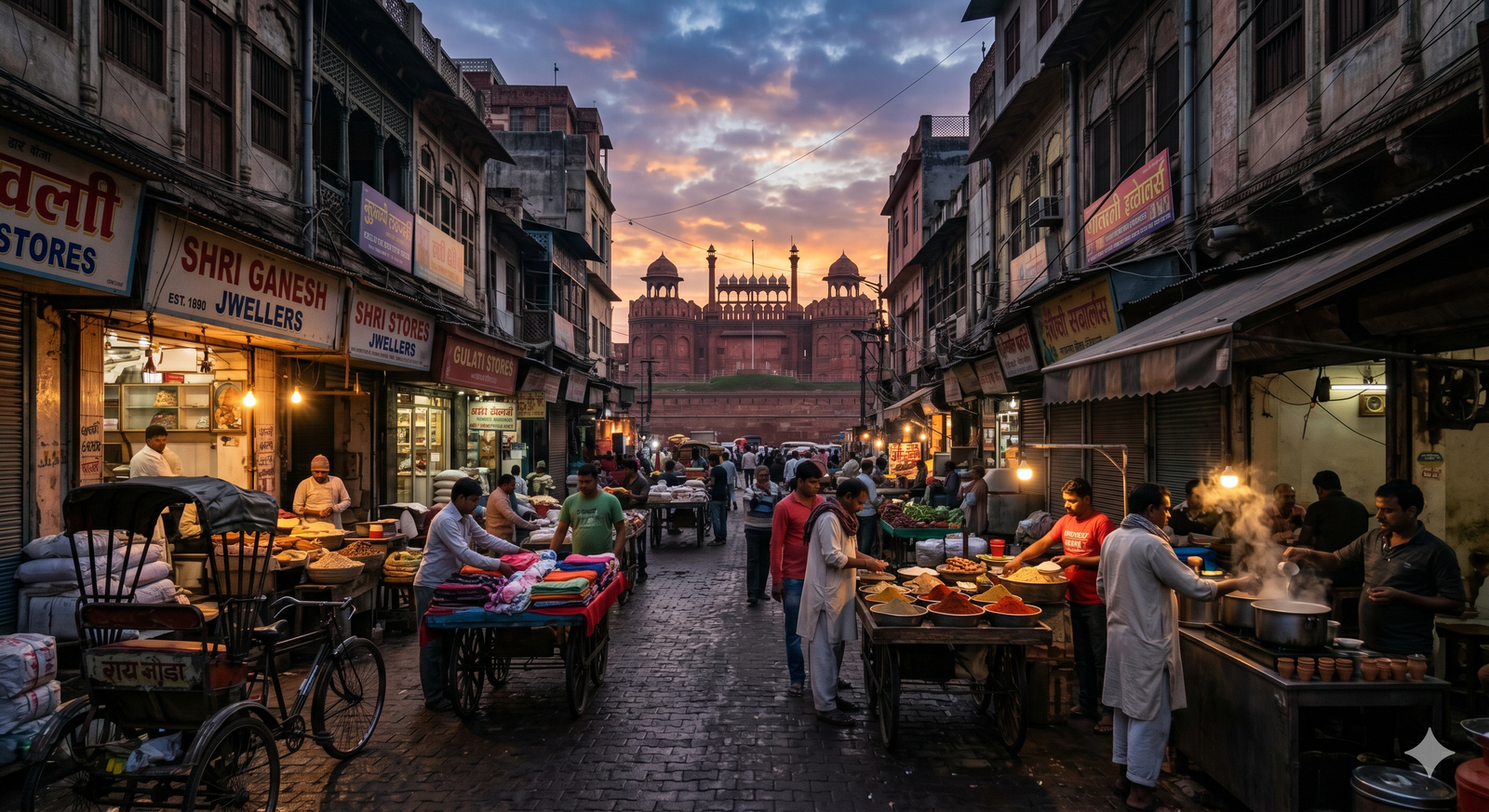
Chandni Chowk in Delhi was established during the reign of Mughal Emperor Shah Jahan in the 17th century. Shah Jahan did not simply commission a market. He designed it as an extension of the Red Fort, with a canal running down its centre that reflected the moonlight, which is what gave it its name. Chandni means moonlight. Chowk means square. The moonlight square. It was a favourite of Emperor Jahangir and his daughter Jahanara, who was reportedly involved in its planning, making it one of the earliest recorded examples of a woman shaping urban commercial infrastructure in India.
Today Chandni Chowk is still one of the most densely packed commercial areas in the world. The same lanes that once sold silks to Mughal nobility now sell wedding jewellery, street food, spices, electronics and textiles in a layered, chaotic, completely irresistible concentration of commerce that has never paused for a single day in over three centuries. The buildings have changed. The crowds have not. The noise has not. The extraordinary sense that everything the world needs is available somewhere in these lanes has absolutely not.
Laad Bazaar in Hyderabad emerged during the Qutb Shahi period and thrived under the Nizams, becoming synonymous with Hyderabadi bridal culture. The name Laad refers to lacquer, the material used to craft the dazzling bangles the bazaar is most famous for. The legends around its origin are suitably dramatic: one story attributes it to the sixth Nizam’s wife, another to a general of the Golconda army, and another still to a colonial-era corruption of “Lord Bazaar” into something the locals could actually say. Whatever the true beginning, the result is a 400-year-old bazaar built beside the Charminar that sells lacquer bangles studded with stones, pearl jewellery, embroidered wedding sarees and traditional Hyderabadi perfumes called ittar, in shops so crammed and colourful that walking through feels like being absorbed into the city’s history rather than simply visiting it.
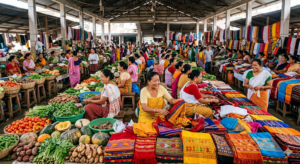
Of all India’s ancient markets, none is more extraordinary than Ima Keithel in Imphal, Manipur. Ima Keithel, meaning “Mother’s Market” in Manipuri, is a historic institution dating back over 400 years and is celebrated as the world’s only all-women’s market. Every stall is owned and operated exclusively by women, with men forbidden by custom from setting up shop here.
This is not a recent policy or a modern statement. It is a tradition that has operated continuously for four centuries, rooted in the matrilineal social structure of the Meitei community where women have always held significant economic authority. The market sells everything from fresh produce, fish and the famous Morok chilli to traditional Manipuri handloom fabrics, handicrafts and household goods, all in two large buildings in the heart of Imphal where thousands of women traders show up every single day. During conflicts, occupations and political upheavals across Manipur’s complex history, Ima Keithel kept operating. The women kept trading. The market never closed.
It is also, separately from all its historical significance, simply one of the most vibrant and extraordinary places to visit in Northeast India, a region that the rest of the country and the world still dramatically underestimates.
India’s ancient bazaars were never only about buying and selling. They were where communities formed opinions, where news travelled before newspapers, where different castes and religions negotiated a shared public life across stalls and lanes and the shared language of commerce. More than mere marketplaces, traditional Indian bazaars are custodians of art, craft and culinary heritage. The craft knowledge embedded in Laad Bazaar’s lacquer work, the zari tradition of Bhendi Bazaar in Mumbai, the gemstone specialisation of Johari Bazaar in Jaipur, these are not simply things you can buy. They are things you can only find here, made by families who have made them for generations, in buildings that have housed this trade for centuries.
The bazaar is still open. It has always been open. Walk in!