India built the world’s oldest conservation system without a single government policy. It used gods instead.
- India has between 100,000 and 150,000 sacred groves still surviving today
- Each grove is protected by community faith, taboos and ancestral tradition
- Sacred groves exist across every Indian state under dozens of local names
- Villages with sacred groves show better soil health and groundwater retention
Sacred groves India has quietly preserved for thousands of years are among the most extraordinary examples of human wisdom on the planet. Long before conservation became a policy, before environmental law existed, before words like biodiversity and ecosystem services entered any dictionary, communities across the Indian subcontinent were protecting patches of forest the only way they knew how. They made them holy. And it worked.
The existence of sacred groves in India most likely dates back to a pre-agrarian hunter-gathering era, and their presence has been documented since the early 1800s. Communities believed trees to be the abode of gods and ancestral spirits, and set aside sanctified areas of forest with rules and customs to ensure their protection. These rules often prohibited the felling of trees, the collection of any material from the forest floor and the killing of animals. The forest belonged to the deity. And because it belonged to the deity, no human hand would touch it.
India’s sacred groves are known by several names across different states: kavu in Kerala, devaravana in Karnataka, dev van in Himachal Pradesh, devrai in Maharashtra, ki law lyngdoh in Meghalaya, vanis in Rajasthan and kovilkadu in Tamil Nadu. The names change from region to region, but the intention never does. The dev vans of Himachal, the orans of the Thar desert, the Mawphalang of Meghalaya and the sarpa kavu of Kerala all stand as evidence of ancient traditions that spread to every corner of the subcontinent. Each grove carries its own mythology. Each community holds its own stories of what happened to those who defied the rules. And inside those stories is encoded a very practical ecological truth that modern science is still catching up to.
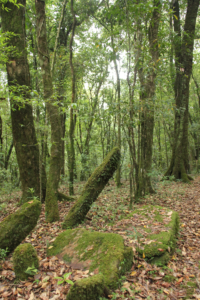
The kavus of Kerala are among the most celebrated. Dense green pockets tucked behind temples and village shrines, they are home to some of the highest concentrations of endemic plant species in South Asia, precisely because they have never been cleared or disturbed. The kavus of Kerala also serve as major centres of the ritualistic art form of Theyyam, the magnificent masked deity performances that draw thousands of devotees each year. The grove is not just an ecological reserve. It is a stage, a temple and a living archive of community identity all at once.
In Meghalaya, the Khasi and Jaintia tribes maintain hundreds of sacred forests they call Law Kyntang, which translates as forest of the gods. Entry is permitted but rules are absolute. Nothing leaves the grove. Not a leaf, not a stone, not a fallen branch. For tribal communities of the Northeast, the forest is both church and god, and that relationship has preserved biodiversity that formal conservation infrastructure is still struggling to replicate.
The results are measurable and striking. Studies by the Indian Institute of Forest Management show that villages with sacred groves had better soil health, groundwater retention and even better resilience to crop failures. The communities that established these groves were not simply performing religious duty. Without knowing the language of modern ecology, they were managing their own water security, their own agricultural stability and their own long-term survival.
Around 14,000 sacred groves have been formally reported across India, though estimates of the actual number range as high as 100,000 to 150,000. Each one is a pocket of original India, maintained not by a government body but by belief, by story and by the quiet, inherited understanding that some things are not ours to take.
India figured out conservation thousands of years before conservation was a word. It just called it something else. It called it faith.