
A god drinks poison to save the universe. The monsoon arrives. Millions walk barefoot across North India carrying river water on their shoulders. Sawan is not a month. It is a state of being.
- Sawan 2026 begins on July 30 and ends on August 28, the holiest month for Shiva devotees
- The Kanwar Yatra draws over 12 million pilgrims walking barefoot to Shiva temples annually
- Every Monday of Sawan is considered especially sacred and is observed with fasting
- The month contains Raksha Bandhan, Nag Panchami, Hariyali Teej and Janmashtami within it
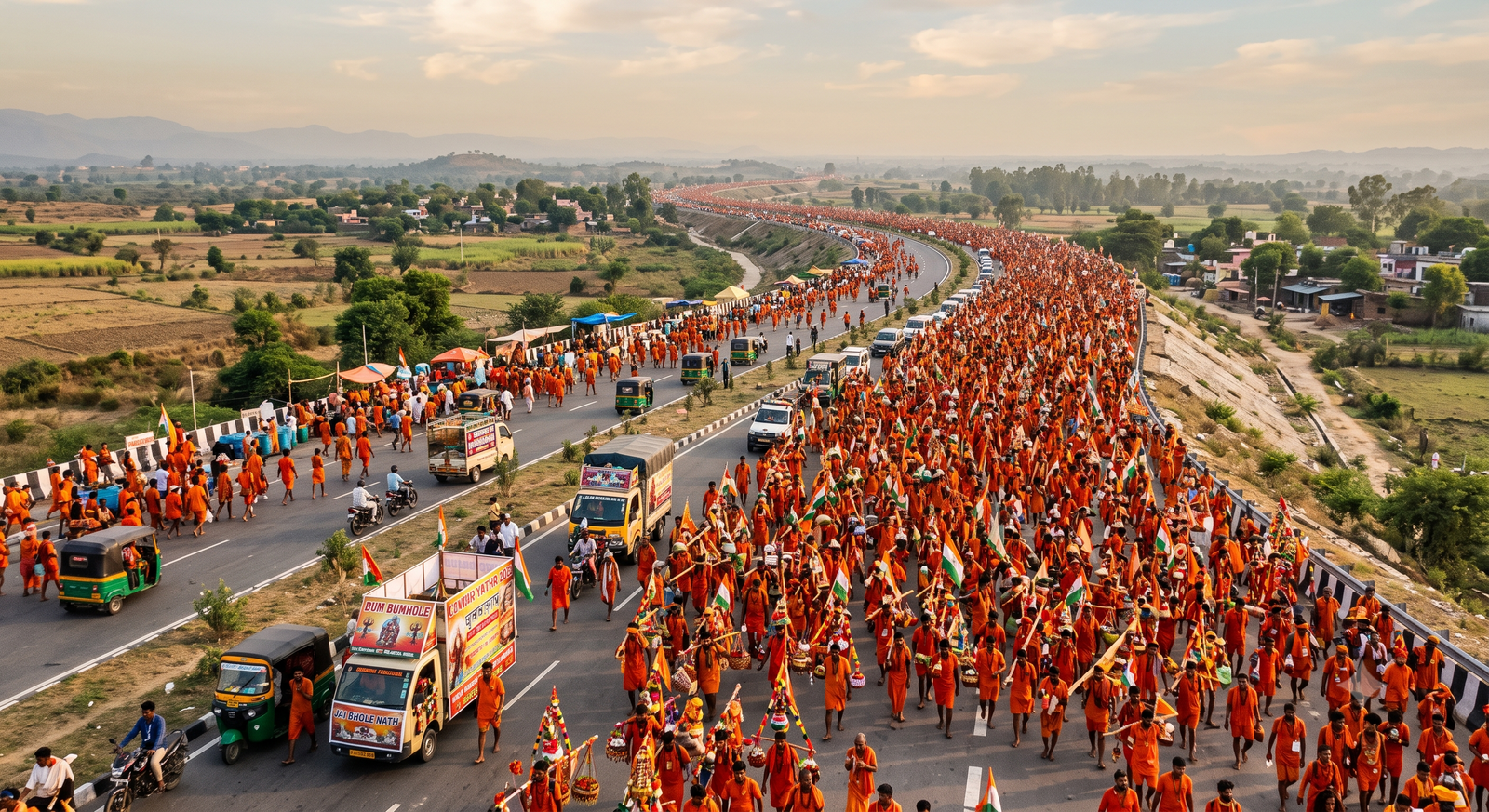
Sawan month in India begins on July 30 this year, and if you have ever been in North India during this season you already know what that means. The highways turn orange with saffron-clad pilgrims walking hundreds of kilometres on bare feet. Temple queues stretch around entire city blocks before dawn every Monday. The smell of fresh bael leaves and milk offerings fills every neighbourhood with a Shiva temple in it. The rain comes down, the earth turns green, and a country of over a billion people shifts into a state of collective devotion that has no real equivalent anywhere else in the world. Sawan is the fifth month of the Hindu lunar calendar and the most sacred. It has been observed this way for thousands of years. The story of why begins, as so many important Indian stories do, with a catastrophe that only one person was willing to absorb.
According to Hindu beliefs, during the cosmic churning of the milky ocean, known as Samudra Manthan, numerous divine and celestial objects were obtained. One of the elements that emerged was the poison called Halahal. To protect the universe from its destructive power, Lord Shiva drank it. However, his consort Goddess Parvati pressed his throat to prevent the poison from reaching his stomach, turning his throat blue. This event bestowed Lord Shiva with the name Neelkanth, meaning the one with a blue throat.
This supreme act of sacrifice happened during the month of Shravan. Out of gratitude and reverence, devotees dedicate this entire month to worshipping Shiva. The continuous monsoon rains during this period are seen as nature’s own abhishek, which is the sacred bathing of the earth, mirroring how devotees pour water and milk over Shivlings throughout Sawan month. The ritual and the rain are the same gesture. Nature and devotion completing each other.
According to Shivapurana, this is also the time when Shivaji married Goddess Parvati. In Vishnupurana, both these incidents explain the significance of this month and the values of sacrifice, devotion and spirituality as the foundation of Sawan. Two cosmic events, one month. The blue-throated god who saved creation and the divine marriage that restored it. Sawan carries both.
The Kanwar Yatra is an annual pilgrimage undertaken by Lord Shiva devotees during Shravan Maas in North India. Devotees collect Gangajal, which is water from the holy river Ganges, from Hindu pilgrimage places such as Haridwar, Gaumukh and Gangotri and carry it in pots on foot to major Shiva temples by walking hundreds of miles along with chants of Jai Bhole and Jai Shiv Shambhu. On reaching, they offer the water to the Shivling in the temple as Jal abhishekam.
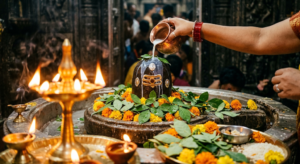
Millions of pilgrims called Kanwariyas travel on foot to sacred rivers like the Ganga in Haridwar, collect holy water in decorated vessels called kanwar, and carry it back to pour over the Shivlinga at their local temple. Some Kanwariyas walk hundreds of kilometres. They sleep on the roadside. They carry their kanwar without letting it touch the ground. And they do it all in orange, barefoot, chanting Shiva’s name.
The tradition of the Kanwar Yatra is believed to have been started by Shravan Kumar, who brought Ganga water from Haridwar to his blind parents in the Himalayas. This act of devotion is still observed today by millions of devotees. The yatra has grown year after year into one of the largest annual religious gatherings anywhere on earth, with an estimated 12 million participants. The highways of Uttar Pradesh, Uttarakhand, Bihar and Haryana become rivers of orange every July, communities along the route competing to offer the best food, rest and hospitality to pilgrims passing through. The spirit of the yatra is not just individual devotion. It is radical collective generosity.
Mondays are inherently connected to Lord Shiva, as Som refers to the moon adorning his head. During Sawan, this connection intensifies exponentially. Observing fasts on Sawan Mondays is believed to bring removal of obstacles in personal and professional life and fulfillment of desires, especially regarding marriage and partnerships. Every Monday of the month sees temple crowds that dwarf even normal festival days. Throughout the entire Shravan Maas, especially on Mondays, temples are thronged by lakhs of Shiva devotees. Fairs, yatras, elaborate pujas and yagnas are organized as devotees pray to Shiva with much gusto, fanfare and devotion.
The Sawan Somvar Vrat is observed across generations, with grandmothers and college students fasting side by side, the shared practice creating a continuity of devotion that feels genuinely remarkable in a world that is otherwise moving very fast in the other direction.
What makes Sawan particularly extraordinary is how much it contains. Sawan encompasses various festivals and celebrations that add to its importance. Raksha Bandhan, a festival celebrating the bond between siblings, is observed during this month. Teej, a festival primarily celebrated by women, also falls in Sawan. Nag Panchami and Janmashtami, the birthday of Lord Krishna, both arrive within the same thirty days. Sawan is not one festival. It is a season of festivals, each carrying its own mythology, its own rituals and its own emotional register, arriving in rapid succession through the height of the monsoon.
Variations of Teej, such as Hariyali Teej and Kajri Teej, festivals of women, are an important part of Sawan celebrations across India. Teej is essentially the worship of the connection between nature and women, especially during the monsoon rains when the earth is fertile and auspicious abundance is all around. Women swing on flower-decorated swings. Songs are sung about the rains and about reunion. The entire cultural life of North India turns toward green, growth and gratitude for exactly one month, every year, without fail.
For the Indian diaspora in Dubai and across the UAE, Sawan carries a particular weight. It is the month that arrives in memory before it arrives on the calendar: the smell of petrichor and temple flowers, the sound of rain on a roof somewhere far away, the feeling of a month that asked you to slow down and pay attention to something larger than yourself. The month begins July 30. It will be observed here too, in apartments and temples across the Gulf, with the same devotion and the same chants that have echoed across India for thousands of years!