
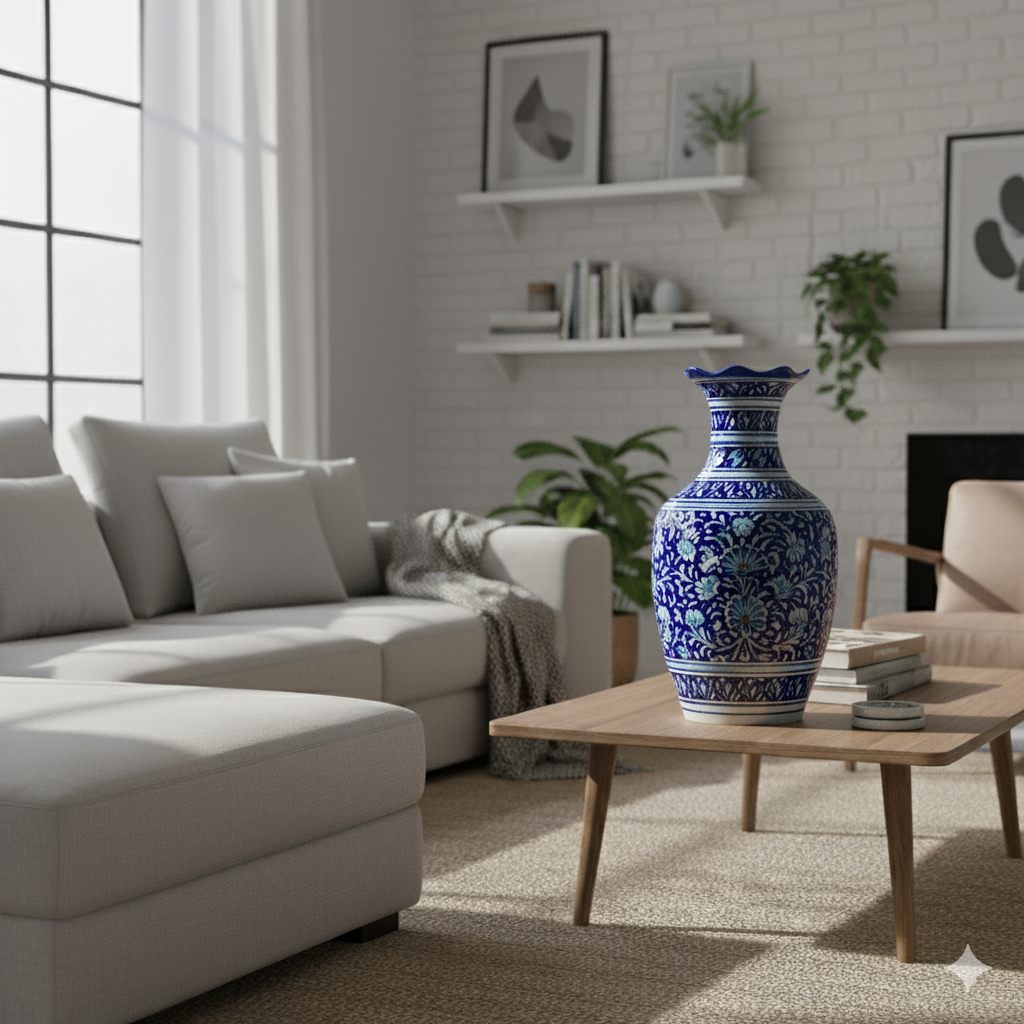
The color blue holds a revered place in India, not just in its spiritual history, but in its visual arts. Specifically, the brilliant, turquoise hue of Blue Pottery tells a story of royal patronage, ancient trade routes, and meticulous craftsmanship. This unique art form, centered primarily in Jaipur, has quietly become one of the country’s most recognizable and enduring artistic legacies.
The journey of Blue Pottery to Jaipur is a fascinating cultural exchange, making it truly iconic. While often associated with Rajasthan, its origins actually lie in Persian and Turko-Persian glazed techniques. The craft arrived in the subcontinent via Central Asian trade routes, later flourishing under the patronage of Maharaja Sawai Ram Singh II in the 19th century. This history is critical; the iconic motifs like the bird, the traditional floral jaali pattern, and geometric designs are direct descendants of Islamic art and tilework, which Jaipur master artisans beautifully adapted using locally sourced quartz stone powder, glass, and Multani Mitti (Fuller’s earth), a blend that distinguishes it from conventional clay pottery.
The process of creating Blue Pottery is deeply artisanal and demanding, underscoring its value. Unlike standard earthenware, Blue Pottery is fired at extremely high temperatures and is the only pottery in India that uses a quartz stone base, not clay. The technique of hand-glazing and the precise mixing of the cobalt blue pigment with copper oxide for the signature turquoise ensures that each piece is completely unique. This commitment to a difficult, manual process speaks to the enduring dedication of India’s artisan community, whose skills are passed down through generations.
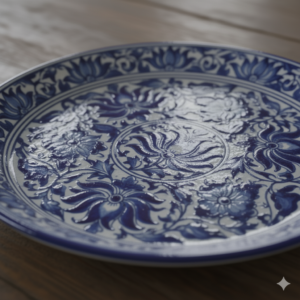
The contemporary relevance of Blue Pottery is experiencing a massive revival. Today, the intense turquoise and deep cobalt colors are frequently seen outside of traditional vases and plates. Modern Indian designers are integrating its vibrant aesthetic into luxury home decor, contemporary jewelry, and even textile prints. This reflects a broader consumer trend toward authentic, sustainable, and handcrafted goods that carry a distinct cultural narrative.
For the modern consumer, owning a piece of Blue Pottery is not just a purchase; it’s an investment in a piece of usable, historical art that instantly adds a vibrant touch of Indian heritage to a contemporary space. The piece acts as a quiet luxury, a tangible connection to the royal courts of the past.
Ultimately, the iconic nature of Blue Pottery lies in its longevity. Despite the rise of mass production, this delicate, hand-painted craft endures. It serves as a beautiful symbol of India’s ability to absorb, adapt, and refine global influences into a uniquely defined local treasure. It continues to inspire awe with its simple, bold color palette and its story of a craft that traveled thousands of miles to find its perfect home in the Pink City.
To explore this beautiful marriage of Persian history and Rajasthani artistry is to understand the depth of India’s cultural expression. Look for the distinctive hue of Blue Pottery to bring a piece of timeless royal heritage into your own modern narrative!