
- The Hornbill Festival unites all 17 Naga tribes in one breathtaking ten-day celebration.
- Named after a sacred bird, this festival is proudly called India’s Festival of Festivals.
- War dances, tribal cuisine, rock concerts and ancient rituals all happen under one roof.
- Born in the year 2000, it remains one of India’s most unique and lesser known treasures.
Most people can name India’s biggest festivals without thinking twice. Diwali, Holi, Eid, Navratri. These are the celebrations that travel well, the ones that made it onto global calendars and international headlines. But India has over a thousand regional festivals beyond these household names, and tucked away in the misty northeastern hills of Nagaland, one of them quietly earned the title of Festival of Festivals. The Hornbill Festival was born in 2000, created by the Government of Nagaland with a single, beautiful purpose: to preserve and protect the diverse cultures of its tribal communities and give them a shared stage to celebrate together. More than two decades later, it has grown into one of the most extraordinary cultural spectacles on earth, and most of the world still hasn’t heard of it.
Nagaland is home to 17 major tribes and numerous sub-tribes, each carrying its own distinct customs, language, attire, and traditions. For centuries these communities lived separately in the hills, their cultures evolving independently, their rituals passed down through oral tradition and ceremony. The Kisama Heritage Village was built in 2003 as the festival’s permanent home, its very name a combination of the two surrounding villages, Kigwema and Phesama, who donated their land to make it possible. Every December from the first to the tenth, this village transforms into something that has no real equivalent anywhere else in India. All 17 tribes arrive together. And for ten days, they share everything.
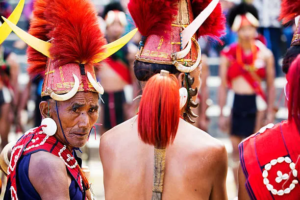
The festival grounds fill with the thunder of war drums, fire-making rituals, martial dances, and soul-stirring songs that carry the weight of centuries into the present. Warriors arrive dressed in full ceremonial attire, shells and beads and feathers layered into outfits that took generations to perfect. Traditional arts take centre stage, with paintings, wood carvings, and sculptures by modern Naga artists displayed alongside ancient tribal crafts, while folk songs and indigenous games add texture to every corner of the grounds. And then, as the sun sets over the Himalayan foothills, the mood shifts entirely. The Hornbill International Rock Festival takes over the evenings, an electric contrast to the ancient daytime rituals that makes the whole experience feel genuinely unlike anything else. Ancient war cries by afternoon. Live rock music by night. Only in Nagaland.
The food alone is worth the journey. Dishes like cassava, potato leaves, fermented bamboo shoots, and smoked pork have been part of Naga cuisine for centuries, and the festival’s food stalls give visitors a rare opportunity to taste a culinary culture that remains almost entirely undiscovered on the global food map. The crafts are equally compelling, from intricately woven Naga shawls to bone and bead jewellery and hand-carved hunting tools, each piece carrying a story that no factory could replicate. The festival has grown into a platform where not just Nagaland but the entire northeast of India comes together in an act of cultural exchange that is as rare as it is moving.
The Hornbill bird itself, for which the festival is named, is a symbol of fidelity, beauty, and grace in Naga folklore, and watching the festival unfold, it’s easy to understand why. There is a fidelity here, to tradition, to community, to the idea that culture is worth protecting even when the world is moving fast. India has over a billion stories to tell. The Hornbill Festival is one of its most vivid, most human, and most overlooked. If you’ve never heard of it before today, now you have. And it belongs on every curious traveller’s list!