
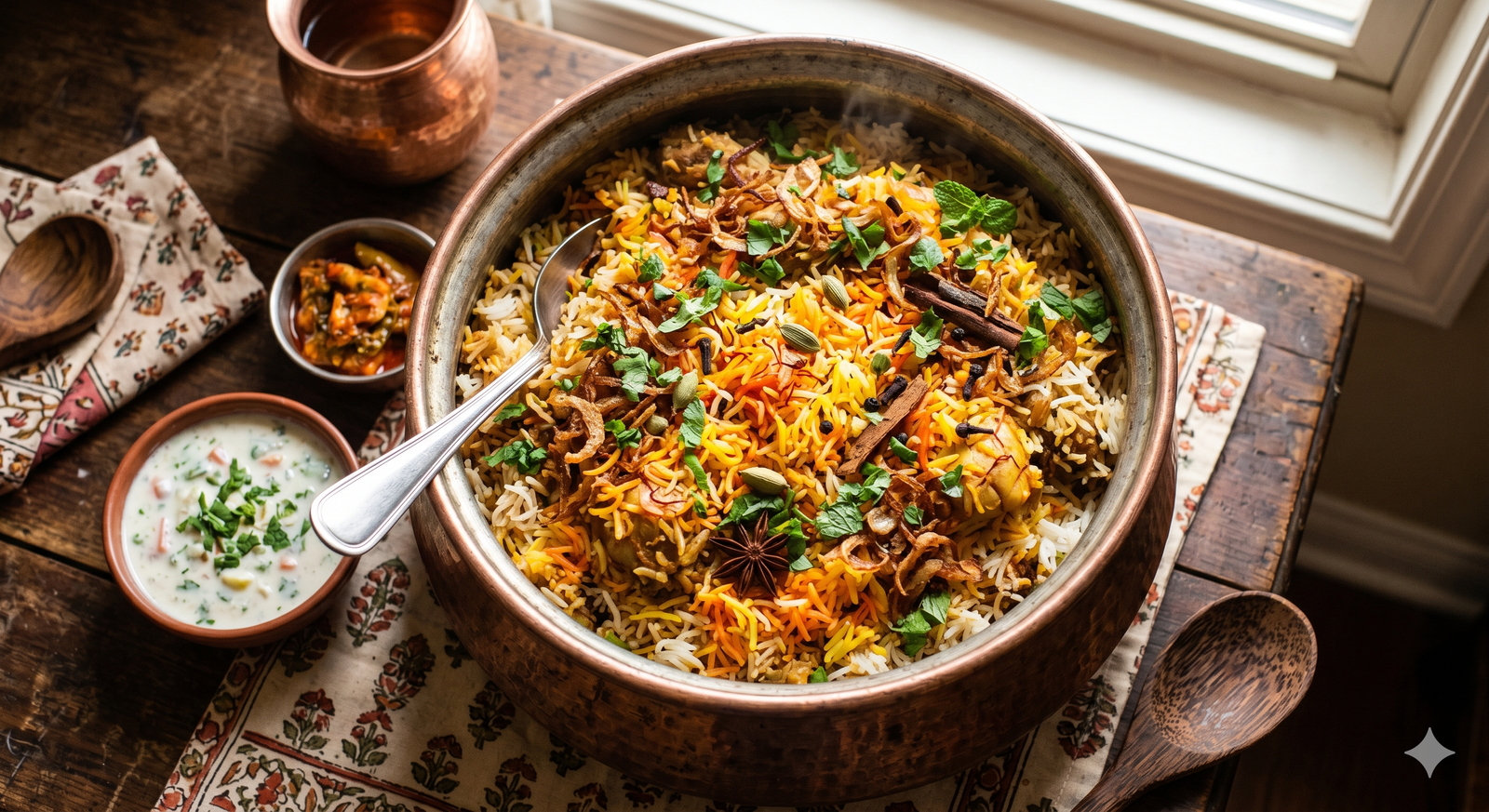
Every biryani, korma, and kebab you have ever eaten has a royal Indian story behind it.
- The Mughal royal kitchen employed hundreds of chefs from across the known world.
- Biryani was reportedly born when Mumtaz Mahal noticed malnourished Mughal soldiers.
- Emperor Akbar’s chefs fused Persian, Kashmiri, Punjabi, and Deccan cooking styles.
- Dishes cooked for emperors in the 16th century now feed millions across the globe daily.
Somewhere in Dubai right now, someone is ordering biryani. In a home kitchen in Sharjah, someone is finishing a pot of korma. At a restaurant in Abu Dhabi, a plate of seekh kebabs is coming off the grill. These are not just popular dishes. They are the direct culinary descendants of meals prepared in some of the most extraordinary royal kitchens in human history, the Mughal imperial kitchens of 16th and 17th century India, where emperors, their chefs, and the cultural collision of Persian, Central Asian, Kashmiri, and Indian cooking traditions produced a cuisine that has never stopped spreading across the world.
Mughlai cuisine consists of delicately spiced dishes developed in the early-modern Indo-Persian cultural centres of the Mughal Empire, representing a combination of the cuisine of the Indian subcontinent with the cooking styles and recipes of Persian cuisine. The Mughals introduced stuffed meat and poultry, leavened bread, pilau, and dried fruits to the region, bringing with them the tandoor clay oven, the braising of meat, the practice of marinating meat in yoghurt, and the making of cheese. When you pull a piece of naan from a tandoor today, you are using a cooking technology the Mughals brought to India. When you eat a korma, the yoghurt-braised sauce technique that defines it was a Mughal innovation. The royal kitchen didn’t just feed an empire. It invented a culinary language that the world still speaks.
The story of biryani is perhaps the most human of all of them. Legend has it that Mumtaz Mahal, the beloved wife of Emperor Shah Jahan who also inspired the Taj Mahal, once visited the army barracks and found the Mughal soldiers looking weak and undernourished. She asked the royal chefs to prepare a special dish that combined meat and rice to provide balanced nutrition, and the result was biryani. Historian Lizzie Collingham writes that the modern biryani developed in the royal kitchens of the Mughal Empire, specifically during the rule of Emperor Akbar from 1556 to 1605, and is a mix of the native spicy rice dishes of South Asia, Persian yoghurt-marinated meat, and the Persian pilau style of garnished rice. The dish spread from Delhi to Hyderabad, from Lucknow to Kolkata, from the subcontinent to the UAE, and it has never stopped travelling. Today biryani is one of the most ordered dishes on food delivery platforms across Dubai, ordered by people of dozens of nationalities who have no idea they are eating something that was originally cooked for a Mughal emperor concerned about his soldiers’ health.
It was during Akbar’s reign that Mughlai cuisine truly began evolving. Thanks to his many marital alliances, his chefs came from all corners of India and fused their cooking styles with Persian flavours, producing some of the most unique, elaborate, and delicious meals in Mughlai food, including the magnificent Murgh Musallam, a whole masala-marinated chicken stuffed with spice-infused minced meat and boiled eggs before being slow-cooked to perfection. Humayun’s Iranian wife Hamida introduced the lavish use of saffron and dried fruits in the royal kitchens during the first half of the 16th century, which is why saffron still appears in so many of the dishes we consider quintessentially Indian today. Each emperor added a chapter. Each royal wife, each new chef recruited from a conquered region, each diplomatic gift of spices and ingredients from distant lands, contributed a new flavour to a cuisine that was always in motion.
Even the Mughal royal breakfast was extraordinary. Nihari, which originated from the Arabic word nahar meaning morning, was a breakfast staple of the Nawabs in the Mughal Empire, consumed for its energy-boosting properties. Meticulous slow-cooking of meat with bone marrow at a low flame for hours ensured a heavy, intensely flavoured stew that kept illness at bay while keeping the body warm through cold northern winters. From their roots in the imperial kitchens, the delicacies of Mughal cuisine made their way into the bazaars and streets of Indian and Pakistani towns and cities. From high-end restaurants to street food stalls, everything from parathas and tikkas to haleem and nihari can now be enjoyed by people from all walks of life. The recipe that a royal chef perfected for an emperor in Agra in 1580 is now available at 2 AM from a street cart outside a Dubai metro station. That is one of the most quietly extraordinary journeys in culinary history.
Next time you sit down to a plate of biryani, pull a piece of naan from the basket, or dip a kebab into a bowl of raita, take one small moment to consider where it came from. An empire that stretched across the subcontinent. A royal kitchen staffed by hundreds of chefs from every corner of the known world. An empress who looked at her soldiers and decided they needed a better meal. India’s Mughal cuisine was born in palaces. It belongs to the whole world now!