
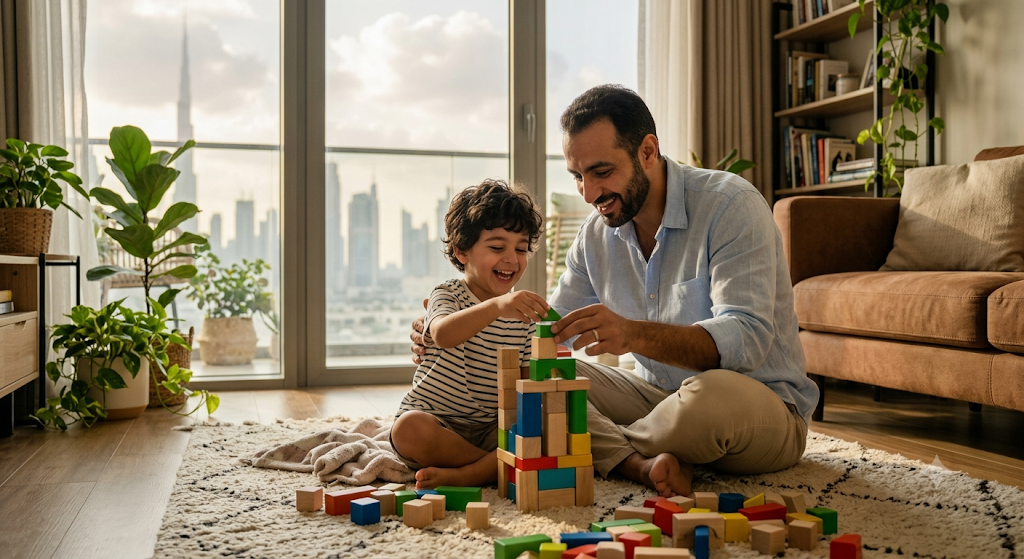
Three experts on child development, psychology, and education share what actually works for keeping UAE children stimulated, connected, and emotionally well this summer.
- UAE child psychologists say behavioural activation breaks the low mood and low stimulation loop.
- Whole brain training through movement and play supports memory, attention, and emotional regulation.
- Unstructured screen-free hours are where children’s imagination does its most important work.
- Ten focused undistracted minutes with a parent does more than an hour of curated activities.
Every July in Dubai, the same quiet challenge lands on every family simultaneously. School ends, the energy in the house rises, and then the thermometer hits 45 degrees and the outdoors disappears as an option for the next two months. With outdoor play limited for much of the day, UAE families face longer indoor days, more screen time negotiations, and children who seem restless or irritable in ways that are hard to address without simply handing over a device. But the experts who work most closely with UAE children say that this summer does not have to be a problem to manage. With the right understanding of what children actually need, it can be one of the richest developmental periods of the year. We spoke to three leading voices in child education, psychology, and development across Dubai to find out what that looks like in practice.
Ms. Deepika Thapar Singh, CEO-Principal, Credence High School Dubai

Ms. Deepika Thapar Singh has spent years watching how Dubai families navigate the summer months, and her perspective is one that reframes the season entirely before offering a single practical suggestion. “Summer in Dubai does something odd to family routines,” she says. “School shuts, the energy in the house goes up, but the heat means everyone’s stuck indoors for most of the day. I don’t see this as a problem to solve, though. Over the years, I’ve noticed it’s actually one of the few times families get real, unhurried time together, no school runs, no homework deadlines, no rushing.”
Her recommendations are deliberately unglamorous and grounded in what she has observed working across years of school leadership. Reading, she argues, is the most undervalued summer tool available to any family. Not structured reading programmes or comprehension worksheets, but the informal kind. A parent reading a story aloud. A child curled up with a book they chose themselves. “That alone does more for vocabulary and imagination than most worksheets ever will,” she says. Music works in a similar way, whether a child is learning an instrument or the family simply puts on old songs on a slow afternoon. It gives children a way to process and express emotion without having to articulate it verbally, which is particularly valuable during the long, less stimulating weeks of peak summer.
She is equally passionate about the return of the board game as a family anchor. Chess, carom, ludo, scrabble. “Beyond just filling time, they teach patience and how to think a few steps ahead, and honestly, how to lose without sulking. And everyone ends up around the same table, which doesn’t happen often enough these days.” Letting children help around the house carries similar weight for her, setting the table, watering plants, helping cook dinner. Small contributions that build responsibility and create the conditions for the kind of honest, unplanned conversations that rarely happen during a scheduled family activity. “Some of the most honest conversations happen while chopping vegetables together,” she reflects, “not during a planned talk.”
Her closing thought is perhaps the most important of all. “Leave some hours unplanned. No screens, no activity, nothing scheduled. That’s often where children’s imagination does its best work. None of this needs to be fancy. Children mostly just remember that their family was there, paying attention.”
Rico Idris, Adult and Adolescent Clinical Psychologist, German Neuroscience Center Dubai

Where Ms. Deepika brings the wisdom of a school leader who has watched thousands of families through this season, Rico Idris brings the clinical psychology framework that explains what is actually happening neurologically and behaviourally when children are stuck indoors for extended periods. His starting point is a concept from Cognitive Behavioural Therapy called behavioural activation, and understanding it changes everything about how parents interpret their child’s summer mood.
“Mood and behaviour feed each other,” he explains. “Low stimulation leads to low mood, and even less activity. Breaking that loop doesn’t need big outings, just a predictable routine of meals, rest, and a mix of mastery activities, things that build a skill, and pleasure activities, things that are purely enjoyable.” The structure itself is doing psychological work, not because children need to be kept busy at all times, but because predictability creates the emotional safety that allows children to engage with the world rather than retreating from it.
His second principle is one that runs counter to almost every parenting instinct in a city where parents are highly resourced and solution-oriented. Do not rescue your child from boredom too quickly. “Research on boredom suggests it often precedes creativity, since an unoccupied brain starts generating its own solutions,” he says. There is also a behavioural reinforcement dynamic to consider. Constantly relieving boredom with a screen teaches children that discomfort is something removed for them, building a pattern of passive reliance on external stimulation rather than developing the internal resources to self-direct. His practical suggestion is specific: when a child says they are bored, wait five to ten minutes, then ask them to offer two ideas of their own first.
His third principle addresses what he calls friction, the increased conflict between siblings or between parent and child that confined indoor living reliably produces. Rather than treating this as something to manage away, he recommends treating it as a teaching opportunity. “Teach a basic assertiveness script the whole family can use: I feel blank when blank, and I want blank.” This helps every family member name emotions, state needs, and negotiate rather than letting frustration build into larger ruptures. His final point is perhaps the most concise and the most powerful in his entire framework. “Ten focused, undistracted minutes with a parent activates a child’s sense of safety more than an hour of curated activities.”
For more information visit here.
Anna Stranack, Executive Director and Founder, The Bright Minds Institute Dubai

Anna Stranack has been working in early childhood education since 2011 and founded The Bright Minds Institute in 2015, specialising in whole brain training for children aged six months to five years old. Her perspective is rooted in the specific developmental needs of the youngest UAE children during the summer months, and her core argument is that movement is not optional for this age group. It is foundational.
“Movement is fundamental to brain development,” she says, “and activities such as dancing, obstacle courses, yoga, action songs and imaginative games support coordination, attention, memory and emotional regulation.” For parents of toddlers and preschool-aged children who may assume that indoor summers are primarily a problem of entertainment, Stranack reframes it as a developmental concern. Children under five learn best through hands-on experiences rather than screen-based or worksheet-based activities, and summer is an opportunity to lean into exactly the kinds of multi-sensory, movement-rich activities that school timetables sometimes crowd out.
Her recommendations for this age group are specific and practical. Sensory play, storytelling, music, art, and imaginative play all build cognitive, language, and social skills simultaneously in ways that isolated screen time cannot. Maintaining a consistent daily routine is equally critical for young children, with regular mealtimes, active play periods, quiet time, and consistent bedtimes helping children feel emotionally secure and regulate their behaviour more effectively. “Children who remain engaged in structured, interactive activities over the summer return with stronger confidence, better social skills and a smoother transition back into nursery or school,” she notes, drawing on years of observation across the families her institute works with.
She is clear that screens are not the enemy, but she is equally clear about their limitations for this age group. “Young children benefit most from activities that engage multiple senses and encourage movement, interaction and exploration.” Social interaction during summer, whether with siblings, cousins, or structured group settings, is particularly important for developing communication skills, resilience, and the emotional wellbeing that children carry back into the classroom when September arrives.
For more information visit here.
Three experts, three different lenses, and one consistent thread running through every perspective: what children need most this summer is not a packed activity schedule or a curated list of indoor experiences. They need presence, structure, space to be bored, and the particular kind of attention that only a family member can provide. The heat will keep them inside. What happens while they are inside is entirely within reach of every parent reading this. The screen is always the easiest answer. These experts are making a compelling case that it is rarely the best one!