A goddess ties a thread before battle. A queen sends a rakhi across enemy lines. A poet uses it to unite a divided nation. Raksha Bandhan has always been about more than siblings.
- Raksha Bandhan 2026 falls on Friday August 28 on the full moon of Shravana month
- The festival’s earliest recorded origin appears in the Vedic Bhavishya Purana
- Rani Karnavati sent a rakhi to Mughal Emperor Humayun across religious lines in 1535
- Rabindranath Tagore used Raksha Bandhan to protest the British partition of Bengal in 1905
Raksha Bandhan history begins not between a brother and sister but between a goddess and a god going to war. In the Bhavishya Purana, one of the eighteen major Hindu texts, Indrani ties a sacred thread around her husband Indra’s wrist before he rides out to battle against the demons. The thread is not a rakhi in the modern decorated sense. It is an act of faith made physical, a gesture that says: I am binding my protection to you, and you to me, and whatever happens out there you carry this with you. That instinct, to tie love into something you can touch, is what Raksha Bandhan has carried across thousands of years and several entirely different political contexts. The thread on the wrist has always meant more than it looks like it means.
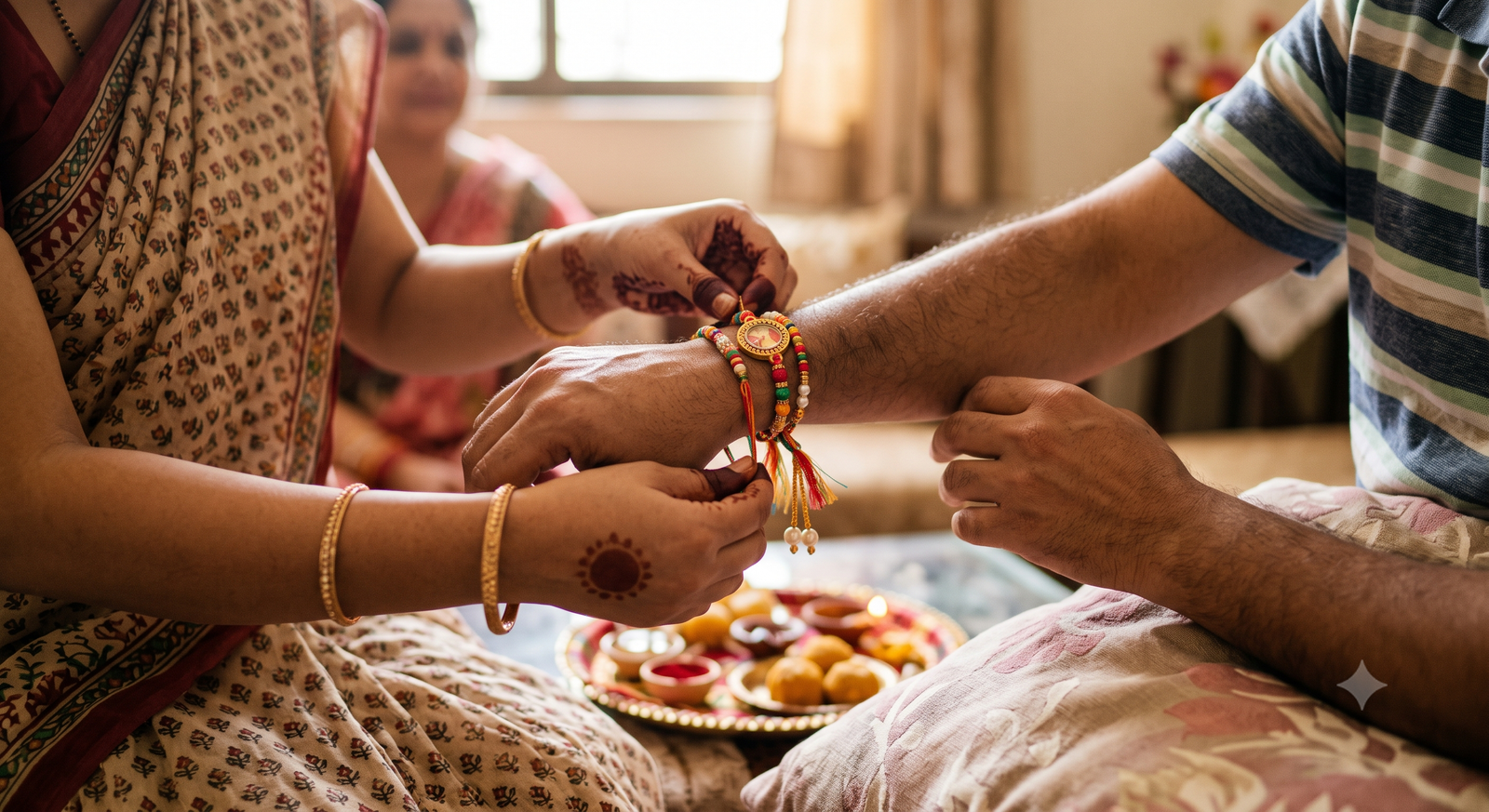
This year Raksha Bandhan falls on August 28. It is one of the most universally observed festivals in the Indian calendar, crossing regional, linguistic and caste lines in a way that very few things in India manage to do. The ritual is familiar: a sister ties a rakhi around her brother’s wrist, he gives her a gift, both make promises. What most people eating the mithai and taking the photographs do not know is how many extraordinary stories brought that moment to their doorstep.
One of the earliest references to Raksha Bandhan can be found in the ancient Hindu epic, the Mahabharata. According to legend, Draupadi, the wife of the Pandavas, once tore a strip of her sari and tied it around Lord Krishna’s wrist to stop the bleeding from a battlefield wound. Touched by her gesture, Krishna vowed to protect her, symbolizing the essence of Raksha Bandhan, a bond of protection.
The detail that matters here is who Draupadi and Krishna were to each other. They were not siblings in the conventional sense. They were friends, confidants and equals, bound by a loyalty that operated completely outside the normal categories of relationship. This bond later played a vital role during Draupadi’s public humiliation, when Krishna miraculously saved her dignity. The rakhi was not a formality. It was the beginning of a debt that Krishna honoured at the most critical moment of her life. That is the standard the festival sets: not a thread you tie and forget, but a promise that holds when everything else has broken.
According to another legend, Yamuna, the sister of Yama, the god of death, tied a rakhi to him. In return, he granted her immortality and promised to visit her once every year. Touched by her affection, he also declared that any brother who receives a rakhi from his sister and gives her protection in return would be blessed with a long life.
Read that again. A sister tied a thread to the god of death and walked away with immortality. Raksha Bandhan has always operated at a scale larger than the domestic. The thread has always carried the weight of something genuinely profound: the idea that love between siblings is protective in both directions, and that the promises made on this day echo forward in ways that cannot be measured.
During the medieval period, Rani Karnavati of Mewar sent a rakhi to Mughal Emperor Humayun, seeking his help to protect her kingdom from invasion. Humayun, moved by the gesture, honored the bond and came to her aid. This historical account highlights how Raksha Bandhan transcended religious and cultural boundaries, fostering unity and mutual respect.
This happened in 1535, and it is one of the most extraordinary diplomatic gestures in Indian history. Rani Karnavati was a Hindu queen. Humayun was a Muslim emperor. They had no familial connection and no obvious political alliance. She sent him a rakhi. He understood what it meant. He rode out to defend her kingdom. The thread crossed boundaries of religion, politics and history that most formal diplomacy of the era would not have dared to attempt. Raksha Bandhan had become, by the sixteenth century, a gesture so universally understood in its meaning that it could function as a language between people who shared almost nothing else.
The most politically daring use of Raksha Bandhan came in 1905. In the early 20th century, during India’s struggle for independence, Raksha Bandhan took on a new dimension. When the British colonial government announced the partition of Bengal, dividing the province along religious lines in a deliberate strategy to weaken Indian unity, Rabindranath Tagore responded by organising a mass Raksha Bandhan ceremony across Bengal. Hindus and Muslims tied rakhis on each other’s wrists in the streets of Calcutta. The message was direct and unmistakable: you cannot divide us by drawing a line, because we are already bound to each other.
The festival that began as a goddess tying a protective thread before battle was being used, four thousand years later, by the greatest Indian poet of his era as an act of political resistance and a declaration of human solidarity. That is what a tradition with genuine depth can do. It carries enough meaning to be redeployed across centuries without losing its core.
The meaning of Raksha Bandhan has evolved and expanded beautifully over time, from symbolic rituals in mythological legends to a modern-day celebration of any bond that feels like family. Today rakhis are tied between friends, neighbours and colleagues, between sisters, between children and parents, between any two people who want to acknowledge that they are bound to each other by something worth acknowledging. The festival has always been bigger than biology. What it has always been about is the specific, deliberately chosen act of saying: I see you, I am here for you, and I am putting something on my wrist to remind both of us of that.
For the Indian diaspora across Dubai and the UAE, Raksha Bandhan arrives by courier in decorated boxes, observed through video calls where rakhis are tied across continents, and celebrated in Indian community centres across the Gulf with exactly the same sweetness and noise it has in every city in India for thousands of years. The distance does not diminish it. If anything it amplifies the feeling.
August 28 is four weeks away. The rakhis are already being made. The stories behind them are older than you knew!