
India developed six complete philosophical systems thousands of years ago covering logic, consciousness, matter, ethics and liberation. The world has been borrowing from them ever since.
- India’s six classical philosophical schools were fully developed by the 6th century BCE
- The Nyaya school created the world’s first systematic logic, centuries before Aristotle
- Patanjali’s Yoga Sutras underpin every yoga class taught anywhere in the world today
- Vedanta’s non-dualist philosophy directly influenced Schopenhauer, Hegel and Carl Jung
Ancient Indian philosophy is the most borrowed-from intellectual tradition in the world that rarely gets credited by name. The concept of zero. The decimal system. Algorithms. Yoga. The idea that consciousness might be the fundamental nature of reality rather than matter. The understanding that logic requires a formal structure rather than simply persuasive argument. All of these trace their origin or their earliest sophisticated development to a tradition of thought that India produced between roughly 1500 BCE and 500 CE, in a period of intellectual activity so extraordinary that it produced six complete and distinct philosophical systems, each with its own epistemology, metaphysics and practical method, all running in parallel, debating each other, refining their positions through centuries of rigorous public argument. The Indian philosophical tradition called this Darsana: not simply thinking, but seeing. The six ways of seeing that it produced are still shaping how the world thinks today, whether the world knows it or not.
The six classical schools are Samkhya, Yoga, Nyaya, Vaisheshika, Mimamsa and Vedanta. All six are classified as Astika, meaning they accept the authority of the Vedas as foundational texts. But what each school does with that foundation is radically different, producing a range of philosophical positions that spans from hard-line materialism to absolute non-dualism and from empirical logic to mystical union. They were not a single tradition with a single view. They were six distinct intellectual programmes, each making its own case for how reality works and what a human being should do about it.
Samkhya: The Oldest and Most Scientific
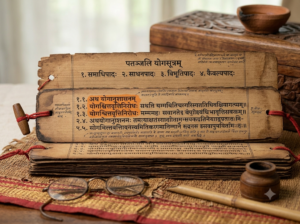
Samkhya is the oldest of the six schools, founded by the sage Kapila, and its core insight is that everything in reality stems from two ultimate principles: Purusha, which is pure consciousness or self, and Prakriti, which is matter or creative energy. The world of experience arises from the interaction between these two. Samkhya accepts only three sources of valid knowledge: perception, inference and testimony. It does not require God as an explanatory principle. The world runs on the interaction of Purusha and Prakriti alone.
This is a remarkably scientific position for a tradition that predates modern science by over two thousand years. The Samkhya description of Prakriti as composed of three qualities, or gunas, in constantly shifting combination anticipates something structurally similar to how modern physics describes matter as energy in different states of configuration. The German philosopher Arthur Schopenhauer read Samkhya texts in the 19th century and described them as producing the highest human wisdom. Carl Jung drew extensively on Samkhya and Vedanta concepts in developing his theory of the collective unconscious. Neither man invented these ideas. They recognised them.
Nyaya: Where India Invented Logic
The Nyaya school, founded by the sage Gotama, is the philosophical system most concerned with how we know what we know. Its primary contribution to human thought is a systematic theory of logic and valid argumentation that predates Aristotle’s formal logic and in some respects surpasses it in sophistication. Nyaya identifies four valid sources of knowledge: perception, inference, comparison and testimony. It then develops a detailed theory of inference with five parts: the proposition, the reason, the example, the application and the conclusion. This is a formal logical structure as rigorous as anything produced in ancient Greece.
Nyaya philosophers spent centuries developing the theory of debate, identifying valid and invalid forms of argument and establishing the conditions under which a conclusion can be genuinely established rather than merely asserted persuasively. The goal was not winning an argument. It was arriving at truth through the most reliable possible method. The Nyaya school was engaging in something that would now be called analytical philosophy, and it was doing it in India at the same time as or before anyone was doing it in Greece.
Yoga: The Philosophy Behind the Practice
The word yoga in the Dubai wellness calendar refers almost entirely to a physical practice of postures, breath and meditation derived from Patanjali’s Yoga Sutras, composed around the 2nd century BCE. But Patanjali’s yoga is not primarily a physical system. It is a philosophical system in which the physical practice is a tool for achieving a specific philosophical goal: the cessation of the fluctuations of the mind, so that pure consciousness can be perceived directly without the distortion of thought, desire and memory.
The Yoga school is closely related to Samkhya and shares its basic metaphysics of Purusha and Prakriti. What Yoga adds is a practical methodology for achieving the liberation that Samkhya describes theoretically. The eight limbs of Ashtanga Yoga that Patanjali outlines, from ethical restraints through physical postures to deep states of meditation, are not a wellness programme. They are a systematic philosophical technology for transforming the quality of human consciousness. Every yoga class taught anywhere in the world today, from a Jumeirah studio to a New York loft, is a downstream product of Patanjali’s philosophical system. Very few of the people in those classes know his name.
Vaisheshika: The World’s First Atomic Theory
The Vaisheshika school, founded by the sage Konada, proposed in ancient times that the material world is composed of indivisible particles called anu, atoms, that combine in different ways to produce all physical phenomena. This is the world’s first recorded atomic theory, predating the Greek atomists Leucippus and Democritus and anticipating, in philosophical form, what modern physics would eventually prove empirically. The Vaisheshika system categorised reality into six fundamental categories: substance, quality, action, generality, particularity and inherence. It was, in effect, the first systematic ontology, an attempt to categorise every kind of thing that exists and understand the relationships between them.
Vedanta: The Philosophy That Travelled Furthest
Of the six schools, Vedanta has had the most visible influence on the wider world. The word means the end of the Vedas, and Vedanta is based primarily on the Upanishads, the philosophical sections of the Vedic literature composed between 800 and 200 BCE. The dominant sub-school, Advaita Vedanta as articulated by the 8th-century philosopher Adi Shankaracharya, proposes that there is only one ultimate reality: Brahman, which is pure, undifferentiated consciousness. The individual self, Atman, is not separate from Brahman. The apparent multiplicity of the world is Maya, a kind of superimposition of apparent difference onto a fundamentally non-dual reality.
This position, that consciousness is fundamental and matter is secondary, runs directly counter to the mainstream materialist assumption of western science and philosophy since Descartes. And yet it keeps resurfacing in unexpected places. Quantum physicists have noted that Vedantic non-dualism sounds remarkably similar to certain interpretations of quantum mechanics in which the act of observation is inseparable from the observed phenomenon. Erwin Schrödinger, one of the founders of quantum mechanics, read Vedanta extensively and wrote about it explicitly. He was not borrowing language. He was recognising something familiar in a very old source.
For the Indian diaspora in Dubai, these six schools are not simply academic history. They are the intellectual foundations of practices and habits that millions of people engage with every day: the yoga class before work, the meditation app, the Ayurvedic supplement, the concept of karma, the idea that there is a deeper self beneath the personality the world sees. All of it traces back to a tradition of thought developed in India thousands of years ago and still, in ways both direct and indirect, shaping the world the rest of us inhabit!