Pepper was once worth more than gold. Three European empires sailed to the same strip of Indian coastline to control it. The Malabar Coast never asked to be the most fought-over place on earth. It simply grew the right things.
- Arab traders had been sailing to the Malabar Coast for over a thousand years before Vasco da Gama arrived in 1498
- Kozhikode was so synonymous with cotton fabric that the English word calico comes directly from its name Calicut
- Kochi was successively colonised by the Portuguese in 1503, the Dutch in 1663 and the British in 1814
- The oldest colonial building in Asia, built by the Portuguese in 1506, still stands in Fort Kochi today
Malabar Coast India history begins with a smell. The pepper that grew in the hills behind the coast, the cardamom from the higher elevations, the cinnamon and the ginger and the turmeric that the Western Ghats produced in extraordinary abundance, had been reaching the noses of Arab merchants, Persian traders, Roman emperors and Chinese admirals for thousands of years before any European knew this coastline existed. Arab traders had been sailing to Kozhikode and Kochi for over a millennium before Vasco da Gama rounded the Cape of Good Hope in 1498. The Arab world, including the communities that would eventually build the cities of what is now the UAE, had a commercial relationship with the Malabar Coast that was already ancient when Europe was still trying to find it on a map. Then the Portuguese arrived. And everything changed in ways that nobody on that coast had asked for.
The City of Spices and the King Who Ruled It
Kozhikode, known to the world as Calicut, was the most important city on the Malabar Coast for much of the medieval period. During classical antiquity and the Middle Ages, Kozhikode was dubbed the City of Spices for its role as the major trading point of Eastern spices. It was ruled by the Zamorins, a dynasty of Hindu kings who had built their power precisely on the back of the spice trade, taxing and regulating the flow of goods through one of the most active commercial ports in Asia. The city was so famous for its cotton fabric exports that the English word calico is a direct corruption of the word Calicut. A city so prominent in global trade that it named a category of textile that the English language still uses today.
Arab merchants had preferred Kozhikode to all other ports because it offered full freedom and security, with Arab and Chinese merchants gathering here and trading freely within a system that the Zamorins had built to be deliberately open and commercially generous. When Vasco da Gama arrived on May 20, 1498, having navigated around the southern tip of Africa in a journey that took eleven months, he was not arriving at an obscure backwater. He was arriving at one of the busiest commercial hubs in the known world. The Zamorin received him, recognised what he was, and sent him away largely empty-handed. The Portuguese would be back with considerably more force.
Three Empires and One Coastline
The sequence of what happened next to the Malabar Coast is one of the most concentrated examples of colonial ambition in the history of the world. Within thirteen years of Vasco da Gama’s first arrival, the Portuguese were in control of the spice trade of the Malabar Coast. They established their strongest foothold not at Kozhikode, where the Zamorin had resisted them, but at Kochi, where a local ruler in rivalry with Kozhikode chose to align with them rather than fight them.
In 1503 the Portuguese colonised Kochi and it became the first European colonial settlement in India, and in 1506 they built what is believed to be the oldest surviving colonial building in Asia, a residence that housed both Vasco da Gama and the Jesuit missionary St Francis Xavier when they passed through the city. The Portuguese St Francis of Assisi Church in Fort Kochi, completed in 1516, was the first European church built in India. Vasco da Gama died in Kochi in 1524 and was buried there before his remains were later transported to Portugal.
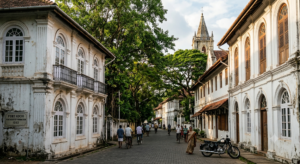
For over 150 years the Portuguese controlled the spice trade of the Malabar Coast with a monopoly so profitable that it transformed Portugal from a small Atlantic kingdom into a global imperial power. Then the Dutch arrived. The Dutch United East India Company, the VOC, came in 1663 and conquered Kochi from the Portuguese, establishing Dutch Malabar and constructing the Bolghatty Palace as a residence for the Governor of Dutch Malabar. The Dutch established the first municipality on the Indian subcontinent in Fort Kochi in 1664. They built a cemetery that still stands today, containing 104 epitaphs and tombs carrying authentic records of hundreds of Dutch and British nationals, one of the oldest European cemeteries in India.
The Dutch held the coast until 1814, when the Anglo-Dutch Treaty formally passed Kochi to the Kingdom of Cochin, a British protectorate. The British completed the sequence that the Portuguese had begun three hundred years earlier. By the time India achieved independence in 1947, the Malabar Coast carried in its architecture, its place names, its food, its religion and its cultural memory the layered mark of every empire that had come for its pepper and stayed for considerably longer.
What the Europeans Left Behind
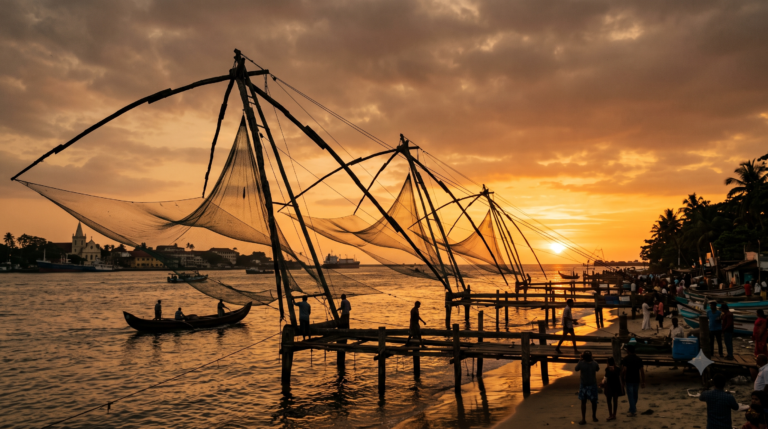
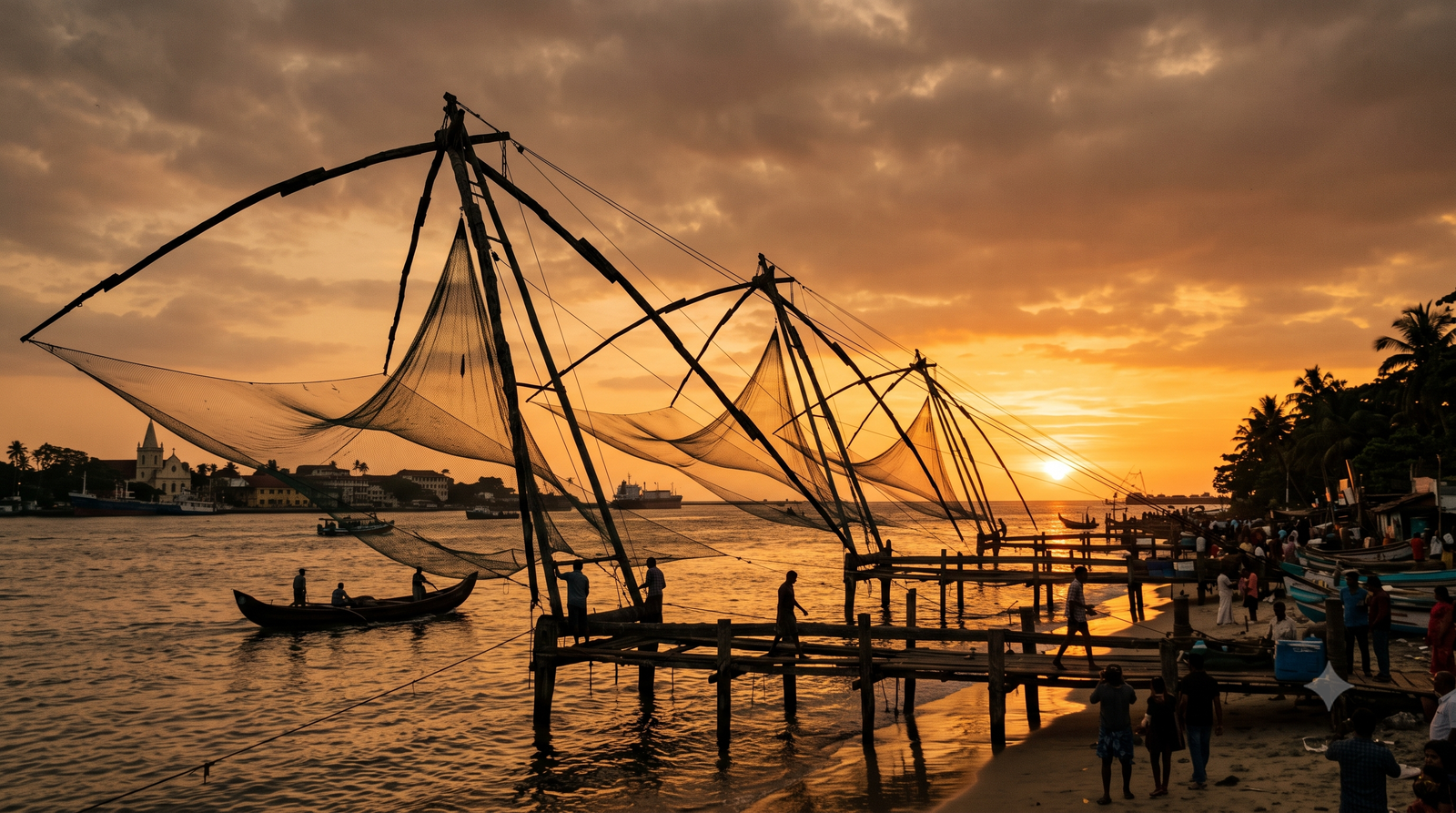
Fort Kochi today is one of the most visually extraordinary places in India precisely because of this compressed colonial history. Portuguese-era, Dutch-era and British-era buildings stand side by side in the city centre, each one a physical record of a different chapter in the coast’s story. The plan of the city itself, with its canals and broad orderly streets lined with towering rain trees, was laid down by the Dutch and has not changed much since. The Chinese fishing nets that are among the most photographed images in Kerala were introduced by traders from the court of Kublai Khan, a reminder that China too had its commercial relationship with this coast long before any European arrived.
The food of the Malabar Coast carries the same layered history in its ingredients and techniques. Malabar cuisine is an intricate blend of indigenous cooking traditions and influences from Arab, Dutch and Portuguese traders. The use of coconut milk, the specific combinations of spice, the techniques for fish and rice that define Malabar cooking today all reflect centuries of commercial and cultural exchange across a coastline that was, for most of the last two thousand years, the most internationally connected strip of land in Asia.
The Arab connection that predates all of it
For the Indian diaspora across Dubai and the UAE, the Malabar Coast carries a particular resonance. The Arab merchants who sailed to Kozhikode and Kochi from the 7th century onwards were the predecessors of the same commercial relationships that link the Gulf and Kerala today. The Malayalam-speaking community is among the largest single communities in the UAE, and the connection between Kerala and the Gulf is not a modern one born of labour migration alone. It is a continuation, across different centuries and different purposes, of a commercial and human relationship that the Malabar Coast and the Arabian Peninsula have maintained for over a thousand years.
The pepper still grows in the hills behind the coast. The spice markets of Kochi still smell the way they have always smelled. And Fort Kochi still carries three empires in its streets, its buildings and its cemeteries. The most fought-over coastline in Asia is now one of the most beautiful places to walk through on a slow morning. History tends to settle, eventually, into something you can simply stand inside!