
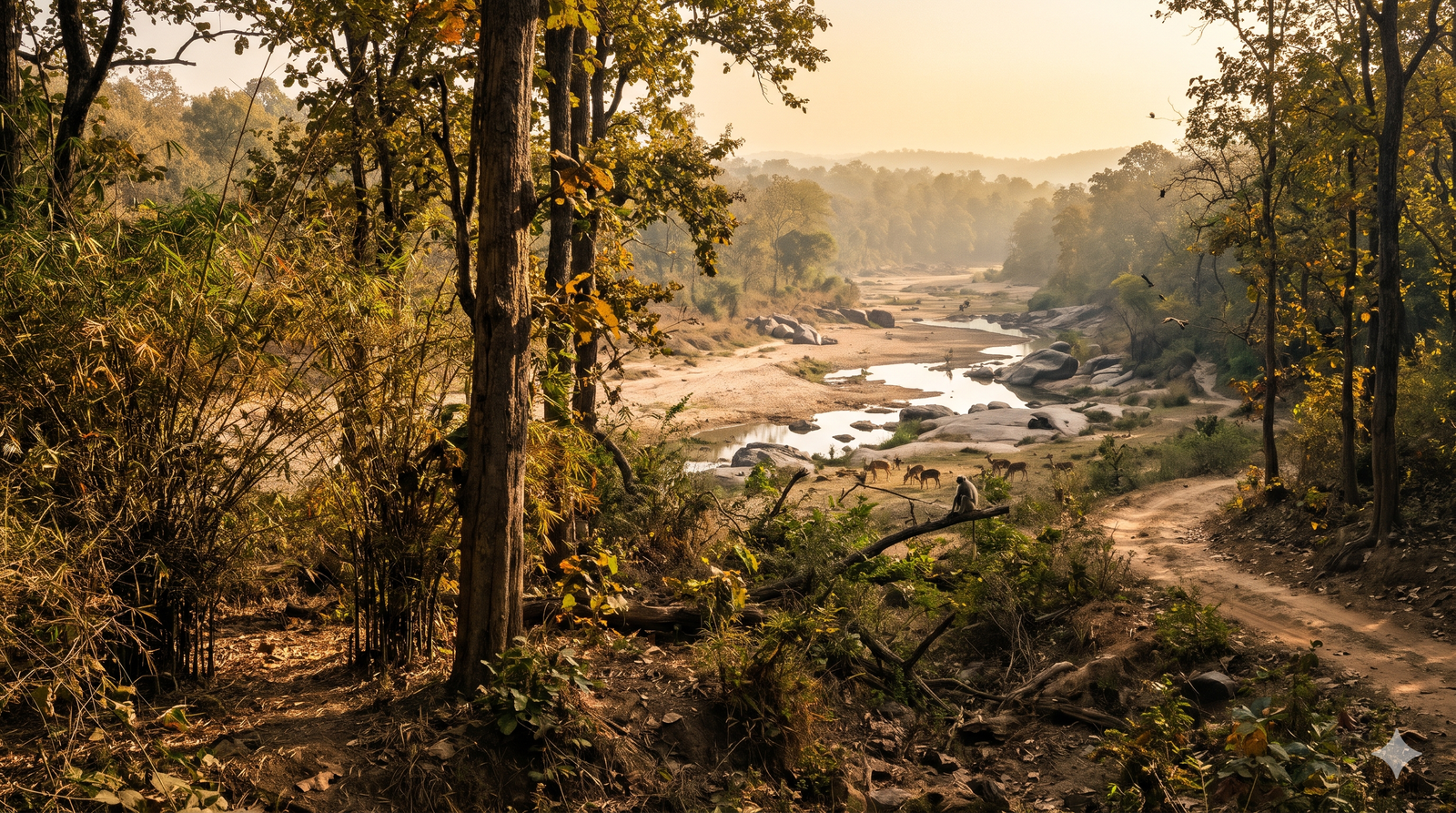
Rudyard Kipling wrote The Jungle Book at a desk in Vermont. But Mowgli’s jungle was a real forest in Madhya Pradesh, and Mowgli himself was based on a real boy caught by wolves in 1831.
- Madhya Pradesh today holds 526 Bengal tigers, the highest population in any Indian state
- Pench Tiger Reserve in Madhya Pradesh is the confirmed real setting of The Jungle Book
- The character Mowgli was based on a real wolf child caught near Seoni in 1831
- Kipling never visited Pench but used accounts from British naturalists who knew the forest
The Jungle Book real forest in India is not a marketing claim or a tourism board invention. It is a specific place with a specific name, a specific river running through it and a specific historical record of a real child who lived among wolves in its borders. The forest is the Pench Tiger Reserve in the Seoni district of Madhya Pradesh, and the story Rudyard Kipling eventually turned into one of the most beloved children’s books in the history of literature was already circulating in that landscape, passed between British officers and local naturalists, long before Kipling ever sat down at his desk in Vermont to write it.
This is not the story most people grew up with. Most people know the Disney version, or the Jon Favreau version, or the version with the singing and the dancing bear. What they do not know is that the Seoni Hills and the Wainganga River that give Mowgli’s jungle its geography are real geographical features of a real Indian forest that still exists, still contains tigers, still shelters leopards and sloth bears and wild dogs, and still looks, in the golden light of October morning, exactly the way a jungle should look if you want to believe that a boy could have grown up inside it.
The Wolf Boy Who Became Mowgli
The story of Mowgli did not begin with Kipling. It began in 1831, when a child who had been living among wolves was caught near the village of Sant Vavadi, ten kilometres from Seoni, by a Lieutenant Moor. The incident was documented in William Henry Sleeman’s Rambles and Recollections, a first-hand account by a British officer who had spent years in central India and whose observations of its wildlife, its people and its extraordinary natural history became essential reading for anyone interested in that part of the world.
Kipling read Sleeman’s account. He also read Robert Armitage Strendale’s Seonee, a semi-autobiographical book about camp life in the Satpura region that described the Pench forest, its animals and its local mythology with a detail and intimacy that only someone who had lived there could produce. From these two sources, and from whatever he had absorbed of India during his years there as a journalist, Kipling constructed Mowgli, Bagheera, Baloo and Shere Khan. He named the river in his stories the Wainganga. The Wainganga is a real river that flows through the Pench Tiger Reserve today.
The Pench Tiger Reserve itself confirms the connection directly. Its official history states that the reserve and its neighbourhood is the original setting of Rudyard Kipling’s most famous work, and that Kipling borrowed heavily from Strendale’s books for the topography, wildlife and its ways.
Pench and Kanha: Mowgli’s Two Jungles
The region that inspired The Jungle Book is not a single park but a broader landscape of central Madhya Pradesh, centred on the Seoni and Mandla districts, that contains two major wildlife reserves: Pench and Kanha. Pench is closest to the town of Seoni that Kipling names specifically in his text, and its 300 square kilometres of dry deciduous forest, teak groves, bamboo thickets and grasslands along the Pench River give you the most direct geographical match to Kipling’s descriptions. The Seoni Hills are visible from within the park. The Wainganga flows nearby.
Kanha, covering over 1,900 square kilometres in the Central Highlands of southeast Madhya Pradesh, is the state’s largest wildlife sanctuary and is regarded alongside Pench as one of the areas that contributed to Kipling’s imagination of the jungle. Kanha is also where the barasingha, the swamp deer that had been reduced to fewer than 66 individuals in the 1960s, was brought back from near-extinction in one of India’s most successful single-species conservation programmes. Today over 700 barasingha live in Kanha. The hard ground barasingha or the Swamp deer of Kanha is found only here in the whole world.
The Animals That Are Still There
Pench Tiger Reserve is known for its significant population of Royal Bengal tigers, along with leopards, wild boars and various species of deer. Madhya Pradesh holds 526 Bengal tigers, more than any other state in India, which means that the landscape Kipling used as the home of Sher Khan is still genuinely the kind of place where a tiger moves through the undergrowth and the rest of the forest goes quiet.
The sloth bear, the model for Baloo, is still present in both Pench and Kanha. The Indian leopard, Bagheera’s real-world counterpart, moves through these forests with exactly the quality of silent, deliberate power that Kipling ascribed to his character. The Indian wild dog, or Dhole, the red dogs that serve as one of Mowgli’s enemies in the stories, run in packs through Pench and have been documented hunting in coordinated groups with a complexity and intelligence that makes Kipling’s portrayal feel less like creative invention and more like straightforward reporting.
The king cobra is here. The rock python is here. The jungle in October, when the monsoon has just cleared and the forest is at its most vividly green, smells of wet earth and teak and something indefinably alive that has no name in English. It smells, to anyone who has stood in it at dawn, exactly the way a jungle should smell if you want to believe a boy could have been raised there by wolves.
What Kipling Got Right and What He Changed
Kipling never explicitly confirmed which forest he was writing about. He may have visited Seoni during his time in the Dewas Riyasat of Madhya Pradesh, or he may have assembled the entire thing from the books and accounts available to him. What is clear is that he got the geography right, the animals right, and the social structure of the jungle right in ways that someone working purely from imagination would have been unlikely to achieve.
What he changed, necessarily, was everything else. The real wolf child of Seoni in 1831 was not a boy who spoke to animals and became a hero of the jungle. He was a traumatised child who had spent his earliest years outside human society and needed years of care before he could function within it. Kipling took that story, a true story of survival and strangeness in a real forest in Madhya Pradesh, and turned it into a mythology about belonging, identity and the tension between the wild and the civilised world. That mythology has been retold in every language on earth, adapted into films, musicals, animations and stage productions across a hundred and thirty years.
But the forest is still there. And in October, when the dry season begins and the animals move back toward the water sources and the morning light comes through the teak trees in long golden columns, Pench looks like exactly the kind of place where a story worth telling could have begun!