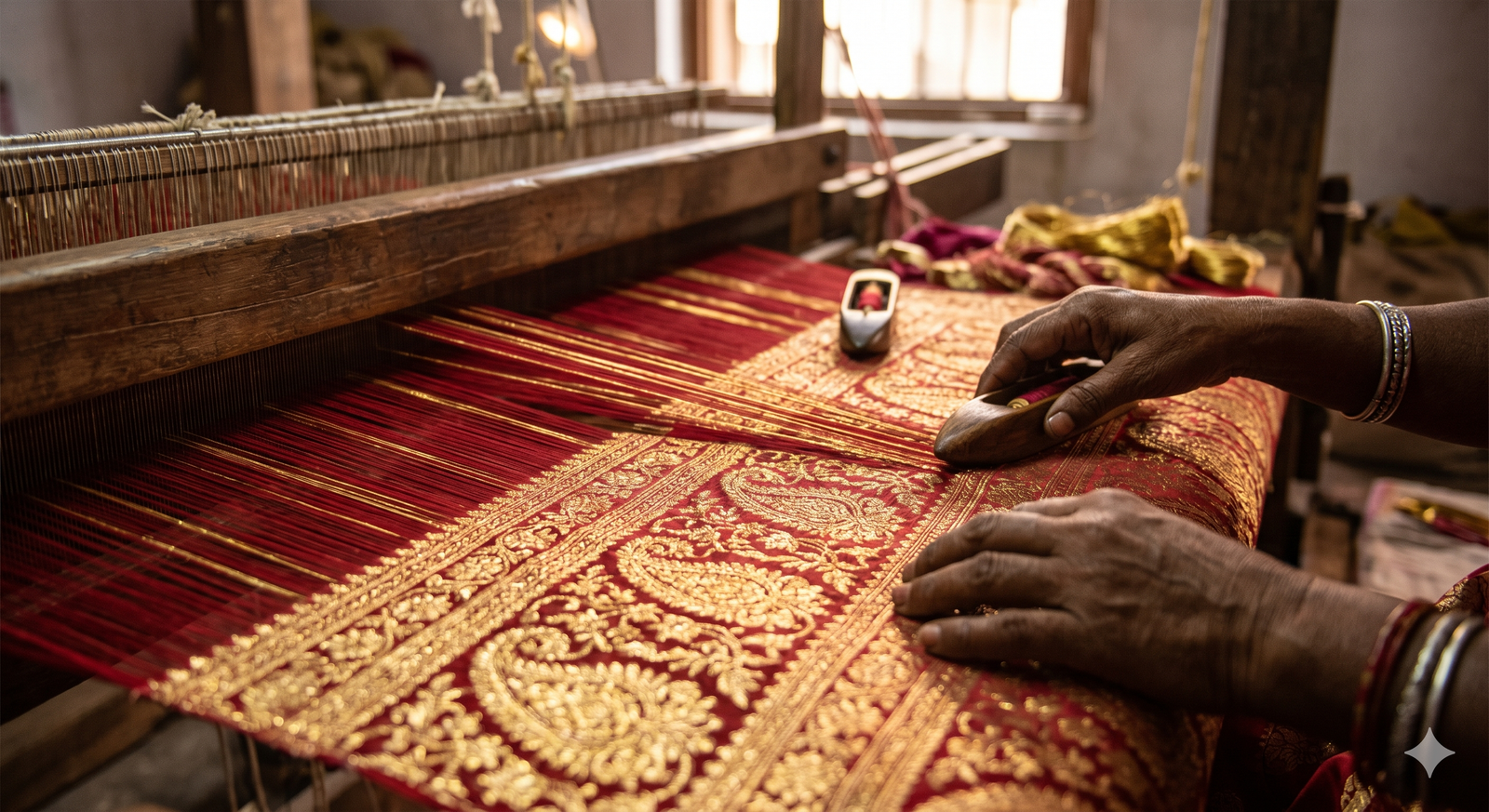
India’s handwoven fabrics clothed Mughal emperors, Persian nobility and global trade routes for five thousand years. The looms are still running.
- Indian textile origins trace back to the Indus Valley Civilisation around 5000 BCE
- A single Patan Patola saree can take a team of experts up to one and a half years to weave
- Pashmina is hand-spun from the undercoat of Himalayan goats that survive at 14,000 feet
- Banarasi silk weaving supports over 1.2 million people around Varanasi today
India textile heritage is not a museum category. It is a living, breathing, commercially active tradition that has been running without interruption for longer than most civilisations have existed. The origin of Indian textiles can be traced to the Indus Valley Civilisation as early as the 5th millennium BCE, making it one of the oldest continuous craft traditions on earth. By the time Portuguese traders arrived on the Malabar Coast in 1498, they were not discovering Indian textiles. They were finally getting access to something the Arab, Persian and Chinese worlds had been trading for centuries. The fabric of India, literally, had already dressed the ancient world. What follows is the story of how it did that and how it still does.
Banarasi silk originates from the ancient city of Varanasi in Uttar Pradesh, one of the oldest continuously inhabited cities on earth, and is one of India’s most iconic textiles. Woven with luxurious gold and silver brocade and adorned with intricate floral and Mughal motifs, these sarees are a staple in North Indian weddings and embody a legacy of opulence and spirituality, often passed down through generations as treasured heirlooms. The fabric echoes the grandeur of India’s royal courts and religious ceremonies, becoming a visual ode to devotion and prestige.
What makes Banarasi silk so extraordinary is not just its appearance but its construction. The floating threads visible on a genuine handwoven Banarasi are the mark of authenticity. The zari work, gold and silver thread woven into the silk to create patterns of breathtaking intricacy, requires a level of skill that takes years to develop. The handloom silk industry of the region around Varanasi directly and indirectly supports about 1.2 million people today. This is not a dying craft. It is an active, living economy built entirely around a tradition that is over a thousand years old.
From the temple town of Kanchipuram in Tamil Nadu comes Kanjivaram silk, celebrated for its vibrant hues, bold contrast borders and motifs inspired by temples and mythology. Each saree is woven from pure mulberry silk with thick zari forming unique and intricate designs. The motifs tell stories: peacocks, temple towers, chariots, lotus flowers and scenes from Hindu mythology are all woven into the fabric with a precision that makes every piece a narrative as much as a garment.
Kanjivaram sarees are woven by artisans who learned from their parents, who learned from theirs, in a line of transmission that stretches back centuries. The temple town connection is not incidental. Weavers historically donated their finest pieces to temple deities, and the aesthetic vocabulary of the saree has always been drawn from sacred architecture and religious iconography. To wear a Kanjivaram is to wear a piece of a temple, which is a very Indian way of carrying devotion into everyday life.
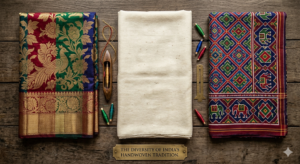
Pashmina, often called the soft gold of Kashmir, is hand-spun from the fine undercoat of the Changthangi goat, which survives the harsh Himalayan winters in Ladakh at altitudes of around 14,000 feet. These shawls, known for their unmatched warmth and delicate weave, have long been symbols of elegance. Favoured by Mughal emperors and Persian nobility, Pashmina has graced royal wardrobes and winter ceremonies for centuries.
The process of making a single Pashmina shawl takes about a week of hand-spinning alone, before embroidery begins. The most elaborate pieces can take months. The fibre itself is extraordinarily fine, around 12 to 16 microns in diameter, which is what gives Pashmina its characteristic lightness and warmth. The word comes from the Persian word pashm, meaning wool in its raw form. It arrived in Persian courts along the same trade routes that carried Indian spices and manuscripts westward, part of a broader flow of Indian luxury goods that shaped the tastes of the ancient world.
Of all India’s textile traditions, the Patan Patola of Gujarat may be the most technically demanding. A single saree uses the double ikat technique, where both sets of threads, the warp and the weft, are resist-dyed before weaving begins. The pattern does not emerge until the weaving is complete, which means every calculation must be perfect before the loom starts. A single saree can take from four months to a year and a half, with a team of experts working together. No mistake can be fixed. The geometric precision of a Patan Patola, with patterns rooted in temple art going back to the 11th century, is the result of accumulated knowledge so complex that only a handful of families in the world still practice it.
The global movement toward sustainability has influenced India’s textile industry significantly, with designers and manufacturers exploring organic fibres, natural dyes and ethical labour practices. But sustainability in India’s handloom tradition is not a modern invention. These fabrics were sustainable by design, made from natural fibres, coloured with plant-based dyes and produced by hand without industrial machinery, long before any of those qualities became aspirational.
For the Indian diaspora in Dubai and across the UAE, these textiles carry weight that goes beyond fashion. A Banarasi saree in a trousseau is not just a garment. It is inheritance. A Pashmina shawl from Kashmir is not just warmth. It is a story of the highest mountain valleys in the world, carried down to the plains and eventually to the Gulf and beyond. India dressed the world for five thousand years. The looms are still running!