
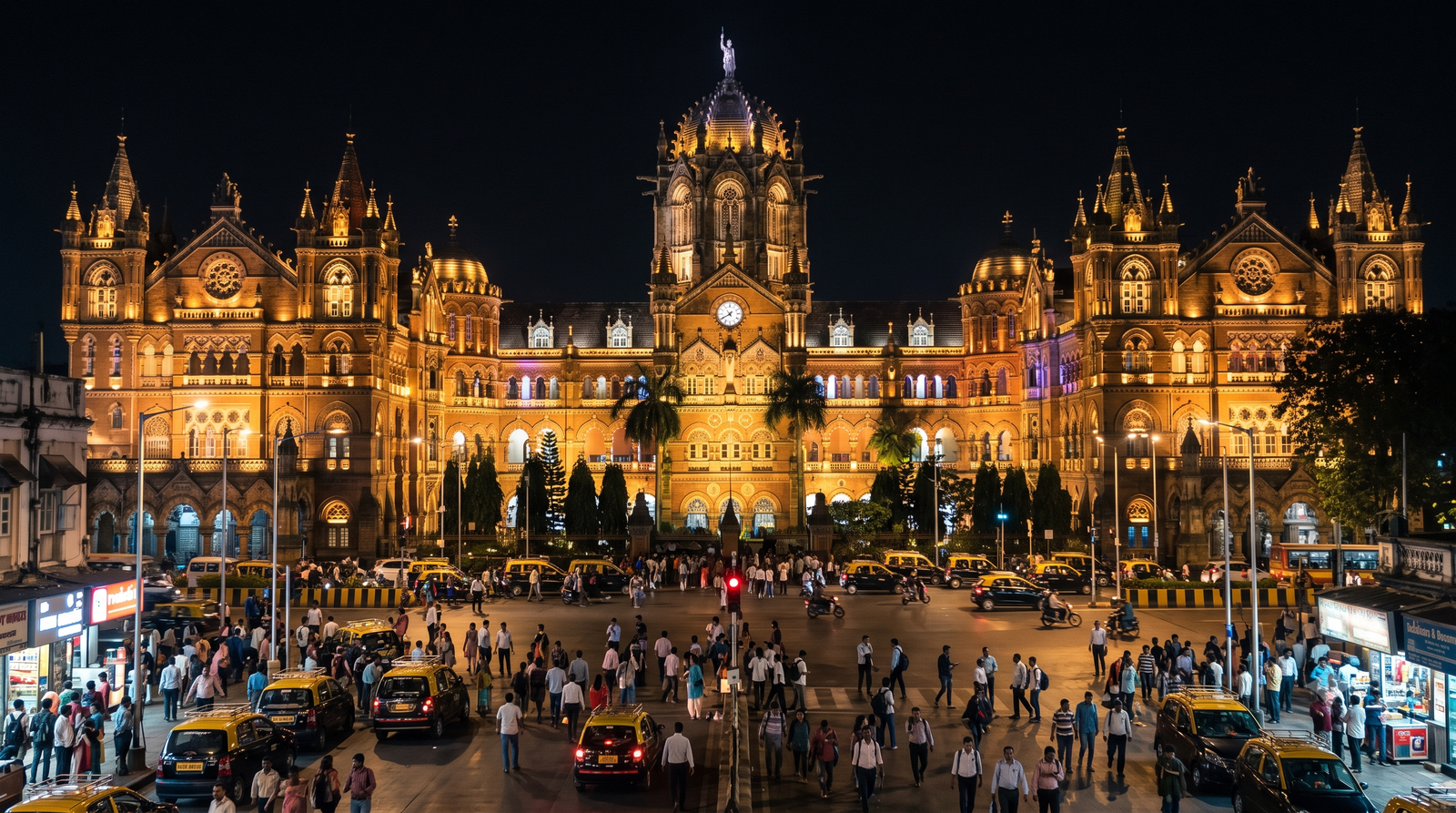
It started as a British export machine. It ended up carrying twenty three million Indians a day and becoming the most culturally significant institution the country has ever built.
- India’s first passenger train ran on April 16, 1853, pulled by three locomotives named Sahib, Sindh and Sultan
- Indian Railways employs over 1.2 million people making it one of the world’s largest employers
- Four Indian railway sites are UNESCO World Heritage Sites including Darjeeling and Nilgiri
- The Vivek Express travels from Assam to Kanyakumari covering India’s longest rail route
Indian Railways history begins with a deception. On April 16, 1853, the first passenger train on the Indian subcontinent was flagged off from Bori Bunder in Bombay, carrying 400 guests in fourteen carriages pulled by three steam locomotives named Sahib, Sindh and Sultan, amidst loud applause and a salute of 21 guns. This historic event marked the beginning of an incredible railway journey that would reshape India’s transportation, economy and identity. What the applauding crowd could not have known was that the railway was not built for them. It was built for cotton and coal, for the efficient extraction of India’s raw materials to British ports and British factories. The East India Company did not build the Indian Railways to connect Indians. It built it to connect India’s resources to Britain’s industrial economy.
What happened next was not in any colonial plan. Indians got on the trains and refused to get off.
Starting with the first passenger train in 1853 between Bombay and Thane, Indian Railways gradually expanded to connect cities, towns and remote regions, supporting trade, administration and social integration. Over time it evolved from a colonial utility into a symbol of national development, playing a crucial role in economic growth, industrialisation and everyday life in India. The speed of that expansion is staggering. Within decades of that first 34-kilometre journey between Bombay and Thane, rail lines were threading through the Western Ghats, crossing the Gangetic Plain, climbing into the Himalayas and reaching the southernmost tip of the peninsula.
During the decade of 1875 to 1886, railway stations in Bengal turned into new spaces for fostering academic culture, a space for adda for the Bengali intelligentsia. Adda: the uniquely Bengali tradition of long, wandering, intellectually promiscuous conversation. It was happening at railway stations. The railway had arrived as infrastructure and became, almost immediately, a social institution. Writers took trains and wrote about them. Politicians took trains to organise independence movements. Mahatma Gandhi’s political awakening in South Africa famously involved being thrown off a first-class train carriage. When he returned to India and travelled third class across the country to understand it, he did it by train.
India boasts four UNESCO-recognised railway sites: the Darjeeling Himalayan Railway, Nilgiri Mountain Railway, Kalka-Shimla Railway and the Chhatrapati Shivaji Maharaj Terminus. The mountain railways deserve particular attention because each of them represents an engineering achievement that was considered impossible at the time of construction.
The Darjeeling Himalayan Railway, completed in 1881, climbs from New Jalpaiguri at 100 metres above sea level to Darjeeling at 2,200 metres, winding through tea estates and Himalayan foothills on a track so narrow and a gradient so steep that the locomotive uses a system of loops and zigzags to gain altitude rather than any kind of tunnel or cutting. The toy train, as it is universally known, has been running for over 140 years and carries both tourists and locals through scenery that makes the journey as significant as any destination it reaches.
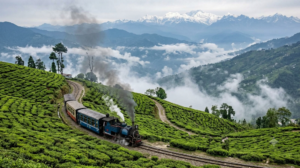
The Nilgiri Mountain Railway in Tamil Nadu was completed in 1908 and uses a rack and pinion system, where a toothed rail engages with a cogwheel on the locomotive, to climb gradients that no conventional train could manage. It is one of only three rack railways in Asia and the only one in India. The journey from Mettupalayam to Ooty takes five hours to cover 46 kilometres. Nobody boards it in a hurry. That is entirely the point.
With over 68,000 kilometres of tracks, 7,300 stations and 1.2 million employees, Indian Railways stands as one of the world’s largest railway systems. Twenty-three million people travel on it every single day. To put that in context: that is approximately the entire population of Australia, moving across India by train, every twenty-four hours. The system carries everything: passengers in all classes from air-conditioned sleepers to unreserved carriages where the concept of personal space is negotiated creatively, freight of every description, pilgrims travelling to temples and shrines across the country, migrant workers moving between cities and home states, families making journeys that would have taken weeks before the railways arrived.
The railways became a microcosm of India’s diverse culture, connecting people from different regions, languages and traditions. The trains became a melting pot of cultures where passengers share stories, languages and cuisines. Anyone who has taken a long-distance Indian train journey knows the specific intimacy of the sleeper class compartment after midnight: the sharing of food that begins within hours of departure, the conversations that cross language barriers through gesture and goodwill, the collective negotiation of space and sleep that turns strangers into temporary neighbours with a speed that surprises everyone involved.
Key developments in modern Indian Railways include the introduction of the first electric train between Bombay and Kurla in 1925, the launch of India’s fastest train the Vande Bharat Express in 2019, expansion of metro networks in Delhi, Mumbai, Chennai, Kolkata, Bengaluru, Hyderabad and other cities, and digital transformation including online ticketing, mobile apps and AI-driven operations. The Vande Bharat Express, capable of 180 kilometres per hour, represents everything the Indian railway system was not when it began: designed in India, built in India, run for Indian passengers and optimised for Indian conditions.
From the first chug of steam in 1853 to the sleek Vande Bharat Express racing across the landscape today, every milestone reflects the nation’s journey through colonialism, independence and into a self-reliant future. The story of Indian Railways is, in this sense, the story of India itself. A system imposed from outside, absorbed completely, transformed from within, and made into something so thoroughly Indian that it is now impossible to imagine the country without it.
The British built the tracks to drain India. India used them to hold itself together!