
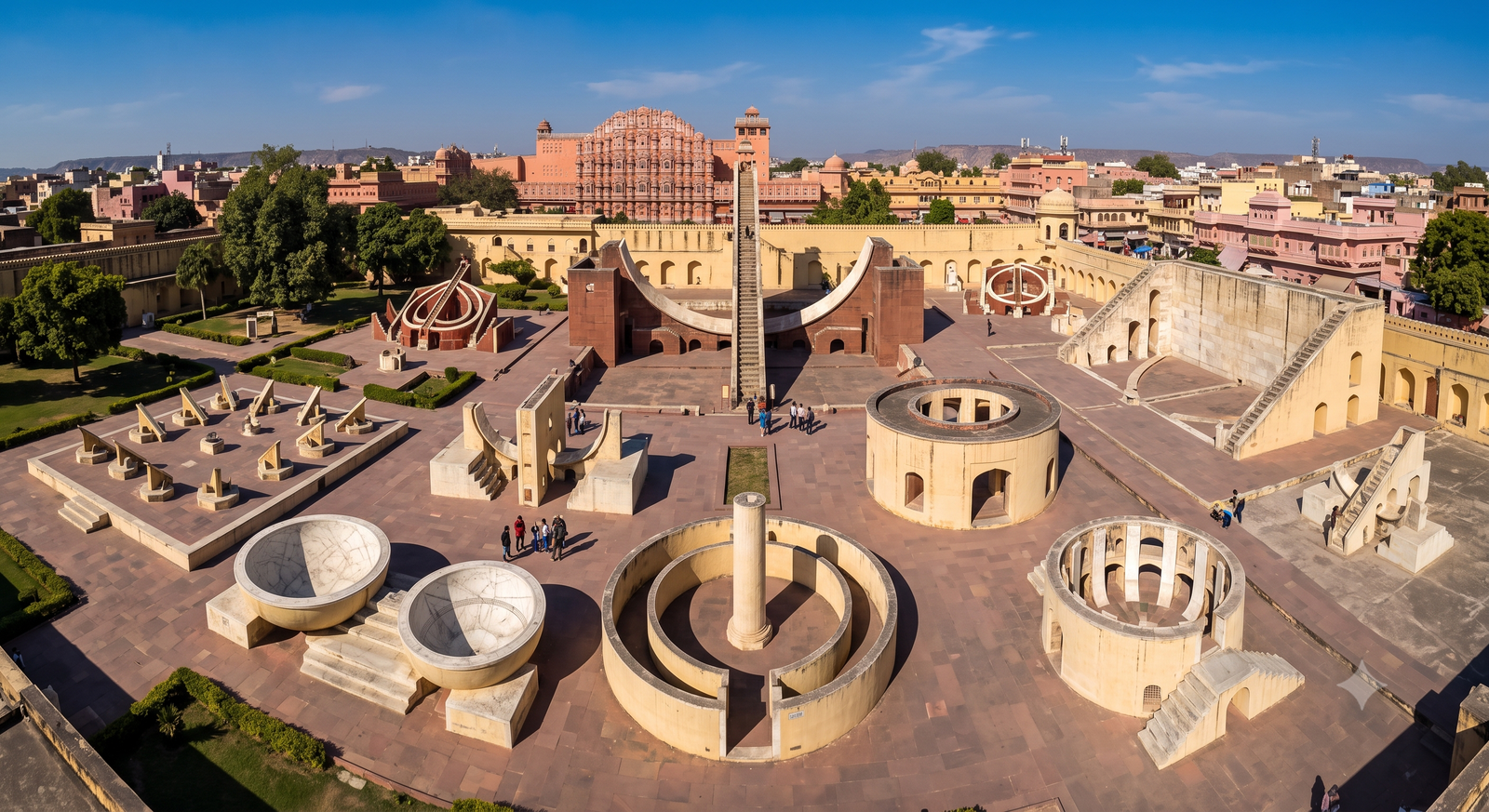
In the 18th century, an Indian king built five stone observatories that tracked the movement of planets more accurately than most European instruments of the same era. The world is still catching up to what he built.
- Sawai Jai Singh II built five astronomical observatories across India between 1724 and 1737
- The Jaipur Jantar Mantar is a UNESCO World Heritage Site with 14 major astronomical instruments
- The Samrat Yantra at Jaipur is the world’s largest stone sundial, accurate to two seconds
- Jantar Mantar means instrument of calculation, derived from the Sanskrit yantra and mantra
Jantar Mantar in India is not a single place. It is five places, built by one man, across five cities, in the span of thirteen years, each one a working observatory capable of tracking the movement of planets, predicting eclipses, calculating the position of stars and telling the time with an accuracy that rivalled and in some cases surpassed the finest astronomical instruments Europe had produced in the same century. The man who built them was Maharaja Sawai Jai Singh II of Jaipur, a Rajput king who was also, by any reasonable measure, one of the greatest scientific minds of the 18th century. Most people who visit his observatories today stand inside them and take photographs without knowing they are standing inside one of the most extraordinary acts of scientific ambition in Indian history. Here is the full story.
The King Who Started an Argument in a Mughal Court
The construction of the Delhi observatory can be traced back to a heated disagreement in the Mughal court in 1719, where the Hindu and Muslim astrologers failed to reconcile over an auspicious date for Emperor Muhammad Shah to embark on an expedition. At the centre of this episode was Sawai Jai Singh II, who was himself deeply invested in astronomy and mathematics. He reasoned that the small size of the existing instruments produced inaccurate readings, and thus the idea of building an observatory dawned on him, following which he requested Emperor Muhammad Shah to allow him to undertake the responsibility of correcting the astronomical tables used by the court.
That is not a small request. Jai Singh was essentially telling the Mughal court that their astronomical instruments were inadequate and that he, a Rajput king with a passion for celestial mathematics, could do better. The emperor agreed. What followed was one of the most remarkable building programmes in Indian scientific history.
Between 1724 and 1730, Maharaja Sawai Jai Singh II constructed five astronomical observatories in northern India. The observatories incorporate multiple buildings of unique form, each with a specialised function for astronomical measurement. These structures with their striking combinations of geometric forms at large scale have captivated the attention of architects, artists and art historians worldwide, yet remain largely unknown to the general public.
What Jantar Mantar Actually Means
The word Jantar Mantar is derived from a combination of two Sanskrit words, yantra and mantra, the former meaning instruments and the latter referring to formula or calculation. Instrument of calculation. It is a straightforward name for something extraordinary. The observatories are not buildings in the conventional sense. They are instruments. Every arch, every ramp, every inclined surface is a precisely calibrated tool for measuring something in the sky above it. You do not go inside a Jantar Mantar the way you go inside a palace or a temple. You operate it. Or rather, you stand inside it and understand, slowly, that the entire structure around you was built to do something specific and does it with extraordinary precision.
The Five Observatories and Why Each Location Was Chosen
Jaipur was founded by Jai Singh in 1726 to become the new capital of his kingdom. Ujjain was the former capital of the Malwa province and is located on the prime meridian established by the ancient Hindu canons of astronomy. Varanasi was an ancient centre of learning and reputedly the oldest continuously inhabited city in the world. Mathura was the legendary city of Krishna. The first to be built was the observatory at Delhi in 1724 and the last to be completed was the observatory at Jaipur around 1738.
Each location was chosen with deliberate astronomical and political intent. Delhi gave Jai Singh proximity to the Mughal court and its endorsement. Jaipur, his own capital, became the site of his most ambitious and complete observatory. Ujjain sits on the meridian that ancient Indian astronomy had always used as its prime reference point. Varanasi and Mathura connected the scientific project to the deepest centres of Hindu learning and sacred geography. This was not a random scattering of instruments. It was a systematic attempt to create a network of observatories that could cross-reference each other’s measurements and produce a more accurate picture of the sky than any single instrument could provide.
The Instruments That Still Work
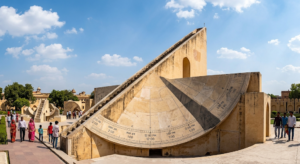
There are 14 major instruments in the Jaipur observatory, which are helpful in measuring time, predicting eclipses, knowing the speed and position of a star, and understanding the movements of planets in the solar system. The most famous of these is the Samrat Yantra, a giant right-triangle sundial whose hypotenuse points directly at the North Pole. The Jantar Mantar in Jaipur boasts having the largest stone sundial in the world. It is 27 metres tall. Its shadow moves at a visible speed, approximately six centimetres per minute, and the instrument is calibrated to an accuracy of two seconds. A stone structure built in the 18th century, telling the time to within two seconds, using nothing but geometry and the movement of the sun.
The Jantar Mantar seamlessly blends science and art, transcending the boundaries of conventional design. Each instrument showcases a unique fusion of intricate carvings, delicate decorations and captivating geometry. The Ram Yantra, for instance, consists of two complementary cylindrical structures that together measure the altitude and azimuth of celestial objects. The Misra Yantra, the mixed instrument, can determine the shortest and longest days of the year and the exact moment of noon at five different cities simultaneously. These were not decorative constructions. They worked. They still work.
The Maharaja Who Read Everything
Before building his observatories, Jai Singh spent years studying existing astronomical traditions. He sent emissaries to European courts to collect the latest astronomical tables. He studied Ptolemy, Ulugh Beg and the Islamic astronomical tradition alongside classical Hindu texts. He corresponded with Portuguese Jesuit scholars. He was, by any reasonable assessment, one of the most intellectually curious rulers of his era, operating across civilisational boundaries in the pursuit of a more accurate picture of the sky.
Jai Singh was fascinated by astronomy and sought greater accuracy in celestial observations. Rather than relying solely on smaller instruments, he commissioned massive masonry structures designed to measure the position of celestial bodies, calculate time and improve astronomical tables. The decision to build in stone and masonry rather than metal or wood was deliberate. Larger instruments produce more accurate readings. Metal instruments flex and warp with temperature changes. Stone does not. Jai Singh built at a scale that made precision possible, and the Jaipur observatory has been proving his instinct correct for nearly three hundred years.
The Jantar Mantar in Jaipur is such an amazing feat of human ingenuity that it was recognised as a UNESCO World Heritage Site in 2010. Of the original five observatories, Delhi and Jaipur survive substantially intact. Ujjain and Varanasi exist in partial form. Mathura did not survive. What remains is extraordinary enough.
The next time someone asks what India contributed to science, the answer includes a king who built stone computers pointed at the sky in the 18th century and calibrated them to within two seconds of accuracy. He did it in five cities simultaneously. He did it before the telescope was widely used in India. And he did it because he thought the existing instruments were simply not good enough.
He was right. He built better ones!