In India, a mountain is never simply a mountain. It is a deity, a cosmic axis, a living temple and sometimes all three at once. Here are the peaks that prove it.
- Mount Kailash is considered the cosmic centre of the universe across four major world religions
- Arunachala in Tamil Nadu is believed to be Shiva himself manifested as a hill of fire and light
- The Nanda Devi Raj Jat Yatra pilgrimage covers 280 kilometres through the Himalayas every 12 years
- Om Parvat in Uttarakhand bears a naturally occurring snow formation in the exact shape of Om
Sacred mountains in India are not metaphors. They are not landscape features that inspired religious thought in the people who lived near them. They are the deities themselves, physically present, permanently manifest, available to anyone willing to make the journey. The distinction matters because it changes everything about how you approach the mountain, how you move around it, how you speak about it and what you are actually doing when you arrive. In most of the world, people build temples to house their gods. In India, the mountain is already the temple. You do not need to construct anything. You simply need to understand what you are standing next to.
The tradition of sacred geography in India is ancient enough to predate written records and comprehensive enough to include peaks across every region of the subcontinent, from the Himalayas of the north to the hills of Tamil Nadu in the deep south. What connects all of them is not simply religious designation. It is the lived experience of communities who have gathered around these peaks for centuries, building their ritual calendars, their agricultural cycles, their marriage customs and their understanding of the cosmos around the mountains that rise above them.
Mount Kailash: The Centre of Everything
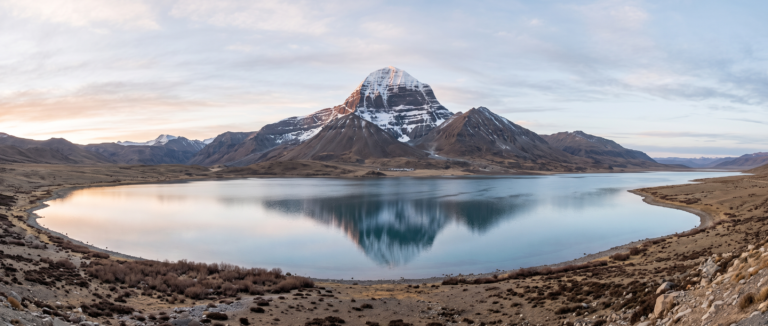
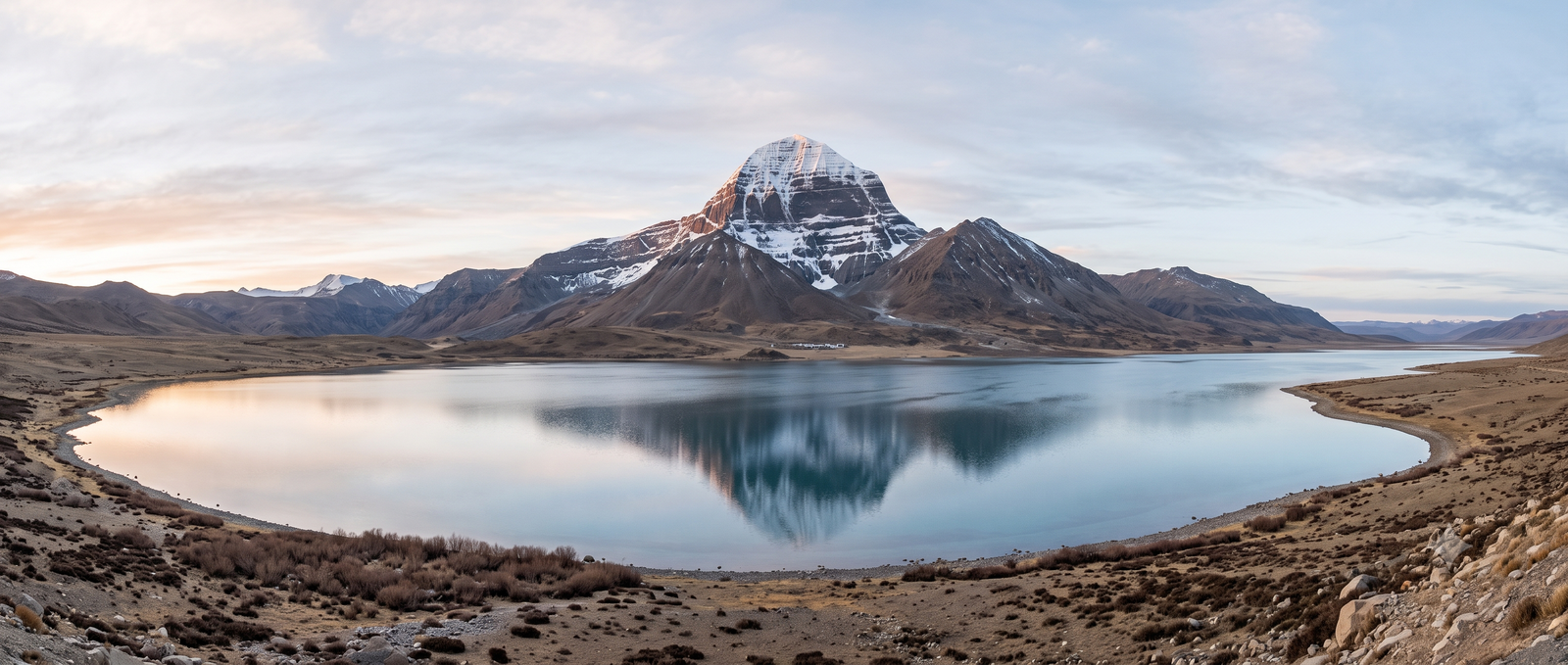
No mountain in India’s sacred geography carries more weight than Kailash, which sits in the Tibetan Autonomous Region of China but belongs entirely to the Indian spiritual imagination. Kailash is considered the abode of Lord Shiva in Hinduism, the centre of the universe in Tibetan Buddhism, the location of the cosmic mountain Meru in Hindu cosmology, and a sacred peak in both Jainism and Bon, the pre-Buddhist religion of Tibet. Four major world religions converge on a single peak at 6,638 metres. That is a level of spiritual density that has no parallel anywhere on earth.
No one has ever climbed Kailash. Not because it is technically impossible, but because no government has permitted it and no serious climber has attempted it. The mountain is circumambulated rather than summited. The parikrama of Kailash covers 52 kilometres at altitudes that regularly exceed 5,000 metres, passing through some of the most remote terrain on the Tibetan plateau. Tibetan Buddhists believe a single circumambulation of Kailash erases the sins of a lifetime. One hundred and eight circumambulations confer liberation. The most devoted pilgrims complete the route by prostrating their full body length along the ground the entire way, a practice that can take weeks. Kailash receives pilgrims from India, Tibet, Nepal and across Asia, each tradition making the same journey to the same peak for different but overlapping reasons.
Arunachala: The Mountain That Is Shiva
In the southern Tamil Nadu town of Tiruvannamalai, at the foot of a hill that rises only 800 metres above the plains around it, one of the most extraordinary sacred relationships in Indian religious history has been maintained for millennia. Arunachala, the red mountain, is not considered a place where Shiva is worshipped. It is considered Shiva himself, manifested as a column of fire and light that later solidified into this specific hill. The Skanda Purana describes Arunachala as more sacred than Kailash itself, because while Kailash is where Shiva lives, Arunachala is what Shiva is.
The Karthigai Deepam festival held at Arunachala each November sees a flame lit at the summit of the hill that is visible for miles in every direction, re-enacting the moment of Shiva’s original self-manifestation as light. Every month, on the full moon, thousands of devotees circumambulate the hill in the Girivalam tradition, walking the 14-kilometre path around its base barefoot, beginning before midnight and completing before sunrise. The great 20th-century sage Ramana Maharshi arrived at Arunachala as a teenager, never left, and spent the remaining 54 years of his life on its slopes, describing the mountain as his Guru. The cave on the hill’s south-eastern slope where he spent his early years is still maintained as a pilgrimage site and attracts visitors from across the world who come not to climb but to sit.
Nanda Devi: The Goddess Who Guards Herself
India’s highest wholly domestic peak, Nanda Devi rises to 7,816 metres in the Garhwal Himalayas of Uttarakhand and is protected by one of the most extraordinary natural formations in the world. A ring of twelve peaks, each exceeding 6,400 metres, forms an almost complete barrier around the central summit, creating what mountaineers and pilgrims alike call the Nanda Devi Sanctuary. It is as if the goddess built her own walls. No visitor enters the sanctuary without the mountain’s permission, which is to say without finding one of the few gaps in the outer ring and passing through them.
Nanda Devi means bliss-giving goddess and the mountain is regarded as an incarnation of Parvati in the Garhwal and Kumaon regions of Uttarakhand. The annual Nanda Devi Mela draws thousands of devotees, while the Nanda Devi Raj Jat Yatra, held only once every twelve years, is one of the most demanding and revered pilgrimages in India, covering 280 kilometres through the central Himalayas at altitudes that test even the most physically prepared. The pilgrimage is symbolic of seeing off Goddess Nanda to her consort Lord Shiva’s abode in the higher Himalayas after her stay at her parents’ home in the lower Himalayas. The journey enacts a cosmic family visit, a daughter returning to her husband’s home, across 280 kilometres of mountain terrain.
Om Parvat: The Mountain That Writes Its Own Name
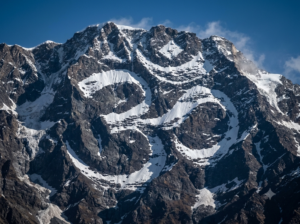
In the Pithoragarh district of Uttarakhand, close to the border with Tibet and Nepal, a peak called Om Parvat carries on its face a naturally occurring formation of permanent snow and rock that forms the exact shape of the sacred syllable Om. The formation is not a carving or a painting. It is geology, light and snow combining on the face of a mountain at approximately 6,191 metres to produce the most sacred symbol in Hindu tradition, legible from the pilgrimage routes below. Most people who see photographs of it assume it has been digitally altered. It has not. The mountain writes its own name in the language of devotion, and has been doing so for as long as anyone has been coming to look.
The Five Kailashas of the Himalayas
For pilgrims who cannot make the journey to Tibet, the Indian Himalayas offer what tradition calls the Panch Kailash, five peaks each bearing the name Kailash and each considered a sacred manifestation of Shiva’s presence. Adi Kailash in Uttarakhand, Kinnaur Kailash in Himachal Pradesh, Shrikhand Mahadev Kailash, Manimahesh Kailash and Sri Kailash form a circuit of alternative sacred peaks that carry the energy and associations of the original without requiring entry into Tibet. The Manimahesh Kailash Yatra, held each August and September, draws hundreds of thousands of pilgrims to the banks of Manimahesh Lake, at the foot of the unclimbed peak.
For the Indian diaspora across Dubai and the UAE, these peaks carry the specific emotional weight of distance. They are not places most people in the Gulf see often. They are peaks remembered from photographs, from stories told by grandparents, from the specific quality of devotion that attaches itself to something you know exists at the far end of a journey you have not yet made. But the mountains do not move. Kailash will be exactly where it is. Arunachala will be exactly what it is. They are in no hurry. Neither should we be!