The UAE uses a major Paris summit to deepen partnerships and expand its space ambitions.
- UAE Space Agency takes its growing ambitions to Paris.
- International partnerships remain central to the UAE’s space strategy.
- The National Space Strategy 2031 targets a stronger space economy.
- A US$1 billion satellite project adds fresh commercial momentum.
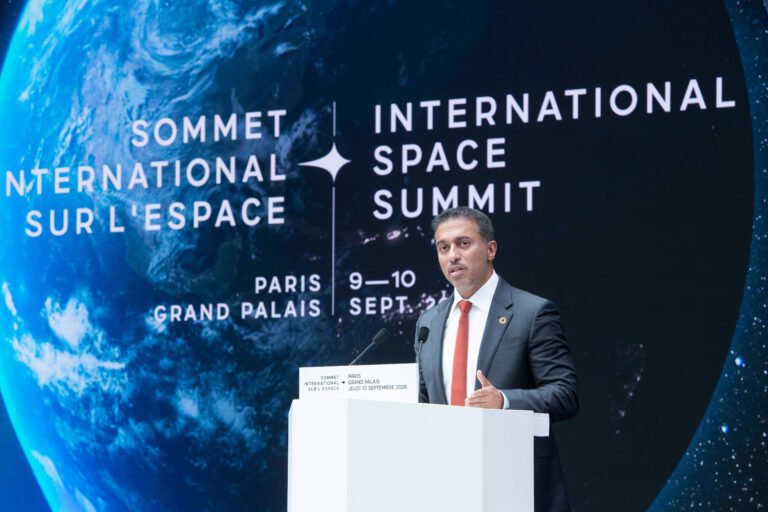
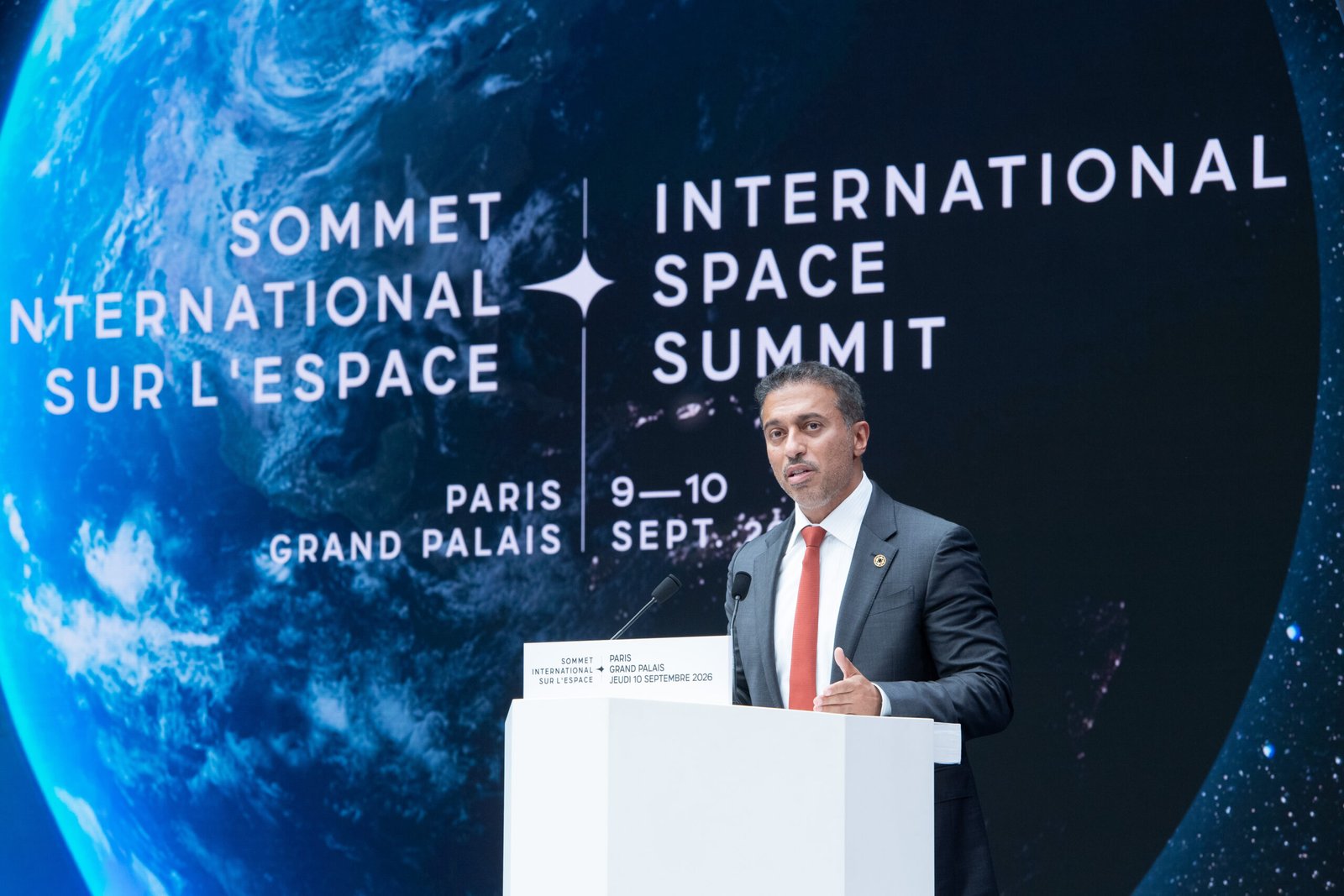
Look up at the UAE skyline on a clear night and satellites are easy to forget, even though they quietly support navigation, communications, weather monitoring and much more. Behind that invisible infrastructure sits a national ambition getting increasingly serious. The UAE Space Agency took that ambition to Paris this month, joining the first International Space Summit to discuss the next era of space.
Space conversations once belonged mostly to astronauts and rockets. Today, they increasingly involve investment, artificial intelligence, infrastructure and climate data, which explains why the UAE’s delegation arrived in Paris with a much broader agenda. At the summit on September 9 and 10, the UAE focused on responsible space activity, scientific cooperation, private-sector participation and national talent. Space is becoming an economy.
For people living in the UAE, that shift has a surprisingly practical side. Satellite technology already touches daily routines, from navigation on Sheikh Zayed Road to weather forecasting and communications, while Earth observation can support climate and environmental work. The UAE Space Agency is positioning its national programme around that wider value, with the National Space Strategy 2031 targeting a 60% increase in space economy value added and doubled revenues and investment in infrastructure.
A high-level panel in Paris brought together leaders including Finland’s President Alexander Stubb, Greece’s Prime Minister Kyriakos Mitsotakis and Armenia’s Prime Minister Nikol Pashinyan alongside UAE Space Agency Chairman Dr. Ahmad Belhoul Al Falasi. Their discussion centred on future space infrastructure and resilience. Infrastructure matters.
For the UAE, international collaboration is a major part of that picture. Meetings with France’s Minister of Higher Education, Research and Space Philippe Baptiste, CNES Chairman and CEO François Jacq, European Space Agency Director General Josef Aschbacher and Korea AeroSpace Administration Administrator Taeseog Oh opened conversations around science, exploration, commercialisation and talent.
The UAE and France already have a substantial history in space cooperation, dating back to a 2015 agreement between the UAE Space Agency and CNES. Their work now spans lunar exploration, satellite manufacturing, propulsion, optical communications, Earth observation, climate action and space life sciences. That is a long list, but the bigger story is connection.
A particularly striking development is the planned Altair-Next Gen project, where UAE-based Marlan Space and Loft Orbital are leading a consortium investing US$1 billion in France to build what has been described as the world’s largest AI satellite infrastructure. For the UAE, this is where space exploration meets commercial technology and global investment.
Back home, representatives from the Mohammed Bin Rashid Space Centre, National Space Science and Technology Center, FADA, Technology Innovation Institute and Orbitworks joined the delegation, showing how broad the UAE’s space ecosystem has become. From Dubai to Abu Dhabi and now Paris, the next chapter is increasingly about building what comes after the launch.
For anyone following the UAE’s technology story, this summit is worth keeping on the radar. Space is no longer a distant ambition. It is becoming part of the country’s economic, scientific and technological future!