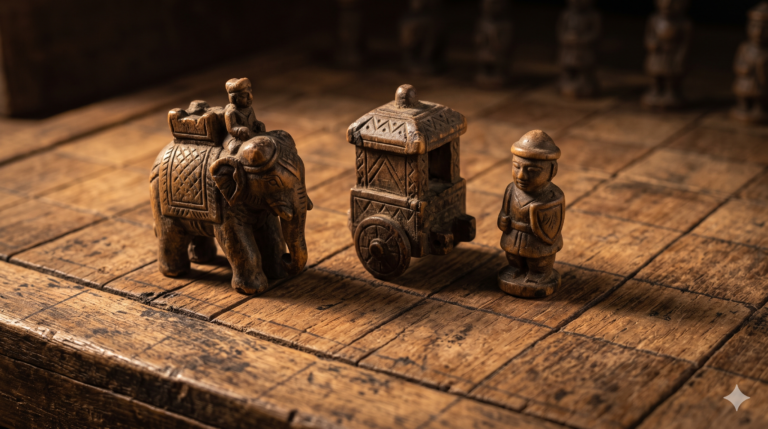
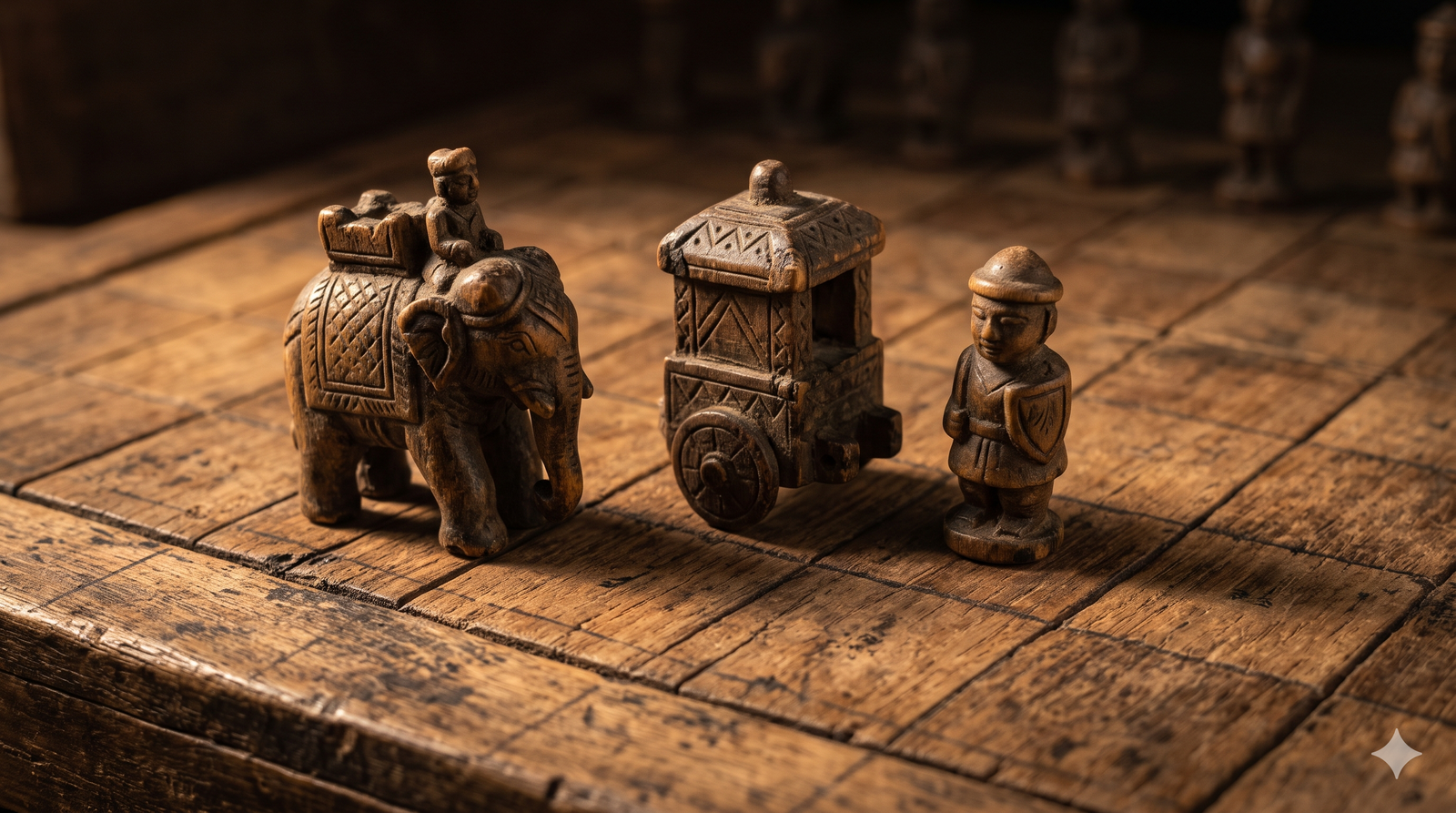
Every piece on the board was once part of an ancient Indian army. Its route to Dubai’s café tables ran through Persia and Arabia.
- Chess began as chaturanga in Gupta India around the sixth century
- Chaturanga means four divisions of the army including elephants and chariots
- Checkmate comes from Persian shah mat meaning the king is helpless
- India took double gold at the 2024 Chess Olympiad in Budapest
A chessboard has 64 squares, 32 pieces and one very old secret. The pieces were once an army, with infantry, cavalry, elephants and chariots, set out on a board in the Gupta Empire around 1,500 years ago. The chess origin India gave the world is a story of trade routes, scholars and kings, and it ends at café tables across Dubai.
Chaturanga History: A Game Built From an Army
The name gives it away. Chaturanga is Sanskrit for four divisions, the four arms of an ancient Indian army: infantry, cavalry, elephants and chariots. They became the pawns, knights, bishops and rooks every player sets out today. The king stood at the centre, and the board was the same 8 by 8 grid we still use. It was a war game first. The mind game came later.
Historians place its birth in northern India during the Gupta Empire, around the sixth century. The exact timeline is still debated, and the earliest firm evidence of the game appears in Sasanian Persia around 600 CE. But both the Persians and the Arabs credited the Indians with inventing it, and the Persian name chatrang is a clear echo of the Sanskrit.
From Chatrang to Shatranj: How the Game Reached Arabia
Persia made chess a courtly art. The game became part of the education of noble families, and the Indian rajah became the shah. Players called out the title as a warning when the king was under attack. When the king had nowhere left to go, the cry was shah mat, a helpless king. That is checkmate, still spoken 1,400 years later.
After the Arab conquest of Persia in the seventh century, the game moved into the Muslim world. Arabic has no ch sound, so chatrang became shatranj, and that is still the Arabic word for chess. Many pieces kept their Persian names, and the Indian elephant became the alfil, which still leaps two squares on the diagonal. By the 10th century, Muslim players had carried the game to North Africa, Sicily and Iberia, and from there it spread across Europe. Watch two uncles argue over a board in a Karama café and you are watching the end of a very long road.
India Chess Grandmasters: The Boom Happening Now
This story did not stay in the past. Viswanathan Anand, a five-time world champion, opened the door. In 2024, D Gukesh became the youngest world champion in history. That same year India won gold in both the Open and Women’s sections at the Chess Olympiad in Budapest, a first for the country. Arjun Erigaisi crossed the 2800 rating barrier. In 2025, 19-year-old Divya Deshmukh won the Women’s World Cup, beat Koneru Humpy in the final and became India’s 88th grandmaster. India also hosted the FIDE World Cup for the first time that year.
A game invented to simulate an army now trains some of the sharpest young minds on earth. The country that gave chess to the world is winning it back.
Next time you say checkmate, you are speaking Persian over an Indian army. The pieces have travelled through Sanskrit, Persian and Arabic, but they still follow the logic of that first Gupta board. Where did you learn chess, and who taught you?