

Seventy percent of UAE residents feel financial stress regularly and most are not talking about it with anyone.
- Seventy percent of UAE residents report experiencing financial stress on a regular basis.
- Financial anxiety activates the same stress response in the brain as a physical threat.
- Dubai’s lifestyle inflation is the single biggest barrier to financial wellness for expat residents.
- An emergency fund of three months expenses is the most impactful financial wellness foundation.
August is National Wellness Month, and every year the conversation fills up with breathwork, sleep hygiene, gut health, and movement habits. All of it matters. But there is one dimension of wellness that affects every other area of health and that UAE lifestyle media consistently avoids discussing with any real honesty: money. Financial wellness has emerged as one of the most significant and underserved pillars of holistic health in 2026, with research consistently showing that financial stress activates the same neurological threat response as physical danger, elevating cortisol, disrupting sleep, impairing decision-making, and contributing directly to anxiety and depression in ways that no amount of breathwork or gut health protocol can fully offset if the underlying financial anxiety remains unaddressed. Seventy percent of UAE residents report experiencing financial stress regularly, making it the most widespread wellness challenge in this country and the least discussed one. This Monday morning, that changes.
The UAE presents a uniquely complicated financial wellness landscape. On one hand, there is no income tax, salaries are often higher than equivalent roles in home countries, and the aspirational energy of the city creates genuine opportunities for financial growth that most other places cannot match. On the other hand, the cost of living is extraordinary, the social pressure to maintain a lifestyle that reflects success is constant and pervasive, and the structural absence of a social safety net means that financial disruption, whether through job loss, medical expense, or family emergency, lands with a weight that residents of countries with stronger welfare systems simply do not face in the same way. Financial wellness in 2026 is increasingly recognised as a core component of overall wellbeing, encompassing not just income and savings but the psychological relationship a person has with money, including their beliefs, behaviours, and emotional responses to financial decisions. In Dubai, that psychological relationship is shaped by a specific set of pressures that most financial wellness content, written for Western audiences with different structural realities, never adequately addresses.
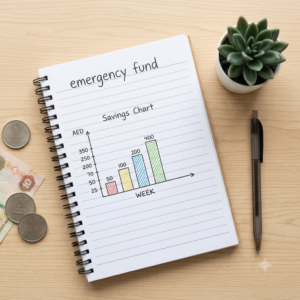
Lifestyle inflation is the most common and most quietly damaging financial wellness challenge for UAE expats. It describes the pattern where every increase in income is immediately absorbed by an equivalent increase in spending, leaving the financial cushion perpetually thin regardless of how much the salary grows. The first apartment upgrade after a pay rise. The nicer car that seemed reasonable at the new salary level. The dining and social spending that feels normal because everyone around you is doing the same thing. People are shifting toward routines designed for longevity rather than short-term optimisation, and financial wellness follows the same principle: the habits that build genuine long-term security are rarely the exciting ones, but they are the ones that compound most powerfully over time. The practical antidote to lifestyle inflation is specific and unglamorous: automate savings before lifestyle spending reaches the account. Set up a standing order that moves a fixed percentage of every salary payment, ideally between ten and twenty percent, into a separate account before the rest is available to spend. The savings happen first. The lifestyle adjusts around what remains.
The emergency fund is the single most impactful financial wellness foundation available to any UAE resident and the one that most consistently gets deferred in favour of more visible financial goals. Three to six months of essential living expenses, held in a liquid account separate from day-to-day banking, transforms the psychological experience of financial risk entirely. Community and financial accountability partnerships are emerging as powerful tools for sustained financial behaviour change, with people who share financial goals with trusted others showing significantly better outcomes than those who manage money in isolation, which reflects something important about why financial stress is so persistent in the UAE: it is almost entirely private. People talk about their gym routine, their diet, their sleep scores. Almost nobody talks honestly about their savings rate, their debt, or their financial anxiety. That silence makes the stress heavier and the habits harder to build.
The mindset dimension of financial wellness is equally important and frequently skipped in practical money conversations. The psychological relationship with money, including beliefs formed in childhood about scarcity and abundance, emotional spending patterns triggered by stress or celebration, and the specific anxiety that comes from comparing financial position to peers in a visibly affluent city, shapes financial behaviour more powerfully than any budgeting app or savings calculator. Understanding your own money story, the beliefs you carry about what money means, what it says about you, and what you deserve, is not a therapy exercise. It is the foundation of every financial decision you make and the starting point for any genuine financial wellness practice.
This August, alongside whatever physical and mental wellness habits you are building or maintaining, add one financial wellness action to your Monday. Set up the automated savings transfer. Calculate your emergency fund target and open the dedicated account. Have the honest conversation about money with a trusted person in your life. Financial wellness is not about being rich. It is about having enough clarity, enough cushion, and enough peace of mind that money stops being the thing that wakes you up at 3 AM. That peace is available. It just requires the same consistent, deliberate effort that every other dimension of wellness demands!