France has Grasse. India has Kannauj. One of them has been making perfume for five thousand years longer. Here is the story nobody told you.
- Indian attar making traces back over 5,000 years to the Indus Valley Civilisation
- Kannauj’s deg-bhapka distillation method predates the famous perfumeries of Grasse France
- Emperor Jahangir wrote that one drop of Noor Jahan’s rose attar could scent an entire room
- Mitti attar, the scent of rain on dry earth, is one of the rarest fragrances in the world
Indian attar history begins not in a perfumery but in an archaeological dig. The oldest known still for aromatic plants was found in what is now Pakistan and dates back at least 5,000 years. The art of attar-making in India stretches back over 5,000 years to the Indus Valley Civilisation, and archaeological discoveries including terracotta distillation equipment and perfume containers hint at the early sophistication of this craft. One such artifact from 5000 BCE is now displayed in the Taxila Museum. The people of the Indus Valley were capturing the essence of flowers in oil several millennia before France built its first perfume house. Kannauj, the city that would become synonymous with Indian fragrance, was already trading in aromatic materials along ancient Silk Road routes as far back as 600 BCE. The French perfumers of Grasse arrived considerably later.
For the UAE, this story is not abstract or distant. The word attar itself comes from the Persian and Arabic ittr, meaning perfume. Attar from Kannauj was once shipped far and wide, especially to the Middle East. The fragrance culture of the Arab world and the fragrance culture of India have been in conversation for over a thousand years, crossing the same trade routes that carried spices and silk in both directions. Every oud, every musk, every rose perfume sold in a Dubai souk carries the genetic memory of a tradition that Kannauj helped to shape.
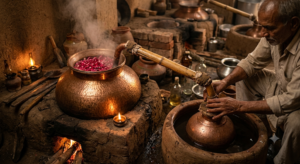
Nestled on the banks of the River Ganga, Kannauj has been the cradle of fragrance for over a thousand years. Its narrow lanes, dotted with traditional distilleries called deg-bhapka, still whisper stories of an era when kings, queens and nobles adorned themselves with the rarest of natural attars. The deg-bhapka method is at the heart of everything. Deg means copper pot. Bhapka means receiver. Between them, connected by a bamboo pipe, flowers are gently heated with water until their essence rises as steam, travels through the bamboo and condenses into sandalwood oil waiting in the bhapka below. This ancient method is sustainable, alcohol-free and purely artisanal. Each batch takes days or even weeks to complete, with craftsmen relying on experience rather than modern instruments to gauge temperature and timing. The result is a natural, long-lasting perfume that evolves with the wearer’s body chemistry, something synthetic fragrances can never replicate.
The deg-bhapka method predates the famed perfumeries of Grasse, France. This is not a boast. It is simply a chronological fact that the global fragrance industry has spent a very long time declining to acknowledge. Kannauj was perfecting hydro-distillation while Grasse was still a tanning town.
Noor Jahan, Jahangir and the Rose Attar That Scented History
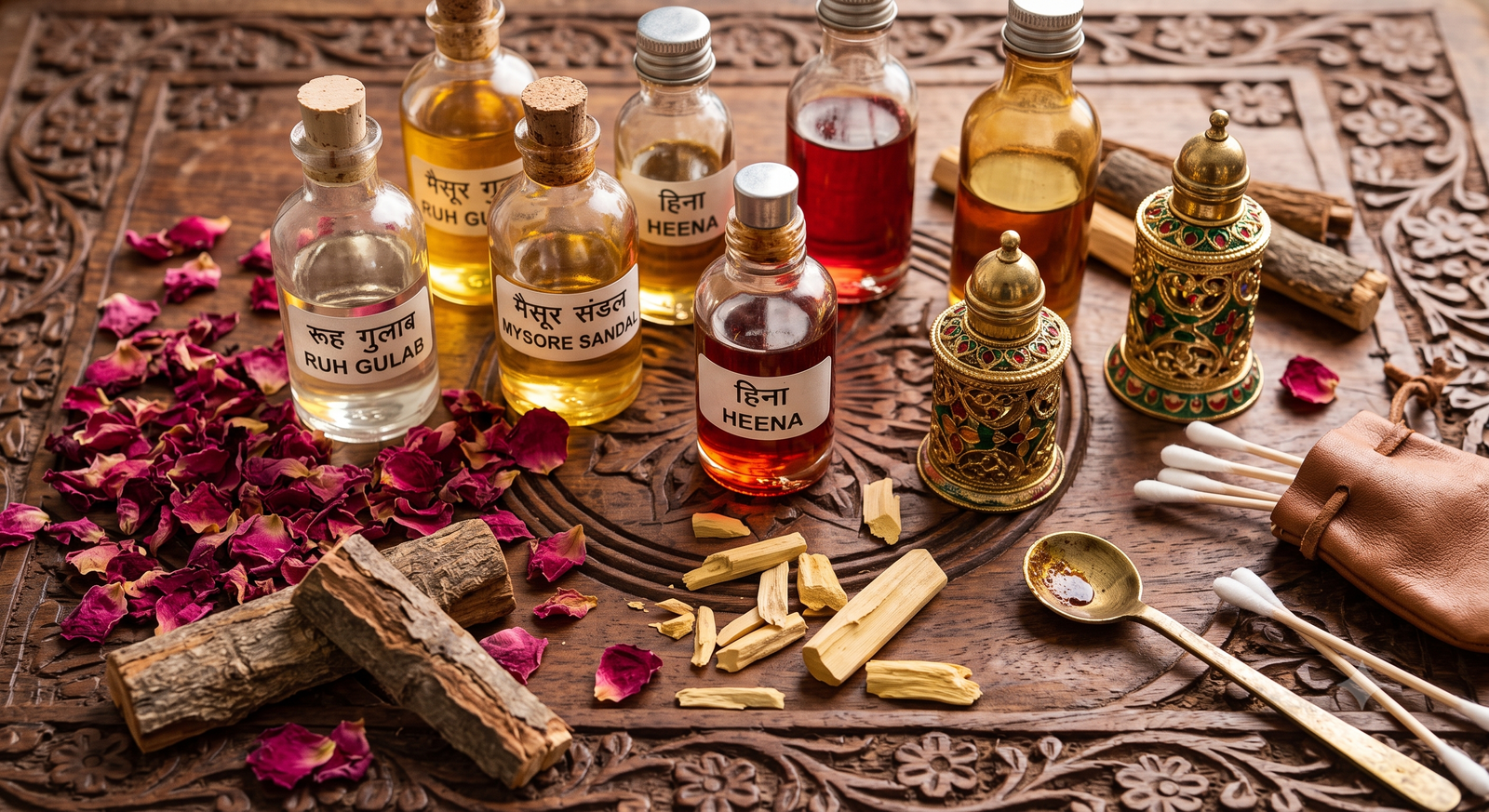
Kannauj’s ittar industry reached its zenith during the medieval period, particularly under the patronage of the Mughal emperors. The Mughals brought Persian sophistication to Indian fragrance culture and the combination produced some of the most celebrated perfumes the world has ever known. One of the era’s most famous innovations was Rooh Gulab, pure rose attar, which historical accounts attribute to Queen Noor Jahan or her mother Asmat Begum. Emperor Jahangir vividly praised its potency: it is of such strength in perfume that if one drop be rubbed on the palm of the hand it scents a whole assembly. It restores hearts that have gone and brings back withered souls.
An emperor writing poetry about a single drop of rose oil. That is what Kannauj was producing at its peak. The attars were not accessories. They were experiences. The rose attar of Kannauj was considered so potent, so alive, so far beyond anything that could be replicated synthetically that it attracted the attention of every royal court that could afford to acquire it. And most of them could not.
Mitti: The Most Indian Fragrance Ever Made
Of all the attars produced in Kannauj, none is more extraordinary or more specifically Indian than mitti. When the stills go cold at the end of a distillation cycle, the ethereal end result can be gilli mitti, or wet earth, the scent of rain. Mitti attar is made by distilling baked clay into aged sandalwood oil, and the result is the petrichor of the Indian subcontinent, that specific smell of the first monsoon rain hitting dry earth that every Indian who has ever lived through a summer immediately recognises. It is rare and expensive. It is also almost impossible to describe to someone who has not experienced it, because it is not a smell you encounter in any other context. It smells like relief. It smells like the end of waiting. It smells, to anyone who grew up in India, like home.
The 20th century was a difficult chapter for traditional Indian attar. The rise of synthetic fragrances, cheap mass-produced alcohol-based perfumes and rapidly changing consumer habits pushed attar to the margins. Many artisan families in Kannauj struggled to survive as demand fell. The number of active distilleries dropped significantly. Fragrance knowledge guarded across generations began to be lost.
Then something shifted. In 2014, Kannauj Perfume received a Geographical Indication tag, legally acknowledging its unique cultural and artisanal value. And globally, the movement toward natural, alcohol-free and heritage-rooted fragrance has brought a new generation back to attar with a seriousness that the industry had not seen for decades. A generation that grew up surrounded by synthetic fragrances is now actively seeking out something that smells real, that connects to something older, that means something beyond a marketing brief.
Kannauj has been waiting for them. The deg-bhapka stills have never stopped.
For the Indian diaspora in Dubai and across the UAE, attar connects two fragrance worlds that were never actually separate. The oud culture of the Gulf and the attar tradition of India share the same ancient Silk Road roots, the same preference for natural concentration over synthetic diffusion, and the same understanding that a great fragrance is not something you spray and forget. It is something that lives with you, changes with your skin, and carries a story longer than any bottle it came in!