Before Shaolin. Before karate. Before kung fu. There was a training ground in Kerala where warriors learned to fight, heal and think as a single discipline. There still is.
- Kalaripayattu is believed to be the world’s oldest surviving martial art over 3,000 years old
- A Tamil monk named Bodhidharma carried its principles to China where Shaolin kung fu was born
- The urumi, a flexible sword that coils around the body, is unique to Kalaripayattu alone
- Kalaripayattu training includes Ayurvedic healing and marma therapy alongside combat
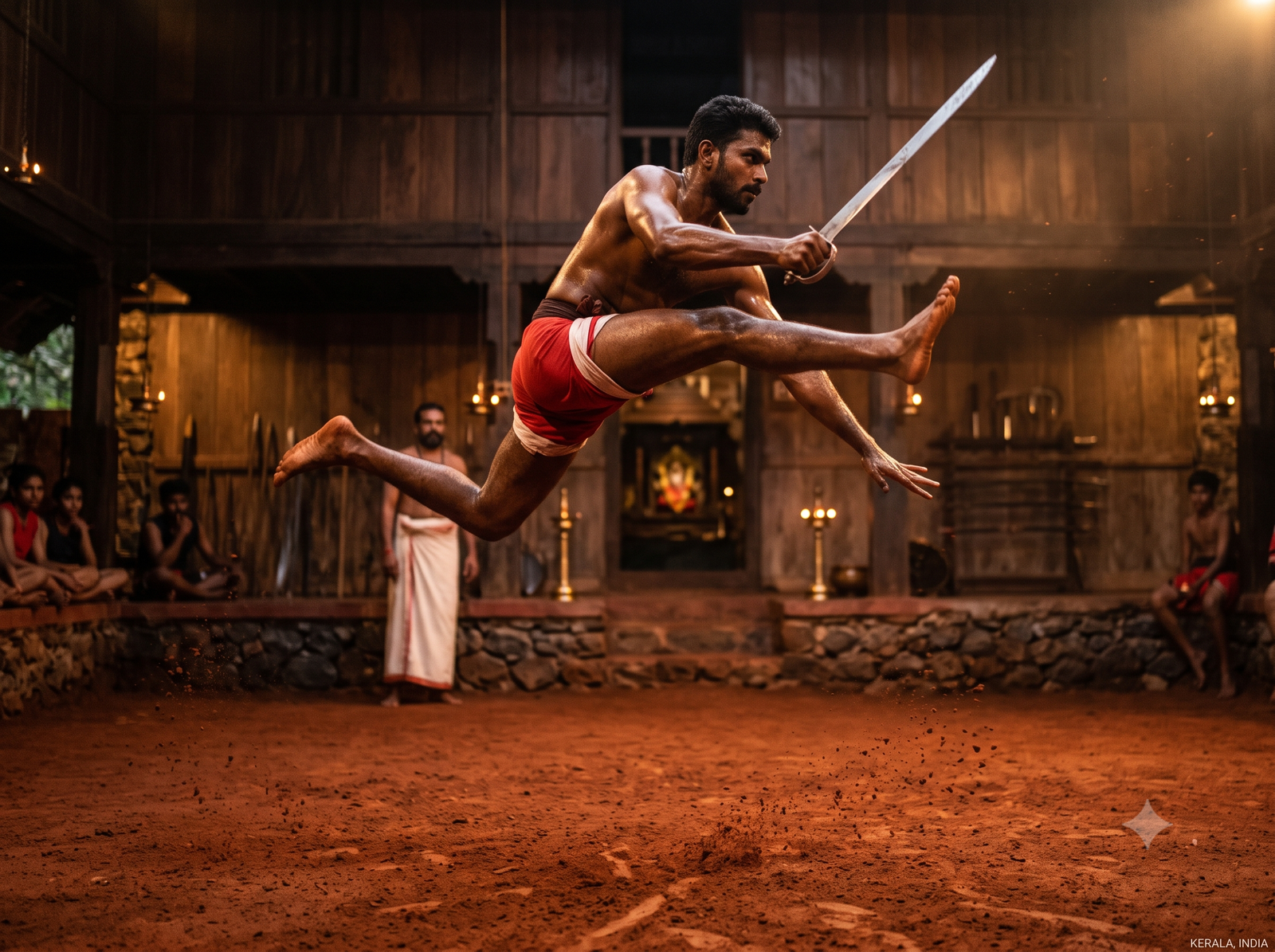
Kalaripayattu in India began before anyone was keeping records of martial arts anywhere else in the world. The ground is made of red Kerala earth, packed and levelled by generations of bare feet. The air smells of oil, the same medicated sesame oil that masters have been applying to their students’ bodies before training sessions for three thousand years. In the low-ceilinged kalari, the training hall, a student stands perfectly still while the Gurukkal, the master, corrects a posture with one hand. Then everything moves at once: a sequence of strikes, kicks, weapons forms and animal-inspired postures that unfolds with a speed and precision that makes most modern martial arts look, by comparison, relatively recently invented. Because by comparison, they are.
Kalaripayattu is widely regarded as the oldest surviving martial art in the world, originating in Kerala over 3,000 years ago. The word itself comes from two Malayalam words: Kalari, meaning training ground or battlefield, and Payattu, meaning practice or fighting training. The art is not simply combat. It is a complete system that integrates physical conditioning, self-defence, weapon mastery, philosophy and Ayurvedic medicine into a single discipline. You do not learn Kalaripayattu the way you learn a sport. You learn it the way you learn a language: immersively, over years, in the company of someone who has already spent a lifetime inside it.
The Monk Who Changed the World
In the 5th century CE, a warrior-monk from Tamil Nadu named Bodhidharma made the journey to the Shaolin Temple in Henan, China. What he brought with him, alongside Buddhist philosophy, were the physical training systems he had learned in the kalaris of South India. The monks he found at Shaolin were physically depleted from long hours of meditation, unable to sustain the rigorous spiritual practice their tradition demanded. Bodhidharma introduced exercises rooted in the Kalaripayattu tradition, and from that introduction grew the Shaolin kung fu system that would eventually give the world karate, judo and a hundred other martial traditions.
The line from a Kerala training ground to the Shaolin Temple to the global martial arts industry is not a straight one, and historians debate specific details of how much Bodhidharma transmitted and what form it took. What is not seriously disputed is the directionality: the sophisticated physical training of South India was among the earliest documented influences on East Asian martial traditions. Kalaripayattu is often called the mother of all martial arts. The title is not entirely a boast.
What Training Actually Looks Like
The curriculum of Kalaripayattu moves through four stages. The first, Maippayattu, is pure body conditioning: sequences of postures and movements designed to develop the kind of flexibility, balance and stamina that the later stages require. A student in this phase can develop the ability to touch their forehead with their foot, to perform full splits in mid-air, to move with the controlled speed of a much larger animal in a much smaller body.
The second stage, Kolthari, introduces wooden weapons: sticks and staffs that teach the student to extend their body’s reach and develop a sense of distance and timing that bare-hand combat does not require. The third stage, Angathari, moves to metal weapons: swords, daggers and spears. And the fourth, Verumkai, brings everything back to the empty hand, applying all the weapons knowledge to unarmed combat, targeting the marma points, the precise anatomical pressure points that Kalaripayattu shares with Ayurvedic medicine and that, when struck correctly, can disable or heal with equal precision.
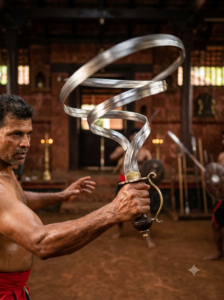
The urumi is the weapon most unique to Kalaripayattu and the one that most visibly captures the art’s particular genius. A flexible sword, sometimes two or three metres long, that coils and whips unpredictably, the urumi is considered the most difficult weapon in any martial tradition to master and one of the most dangerous. In the hands of a trained practitioner it moves with the quality of liquid metal, simultaneously attacking from multiple angles, near-impossible to block by conventional means. In the hands of someone who has not spent years learning it, it is equally dangerous to the person holding it. That combination of extreme difficulty and extreme power is characteristic of Kalaripayattu as a whole.
The Women Warriors Nobody Talks About
Women have been part of Kalaripayattu for centuries, which surprises many people who assume a three-thousand-year-old martial tradition would have excluded them. The oldest ballads from Kerala praise female warriors like Unniyarcha, celebrated for her skill with the urumi, whose stories appear in the Vadakkan Pattukal, the collection of northern Kerala ballads that constitute the earliest written record of Kalaripayattu’s principles and practitioners. Traditionally associated with masculinity, Kalaripayattu also features stories of formidable female warriors challenging their male counterparts, and in modern kalaris, women often train alongside men learning the same techniques and advancing at the same pace.
How It Lives Today
After centuries of flourishing, Kalaripayattu faced near-extinction under British colonial rule, which banned the practice of indigenous martial arts across India. The ban effectively drove the art underground, preserved in the memories of masters who continued teaching quietly in private kalaris rather than publicly in the social spaces they had always occupied. After Independence, Kalaripayattu experienced a gradual revival that has gained significant momentum in recent decades.
Today the art is practiced for combat, for fitness, for performance and for spiritual development. Kathakali, Kerala’s celebrated classical dance-drama, draws its extraordinary physical vocabulary directly from Kalari training: the eye movements, the body positions, the articulated gestures that make Kathakali one of the most technically demanding performance traditions in the world all trace back to the same kalari floor. Bollywood action star Vidyut Jammwal, a trained Kalaripayattu practitioner, has brought its signature movements into mainstream Indian cinema through films including Commando and Junglee, introducing a generation of viewers to the art through the language of action sequences.
And in Dubai, a city with one of the largest Kerala communities outside India, Kalaripayattu classes are available for anyone who wants to understand what it feels like to stand in a tradition that started three thousand years before the gym was invented.
The kalari is still open. The Gurukkal is still waiting. The red earth is still packed by bare feet!